For nearly 60 years, a small, stamp-sized seal of approval dictated what you could and couldn’t see in American comic books. This seal, bearing the words “Approved by the Comics Code Authority,” was a symbol of self-censorship, a desperate measure by an industry under siege. But how did this system of creative control come to be, and what was its lasting impact on the comics we know and love today?
The story of the Comics Code Authority is a dramatic tale of moral panic, political theater, and a battle for the very soul of a beloved art form. In the early 1950s, comic books were a cultural phenomenon, reaching more readers than magazines, radio, or television [1]. But as their popularity soared, so did the controversy surrounding them. A perfect storm of concerned parents, crusading psychiatrists, and opportunistic politicians created a moral panic that threatened to destroy the entire industry.
This is the story of how a book called Seduction of the Innocent sparked a nationwide witch hunt, leading to Senate hearings, public book burnings, and the creation of a censorship code that would shape the comic book landscape for decades to come.
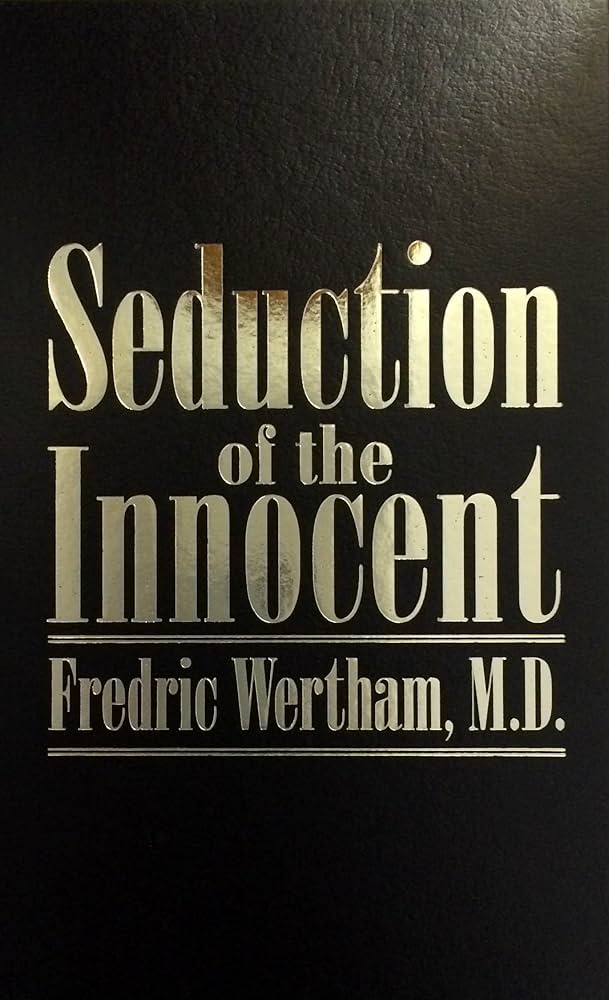 Dr. Fredric Wertham’s influential 1954 book “Seduction of the Innocent” that sparked the comic book censorship movement. Credit: Book cover image via Amazon.com
The Golden Age and the Growing Storm
The post-World War II era was a golden age for comic books. By 1954, publishers were selling an estimated 1.2 billion comics each year, with the average issue passed along to at least six readers [2]. At just ten cents a copy, these colorful pamphlets were an affordable and accessible form of entertainment for millions of children.
While superheroes had dominated the early 1940s, the late 40s and early 50s saw a boom in new genres, particularly crime and horror comics. Titles like The Vault of Horror, Weird Tales, and Crime SuspenStories offered gruesome and sensational stories that pushed the boundaries of popular entertainment.
But this creative explosion was met with a growing wave of criticism. Three distinct groups led the charge against the burgeoning comic book industry:
Educators and literacy experts worried that comics were a “bad influence” on children’s reading habits, luring them away from more “respectable” literature. They saw comics as a threat to their authority, as children could now choose their own reading material for the first time.
Church and civic groups voiced their objections to what they saw as “immoral” content. They were particularly concerned with the “scantily clad women” in jungle comics and the “glorification of villains” in crime comics. The Catholic Church’s National Office of Decent Literature even began evaluating and blacklisting comics it deemed objectionable.
Mental health professionals emerged as a new group of critics. In postwar America, a rising tide of juvenile delinquency became a national obsession, and many experts were quick to point the finger at comic books. The most prominent of these was Dr. Fredric Wertham, a respected New York City psychiatrist who would become the face of the anti-comics crusade.
Seduction of the Innocent: The Book That Ignited a Firestorm
Dr. Fredric Wertham was a German-born American psychiatrist who practiced a form of “social psychiatry,” examining the influence of social and cultural factors on behavior. Beginning in 1948, he began a relentless campaign against comic books, arguing that they were a primary cause of juvenile delinquency [3].
His crusade culminated in the 1954 publication of his book, Seduction of the Innocent, which served as a rallying cry for the anti-comics movement. In the book, Wertham argued that comics were a “harmful form of popular literature” that exposed children to “overt or covert depictions of violence, sex, drug use, and other adult fare.”
Seduction of the Innocent was filled with lurid and often exaggerated claims about the content of comic books. Wertham pointed to what he called “recurring morbid themes,” such as “injury to the eye,” and reproduced gruesome images from horror comics to shock his readers.
Wertham’s Controversial Claims About Superheroes
He also made a series of sensational and highly controversial claims about popular superheroes:
- Batman and Robin: Wertham famously claimed that the relationship between Batman and Robin was a homosexual fantasy, a claim that was later revealed to have been suggested to him by gay men he had interviewed.
- Wonder Woman: He argued that Wonder Woman’s strength and independence made her a lesbian and that her stories had a bondage subtext.
- Superman: Wertham even went so far as to call Superman “un-American” and “fascistic.”
While many of Wertham’s claims were met with derision within the comics industry, his book was a bestseller and struck a chord with a public already anxious about juvenile delinquency. Parents were alarmed, and a full-blown moral panic ensued. The book’s publication directly led to a U.S. Congressional inquiry into the comic book industry, setting the stage for a dramatic showdown that would change comics forever.
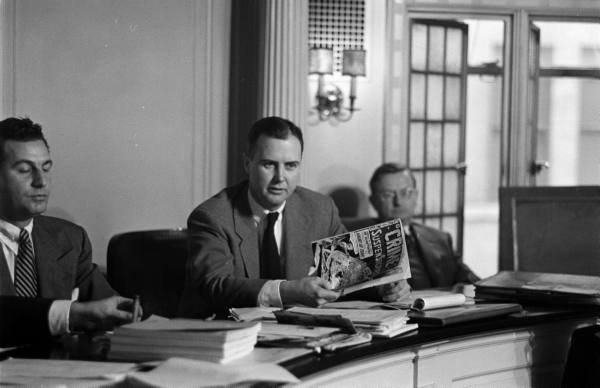 The 1954 Senate Subcommittee hearings on juvenile delinquency that examined comic books’ impact on children. Credit: Historical photo via Tim Hanley blog
The Senate vs. The Comics: A Public Showdown
The publication of Seduction of the Innocent and the ensuing public outcry caught the attention of Senator Estes Kefauver, a Tennessee Democrat with a reputation as a mob hunter. Kefauver saw the comic book controversy as a political opportunity and a way to investigate organized crime’s influence on the distribution of magazines and comics.
In April 1954, the Senate Subcommittee on Juvenile Delinquency, chaired by Robert Hendrickson, convened hearings in New York City, the heart of the comic book industry [4]. The hearings were a media spectacle, broadcast on television and making front-page news.
Dr. Wertham was a star witness, delivering his now-infamous line:
“Well, I hate to say that, Senator, but I think Hitler was a beginner compared to the comic-book industry. They get the children much younger.”
The William Gaines Testimony Disaster
But the most dramatic moment of the hearings came during the testimony of William Gaines, the publisher of EC Comics, which produced many of the most popular and controversial horror and crime titles. Gaines voluntarily testified to defend his publications, but the subcommittee was ready for a fight.
Senator Kefauver confronted Gaines with a gruesome cover from Crime SuspenStories that depicted a man holding a bloody ax and a woman’s severed head. The following exchange has become legendary in comics history:
Senator Kefauver: This seems to be a man with a bloody ax holding a woman’s head up which has been severed from her body. Do you think that is in good taste?
William Gaines: Yes, sir; I do, for the cover of a horror comic. A cover in bad taste, for example, might be defined as holding the head a little higher so that the neck could be seen dripping blood from it, and moving the body over a little further so that the neck of the body could be seen to be bloody.
This single exchange was a public relations disaster for the industry. The headline in the New York Times the next day read: “No Harm in Horror.” The damage was done. The public was outraged, and the comic book industry was left scrambling to save itself from government censorship.
 The Comics Code Authority seal that appeared on approved comic books from 1954 to 2011. Credit: Comics Code Authority seal (public domain)
The Birth of the Comics Code: An Industry on the Brink
Faced with the threat of federal censorship and a public relations nightmare, the comic book industry decided to take matters into its own hands. In October 1954, the Comics Magazine Association of America (CMAA) was formed, and with it, the Comics Code Authority (CCA). The Code was a set of self-regulatory guidelines designed to appease critics and demonstrate that the industry could police itself.
The original 1954 Comics Code was a draconian document, a list of 41 provisions that effectively gutted the crime and horror genres and placed severe restrictions on all comic book content. The Code was designed to ensure that comics were suitable for the youngest readers, and its rules were sweeping and absolute.
Key Restrictions of the Comics Code
Among the most significant restrictions:
Crime and Authority: Crimes could never be presented in a way that created sympathy for the criminal or distrust of law enforcement. Criminals could not be glamorous, and good had to triumph over evil in every instance.
Horror and Violence: The words “horror” and “terror” were banned from comic book titles. All scenes of excessive violence, brutal torture, and gore were eliminated. Vampires, werewolves, ghouls, and zombies were strictly forbidden.
Sex and Romance: Nudity, indecent exposure, and suggestive illustrations were prohibited. Illicit sex relations, seduction, and rape could not be portrayed or even hinted at. The sanctity of marriage and the home was to be upheld at all times.
The Devastating Industry Impact
The impact of the Code was immediate and devastating. Wholesalers and distributors refused to handle comics without the CCA seal, effectively shutting down any publisher who refused to comply. The industry was decimated [5]:
- Between 1954 and 1956: Comic book titles dropped from nearly 650 to around 250 annually
- More than 800 artists, writers, and other creators left the field
- Careers were ruined by the new censorship regime
EC Comics, the publisher at the center of the controversy, was a major casualty. William Gaines initially refused to join the CMAA but was forced to capitulate when distributors refused to carry his comics. After a series of disputes with the Code administrator, including a famous battle over a story featuring a Black astronaut, Gaines resigned from the CMAA in 1955.
He folded his entire comic book line, with the exception of one title: Mad. By converting Mad into a magazine, Gaines was able to evade the restrictions of the Comics Code and continue his satirical work, creating what many consider to be the first work of mass culture dedicated to satirizing mass culture itself.
The Silver Age and the Slow Thaw
The Comics Code ushered in a new era for the industry. With crime and horror comics effectively banned, superheroes once again rose to prominence. The late 1950s and 1960s saw the birth of the Silver Age of comics, with the creation of iconic characters like Spider-Man, the Fantastic Four, and the modern Flash.
But even in this new golden age, the shadow of the Code loomed large. The stories were tamer, the themes less complex, and the creative freedom of artists and writers was severely curtailed.
The First Challenge: Marvel’s Drug Story
For years, the Comics Code remained the unchallenged law of the land. But by the late 1960s and early 1970s, the cultural landscape was changing, and the Code began to seem increasingly outdated.
The first major challenge to the Code’s authority came in 1971, when Stan Lee and Marvel Comics published a Spider-Man story arc that dealt with the issue of drug abuse. The story was written at the request of the U.S. Department of Health, Education, and Welfare, but the Comics Code Authority refused to grant its seal of approval.
Marvel decided to publish the issues without the seal, a bold act of defiance that marked a turning point in the history of the Code. The controversy surrounding the Spider-Man story led to the first major revision of the Code in 1971, which relaxed some restrictions and allowed for the depiction of drug use in a negative context.
The End of an Era: The Decline and Fall of the Code
The final death of the Comics Code was a slow and gradual process. Several factors contributed to its decline:
The Rise of the Direct Market
The rise of the direct market in the 1980s, which allowed publishers to sell comics directly to specialty stores, was a major blow to the Code’s authority. For the first time, publishers had a viable way to distribute comics without the CCA seal. This led to the rise of independent publishers who were free to create more mature and experimental work.
Major Publishers Withdraw
By the 1990s, the Code was becoming increasingly irrelevant:
- 2001: Marvel Comics withdrew from the Comics Code Authority altogether, opting for its own in-house rating system
- January 2011: DC Comics announced it would no longer submit comics to the CCA
- 2011: Archie Comics, the final publisher to carry the seal, dropped it shortly thereafter
After 57 years, the Comics Code Authority was officially dead.
The Legacy of the Comics Code: A Cautionary Tale
The story of the Comics Code Authority is a cautionary tale about the dangers of censorship and the power of moral panic. For decades, the Code stifled creativity, limited the potential of the medium, and reinforced the perception of comics as juvenile entertainment.
But it also, in a strange way, may have saved the industry from complete collapse. By providing a system of self-regulation, the Code may have prevented the government from stepping in and imposing even harsher restrictions.
The Modern Comics Renaissance
The end of the Comics Code era has ushered in a new golden age of creative freedom. Today, creators are free to tell a wider range of stories for a more diverse audience than ever before. The industry is more vibrant and innovative than it has been in decades, and the medium is finally getting the respect it deserves as a legitimate art form.
The story of the Comics Code is a reminder of how far the industry has come and a testament to the enduring power of comics to challenge, provoke, and inspire. From the moral panic of the 1950s to today’s critically acclaimed graphic novels, comics have proven their resilience and their ability to evolve with the times.
Frequently Asked Questions
What was the Comics Code Authority? The Comics Code Authority was a self-regulatory body created by the comic book industry in 1954 to censor content and avoid government regulation following public outcry over crime and horror comics.
When did the Comics Code end? The Comics Code Authority effectively ended in 2011 when the last major publishers stopped submitting comics for approval, though it had been declining in relevance since the 1980s.
Who was Fredric Wertham? Dr. Fredric Wertham was a psychiatrist who wrote “Seduction of the Innocent” (1954), a book that blamed comic books for juvenile delinquency and sparked the moral panic that led to the Comics Code.
How did the Comics Code affect the industry? The Code devastated the industry, reducing annual titles from 650 to 250 between 1954-1956 and forcing over 800 creators to leave the field. It effectively banned crime and horror comics for decades.
References
[1] Hajdu, David. The Ten-Cent Plague: The Great Comic-Book Scare and How It Changed America. The New Yorker, March 31, 2008. https://www.newyorker.com/magazine/2008/03/31/the-horror
[2] Hastings, Emma Brodfuehrer. “The Senate Comic Book Hearings of 1954.” Library of Congress Law Blog, October 26, 2022. https://blogs.loc.gov/law/2022/10/the-senate-comic-book-hearings-of-1954/
[3] Comic Book Legal Defense Fund. “Comics Code History: The Seal of Approval.” https://cbldf.org/comics-code-history-the-seal-of-approval/
[4] United States Senate Subcommittee on Juvenile Delinquency. “Juvenile Delinquency (Comic Books) Hearings.” April 21, 22, and June 4, 1954.
[5] Hajdu, David. The Ten-Cent Plague: The Great Comic-Book Scare and How It Changed America. Farrar, Straus and Giroux, 2008.
For more comic book history and analysis, explore our archives of comic book retrospectives and industry analysis. Stay updated with the latest in comics by following our newsletter.