Once upon a time, the world of comics was a realm of paper and ink, a tangible universe confined to the pages of floppy single issues and collected trade paperbacks. But a seismic shift has been rumbling through the industry, a digital revolution that has torn down old barriers and ushered in a new era of storytelling. The rise of webcomics and digital platforms like Webtoon and Tapas hasn’t just changed how we read comics—it has fundamentally transformed who gets to create them, what kinds of stories get told, and what it even means to be a comic book fan in the 21st century.
From Print to Pixels: The Dawn of a New Era
The seeds of this revolution were planted in the late 1990s, a time when the internet was still a wild frontier. Aspiring creators, often with niche ideas and unconventional art styles that mainstream publishers wouldn’t touch, began scanning their zines and uploading them to personal blogs and fan forums. Early pioneers like User Friendly (1997) and Penny Arcade (1998) found a foothold among tech-savvy readers hungry for something new, proving that a viable audience existed outside the traditional comic shop ecosystem.
Before the digital age, breaking into the comics industry was a Herculean task. The financial barriers were immense, with the cost of printing even a small run of comics being prohibitively expensive for most independent creators. Distribution was another massive hurdle, requiring partnerships with gatekeepers like Diamond Comic Distributors to get books into stores. This system naturally favored established properties and genres, with publishers sticking to the safe bets of superheroes and licensed IPs. As a result, countless unique and experimental voices were left on the sidelines.
Digital publishing obliterated these barriers. Suddenly, a single webpage or social media profile could serve as a global storefront, giving creators a direct line to their audience without needing permission from a publisher or the astronomical costs of printing. This digital liberation has allowed for an explosion of creativity, with stories that would have never seen the light of day in the old system now finding massive, passionate audiences. The internet has become a true meritocracy, where quality and audience connection, not industry connections, are the keys to success.
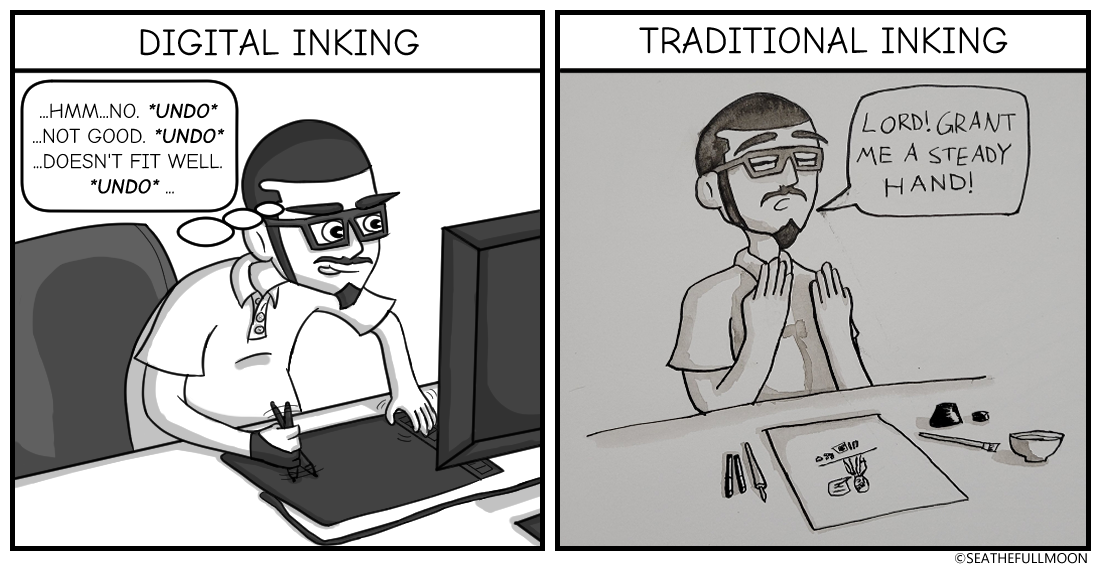
Caption: The evolution from traditional to digital inking is just one aspect of the comics industry’s transformation. Credit: a-fly-on-the-wall / Reddit Source: https://www.reddit.com/r/webcomics/comments/9j0fe9/digital_vs_traditional_inking_oc/
The Rise of the Vertical Scroll: Webtoon and Tapas Change the Game
While webcomics had been around for years, the true turning point in the digital revolution came with the popularization of the vertical scroll format, pioneered by South Korean platforms like Naver Webtoon (launched in 2004) and Daum Webtoon. Instead of traditional page layouts, creators stacked panels vertically, creating an
infinitely scrolling canvas perfectly suited for smartphone reading. This seemingly simple innovation was a game-changer, allowing readers to consume comics in short, convenient bursts, whether on their daily commute or during a lunch break.
When Naver launched its international platform, LINE Webtoon (now just Webtoon), in 2014, it brought this model to a global audience. Along with its competitor, Tapas, these platforms introduced a “freemium” model where most content is free to read, supported by ad revenue and options for readers to purchase premium chapters or tip creators directly. This model has proven to be incredibly successful. In 2019, Webtoon boasted over 60 million active monthly users and more than a billion views annually [2].
The impact has been staggering. Genres like romance, fantasy, and slice-of-life have exploded in popularity, with titles like Rachel Smythe’s Lore Olympus—a modern retelling of the Hades and Persephone myth—garnering millions of subscribers and even an animated series adaptation. These platforms have become a dominant force in the industry, with readership numbers that often dwarf the monthly sales of even the most popular mainstream print comics.

Caption: The Webtoon platform offers a vast library of comics in a mobile-friendly, vertical scroll format. Credit: Sara Gregorio / Medium Source: https://medium.com/@sara.gregorio/case-study-redesigning-webtoon-app-5b29f93f5391
A New Creator Economy: Monetization and Diversity
One of the most significant impacts of the digital comics revolution has been the democratization of the industry. Anyone with a story to tell and the passion to create can now publish their work on these platforms without needing to pay hosting fees or navigate the complex world of traditional publishing. This has led to an unprecedented wave of diversity, with marginalized creators who have long been underrepresented in mainstream comics now finding a platform to share their voices and build their own communities.
These platforms have also created new and viable career paths for creators. The revenue models are a key part of this. As noted by CBR, both Webtoon and Tapas share ad revenue with creators, and Webtoon even has a performance-based rewards system that pays creators based on monthly page views [2]. Tapas allows readers to earn a digital currency called “ink” by watching ads, which they can then use to tip their favorite creators. This allows fans to support creators directly, even if they can’t afford to spend money.
This creator-centric approach extends to intellectual property as well. As Scraps From The Loft reports, many of these platforms allow creators to retain ownership of their IP, giving them the freedom to sign with other publishers or pursue adaptations in other media [1]. This is a stark contrast to the traditional work-for-hire model of mainstream comics, where creators often have no ownership over the characters and stories they create. This has empowered a new generation of creators to build their own brands and careers on their own terms.
Check out our other article: The Evolution of Comic Book Art: From Golden Age to Modern Masterpieces
The Web-to-Print Pipeline: How Digital Success Translates to Traditional Publishing
While the digital realm is where these comics are born, the story doesn’t end there. The massive success of webcomics has not gone unnoticed by traditional publishers, who are increasingly turning to these platforms as a breeding ground for new talent and proven properties. The built-in audience of a popular webcomic provides a significant advantage, as publishers can gauge interest and even forecast sales before committing to a print run. This has led to a thriving web-to-print pipeline, with successful webcomics being collected and released as graphic novels.
This trend isn’t entirely new—pioneering works like Gene Luen Yang’s American Born Chinese and Raina Telgemeier’s Smile both began as webcomics in the 2000s. However, the sheer volume of web-to-print deals has skyrocketed in recent years. Publishers like Scholastic’s Graphix imprint and Random House Graphic are actively scouting for the next big hit on platforms like Webtoon and Tapas. The success of these print editions, like Ngozi Ukazu’s Check, Please! and Wendy Xu and Suzanne Walker’s Mooncakes, has proven that the digital audience is more than willing to show up and support their favorite creators in the physical world.
This has created a powerful synergy between the digital and print worlds. The digital platform serves as an incubator, allowing creators to build an audience and hone their craft. The print edition then offers a new revenue stream and a different kind of legitimacy, allowing the work to reach a new audience that may not be active on webcomic platforms. It’s a win-win for creators, publishers, and fans alike.
The Future is Infinite: What’s Next for Digital Comics?
The digital comics revolution is far from over. The industry is constantly evolving, with new technologies and platforms emerging all the time. The synergy with social media platforms like TikTok, Twitter, and Instagram has become a powerful marketing tool, with hashtags and viral trends driving discovery and bringing new readers into the fold. As Toons Mag points out, the future will likely see even more cross-media collaborations, with successful webcomics being adapted into TV shows, movies, and video games [3].
However, the digital landscape is not without its challenges. The sheer volume of content can lead to oversaturation, making it difficult for new creators to get noticed. Creator burnout is also a very real concern, with the pressure to produce consistent updates and engage with a demanding audience taking its toll. And the reliance on a few dominant platforms raises concerns about platform dependence, as creators are subject to the whims of algorithm changes and policy updates.
Despite these challenges, the future of comics is undeniably digital. The accessibility, diversity, and creative freedom offered by these platforms have unleashed a torrent of new stories and voices that have enriched the medium in countless ways. The old walls of the industry have been torn down, and in their place, a vibrant, dynamic, and global community has been built. The digital comics revolution is here to stay, and for fans of sequential art, the future has never looked brighter.
References
- Scraps From The Loft. (2023, November 15). The Digital Renaissance: How Webcomics Are Reshaping the Literary Landscape. scrapsfromtheloft.com/comics/digital-renaissance-how-webcomics-are-reshaping-literary-landscape/
- Puc, S. (2020, July 10). Webtoon and Tapas Changed the Game for Webcomics – Here’s How. cbr.com/how-webtoon-tapas-changed-webcomics/
- Alosson, T. (2025, February 13). The Rise Of Webcomics Explained: How Digital Platforms Changed The Game. toonsmag.com/rise-of-webcomics-explained-how-digital-platforms/