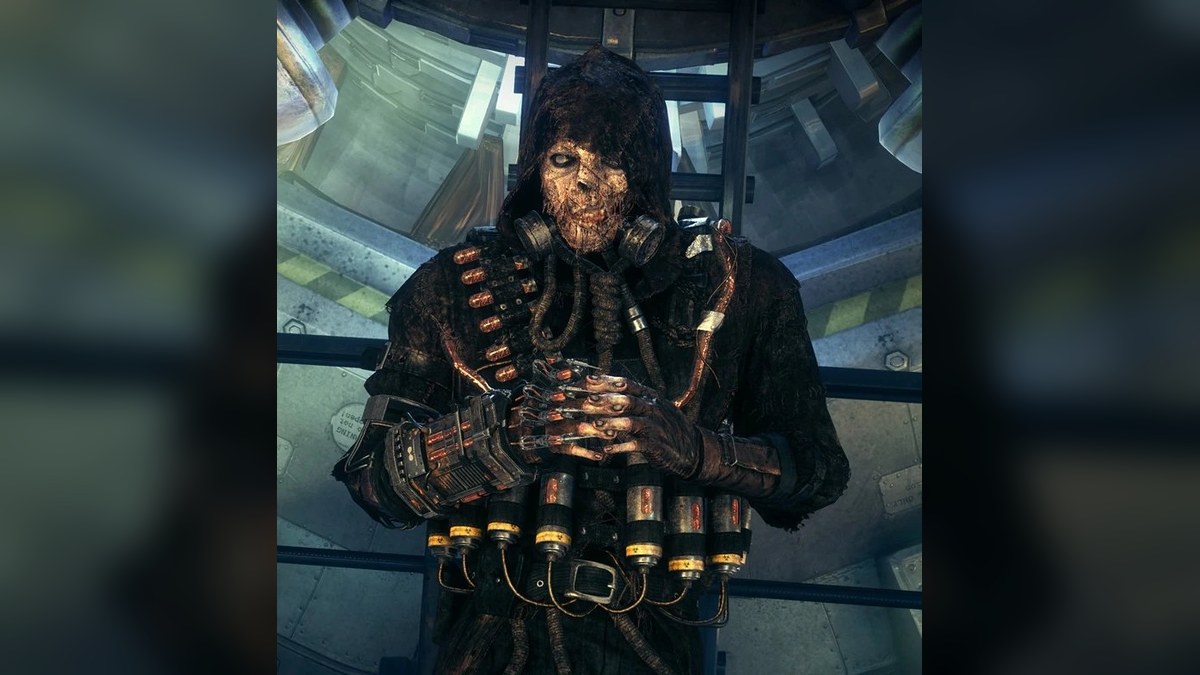
Scarecrow is the main antagonist of Batman: Arkham Knight, returning after Killer Croc mauled him in Arkham Asylum. Jonathan Crane forces Gotham’s evacuation, bankrolls the Arkham Knight’s militia, and floods three islands with a new fear toxin. He is voiced by John Noble, and he is never fought in conventional combat.
⚠️ Spoiler warning: everything below the next image discusses the full plot and ending of Batman: Arkham Knight (2015), including the Arkham Knight’s identity and the game’s final scene. If you have not played it, stop here.
Who Scarecrow is, in the comics and in the games
Jonathan Crane debuted in World’s Finest Comics #3 in 1941, written by Bill Finger and drawn by Sheldon Moldoff. It is worth naming Moldoff, because Bob Kane’s blanket byline on early Batman work still gets him the credit in a lot of write-ups. You can read DC’s own Scarecrow profile for the modern version.
The shape of the character has held for eighty years: a gaunt psychology professor, obsessed with fear, who is fired in disgrace and turns his research into a weapon. The specifics were updated over time — in 1941 he was dismissed for firing a gun in a lecture hall to prove a point about fear, where later versions have him experimenting on patients — but the core never moved.
Crucially, he has no powers and no physical presence. He is a chemist and a theorist who wins by making you hallucinate. That single characteristic explains almost every choice Rocksteady made with him, including the one most players notice but rarely name — which we will get to.
Why Scarecrow looks so different in Arkham Knight
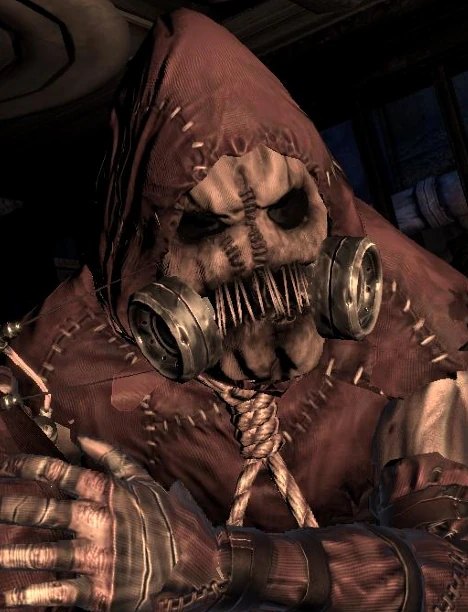
In Arkham Asylum (2009), Crane wears a stitched burlap sack, a surgical gown and a leather gas mask, hunched and theatrical. He ends that game being dragged underwater by Killer Croc in the sewers — an attack he only survived because Batman intervened.
The Crane of Arkham Knight is what crawled out. His right eye is white and presumed blind. His nose and lips are gone. What is left of his face reads as a burlap mask because, according to militia chatter in the game, he had reconstructive surgery specifically to look that way, with cord grafted where his lips used to be. His breathing apparatus is fixed to his throat rather than worn over his mouth, and he wears a leg brace. He also stands noticeably taller, because he no longer hunches.
The redesign is doing character work, not just shock. Asylum-era Crane performed fear in a high, showy voice. Post-Croc Crane is quiet, flat and personal, and John Noble plays him almost entirely without theatrics.
Scarecrow’s plan in Arkham Knight, step by step
The plot is easy to lose track of because Crane spends most of it talking to you through screens. Laid out in order, it is methodical:
| Stage | What Crane does |
|---|---|
| 1. The threat | Announces a toxin attack on Halloween night, triggering a full civilian evacuation of Gotham and leaving the city to the gangs. |
| 2. The army | Bankrolls the Arkham Knight’s militia. Crane, Harley Quinn, Two-Face and Penguin pay a combined $3 billion, with Deathstroke brought in as a back-up commander and adviser. |
| 3. The chemistry | Partners with industrialist Simon Stagg to develop a strain absorbed through skin, making gas masks useless. |
| 4. Plan A — Ace Chemicals | Seizes Ace Chemicals to build a toxin bomb large enough to cover the Eastern Seaboard. Batman neutralises the mix and contains the blast. |
| 5. Plan B — the Cloudburst | Steals Stagg’s Cloudburst, a dispersal device powered by a Nimbus Cell that doubles as an EMP, and blankets Bleake, Miagani and Founders islands in fear gas. |
| 6. The unmasking | Captures Batman and reveals his identity as Bruce Wayne on a live broadcast. |
Two costs are worth naming. Destroying the Cloudburst clears the gas only because Poison Ivy channels her own life into Gotham’s plants to absorb it, and it kills her. And the Arkham Knight himself turns out to be Jason Todd, the second Robin, held and tortured by the Joker for over a year. Crane did not create that grudge; he rented it.
How Scarecrow is defeated
Crane wins more of this game than most Batman villains ever do. He unmasks Batman, and he does not undo it. The ending is not a rescue — it is a containment.
At Arkham Mansion, with Crane about to break him for an audience, Batman turns the syringe around and injects Crane with an enormous dose of his own toxin. The man who had made himself immune to fear — through years of self-exposure and being dosed with his own supply — is left permanently terrified and incoherent, and is taken into GCPD custody.
That is the irony the whole game is built toward. Crane’s files establish that exactly one thing could still frighten him: bats. Batman does not beat him with that. He beats him with chemistry, which is a colder ending than a fistfight would have been.
The unmasking then forces Batman to trigger the Knightfall Protocol, the contingency that closes the game and the trilogy.
The detail almost nobody names: Scarecrow never gets a boss fight
Here is something worth noticing if you have played the whole trilogy. Scarecrow is arguably Rocksteady’s most important villain across three games — and he is never once fought as a boss.
In Arkham Asylum, his three sequences are the most celebrated stretches in the game, and none of them are combat. They are stealth and traversal set-pieces inside a hallucination, resolved by pointing the Batsignal at him. In Arkham Knight, he is a voice on a monitor for most of the runtime, and his defeat is a scripted scene. There is no health bar with his name on it in either game.
Read against the comics character, that looks deliberate rather than lazy. Crane is a malnourished academic in a burlap sack. A punch-up between him and Batman would be over in a second and would make him ridiculous. So Rocksteady moved the fight from the character to the environment: the level itself becomes the boss, and the thing you are fighting is your own perception. Villains with muscle — Croc, Bane, Deathstroke, the Knight — get mechanical fights. The man who attacks minds gets the level design.
It is also why he survives narratively. You cannot beat Scarecrow by getting good at combat, so he never stops being a threat the way a defeated boss does.
Where was Scarecrow during Arkham City?
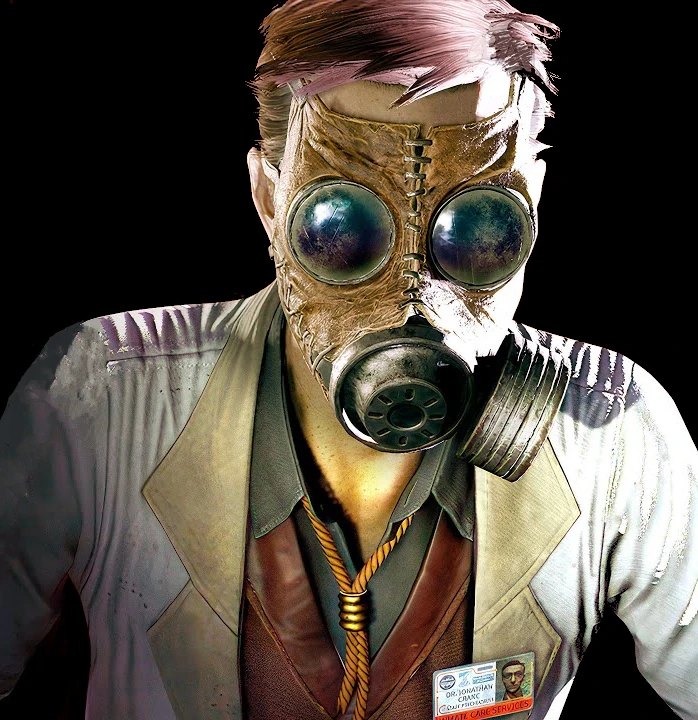
He is not in it, and the game is careful about that. After the Croc attack, Crane spends Arkham City (2011) off-screen, rebuilding and refining the toxin. What you get instead are traces: canisters of his fear gas in the Identity Thief’s hideout and in one of Riddler’s rooms, his old mask turning up as a puzzle, and Oracle refusing to accept that he is dead.
That four-year silence is the setup for the Arkham Knight version. He needed to be gone long enough for Gotham to write him off.
Scarecrow at a glance
| Detail | |
|---|---|
| First comics appearance | World’s Finest Comics #3, 1941 |
| Created by | Bill Finger (writer) and Sheldon Moldoff (artist) |
| Role in Arkham Knight | Main antagonist |
| Voiced by | John Noble in Arkham Knight; Dino Andrade in Arkham Asylum; Elijah Wood in Arkham Shadow |
| Appears in | Arkham Asylum (2009), Arkham Knight (2015); referenced only in Arkham City (2011) |
| Signature weapon | Fear toxin; the Cloudburst dispersal device |
| Boss fight? | No conventional boss fight in any Rocksteady game |
If you are working out which entries to play and in what order, our guide to the Batman: Arkham games in order lays out both release and story chronology. Scarecrow also turns up in our look at the best and worst comic book video games.
Frequently Asked Questions
Is Scarecrow the main villain of Batman: Arkham Knight?
Yes. Jonathan Crane is the primary antagonist. The Arkham Knight is the secondary antagonist and works for him for most of the story, while the Joker appears as a hallucination caused by Joker-infected blood rather than as a living character.
Do you fight Scarecrow in Arkham Knight?
No. There is no conventional boss fight against Scarecrow in Arkham Knight. He appears through broadcasts and cutscenes, and the final confrontation at Arkham Mansion is a scripted sequence rather than a combat encounter.
Why does Scarecrow look disfigured in Arkham Knight?
Killer Croc mauled him at the end of Arkham Asylum. He lost his nose and lips and his right eye was blinded. The game indicates he then had surgery to make his face resemble his old burlap mask, with cord grafted where his lips had been.
What happens to Scarecrow at the end of Arkham Knight?
Batman injects him with a massive dose of his own fear toxin at Arkham Mansion. Crane, who had made himself immune to fear, is left permanently terrified and is taken into GCPD custody. His unmasking of Batman is not reversed.
Why is Scarecrow not in Batman: Arkham City?
He is recovering from the Killer Croc attack and developing a stronger toxin. The game references him through fear gas canisters, his discarded mask and Oracle’s suspicion that he is still alive, but he never appears.
Who voices Scarecrow in Arkham Knight?
John Noble, best known as Denethor in The Lord of the Rings and Walter Bishop in Fringe. Dino Andrade voiced the character in Arkham Asylum.