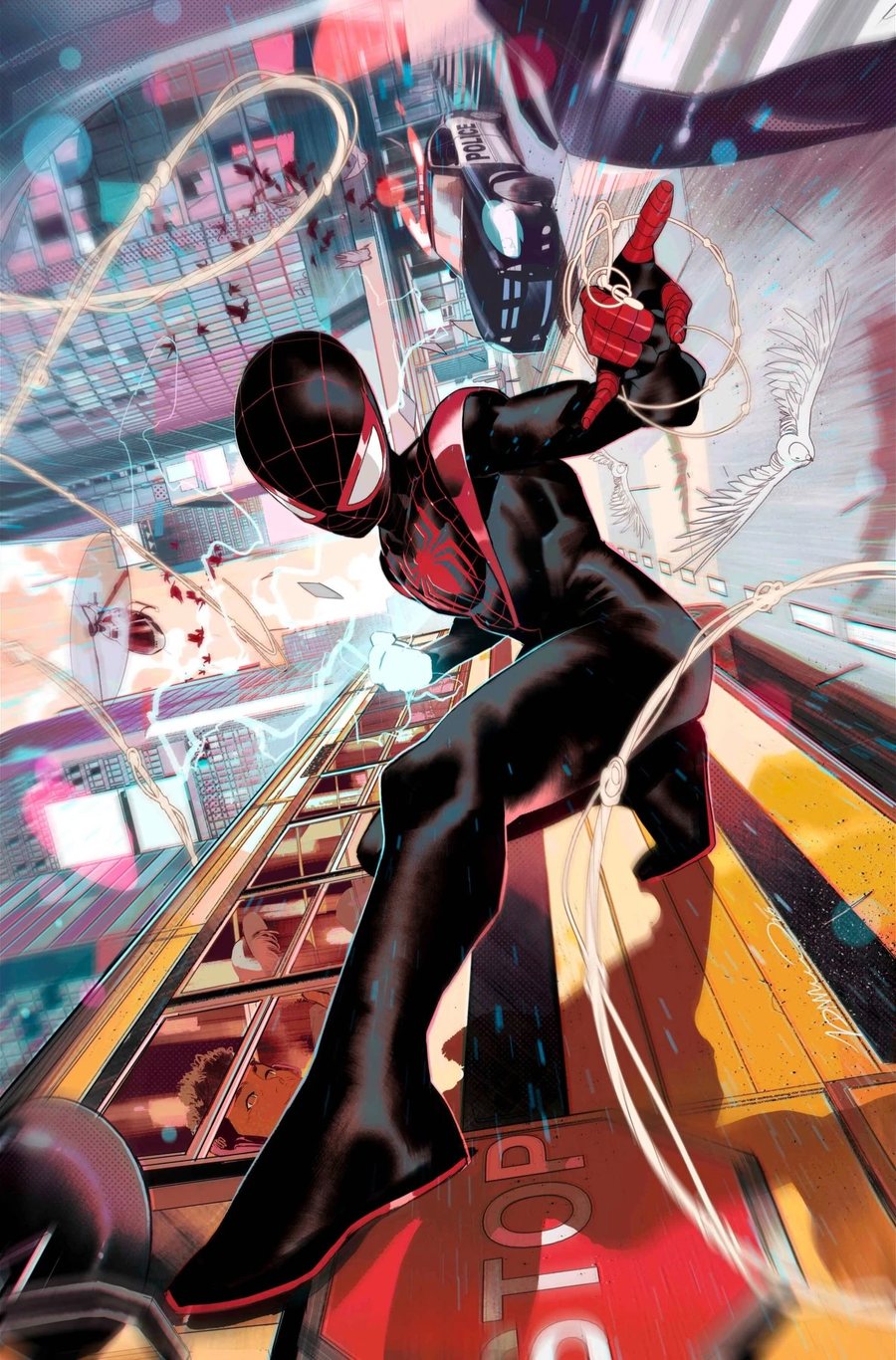
Miles Morales: Spider-Man #1 launched on August 12, 2026 from writer Bryan Hill and artists Nico Leon and Val De Landro, resetting Marvel’s second Spider-Man as a street-level Brooklyn hero in his classic red-and-black suit. The 32-page debut introduces a new villain, Revenant, tied to his father’s S.H.I.E.L.D. past.
What actually happens in Miles Morales: Spider-Man #1
The issue opens the way a Spider-Man comic is supposed to open: with a rescue. Leon stages Miles saving construction workers from a falling crane, an action beat built around acrobatics rather than firepower, and then spends most of the remaining pages on Miles’s civilian life — school, friends, and a new romantic thread involving a Ukrainian foreign-exchange student.
The threat arrives from an unexpected direction. Rather than a Spider-villain, the antagonist is a figure out of Jefferson Morales’s history as a S.H.I.E.L.D. operative, returning for revenge and putting the Morales family — not the city, not the multiverse — in the crosshairs. Cover duties go to Simone Di Meo, whose kinetic, colour-blown style is doing a lot of the work of signalling that this is a modern book with a retro premise.
The relaunch is defined by what it removes
Here is the part most coverage has skipped. Since 2018, Marvel has turned Miles Morales into one of its most valuable brand assets — Into the Spider-Verse won the Academy Award for Best Animated Feature and its sequel was nominated, Insomniac shipped a bestselling game built around him, and he anchors the relaunched Ultimate line. Almost none of that value was generated by his solo comic, which kept getting absorbed into line-wide crossovers and multiversal Spider-events.
So the pitch for this #1 is not an addition. It is a subtraction. No event tie-in, no Spider-Verse, no cosmic stakes, no team book. The villain is a personal grudge against his dad. The setting is a borough. Marvel is essentially arguing that the reason Miles’s comic underperforms his brand is that the comic has never been allowed to be small.
Revenant exposes the real problem
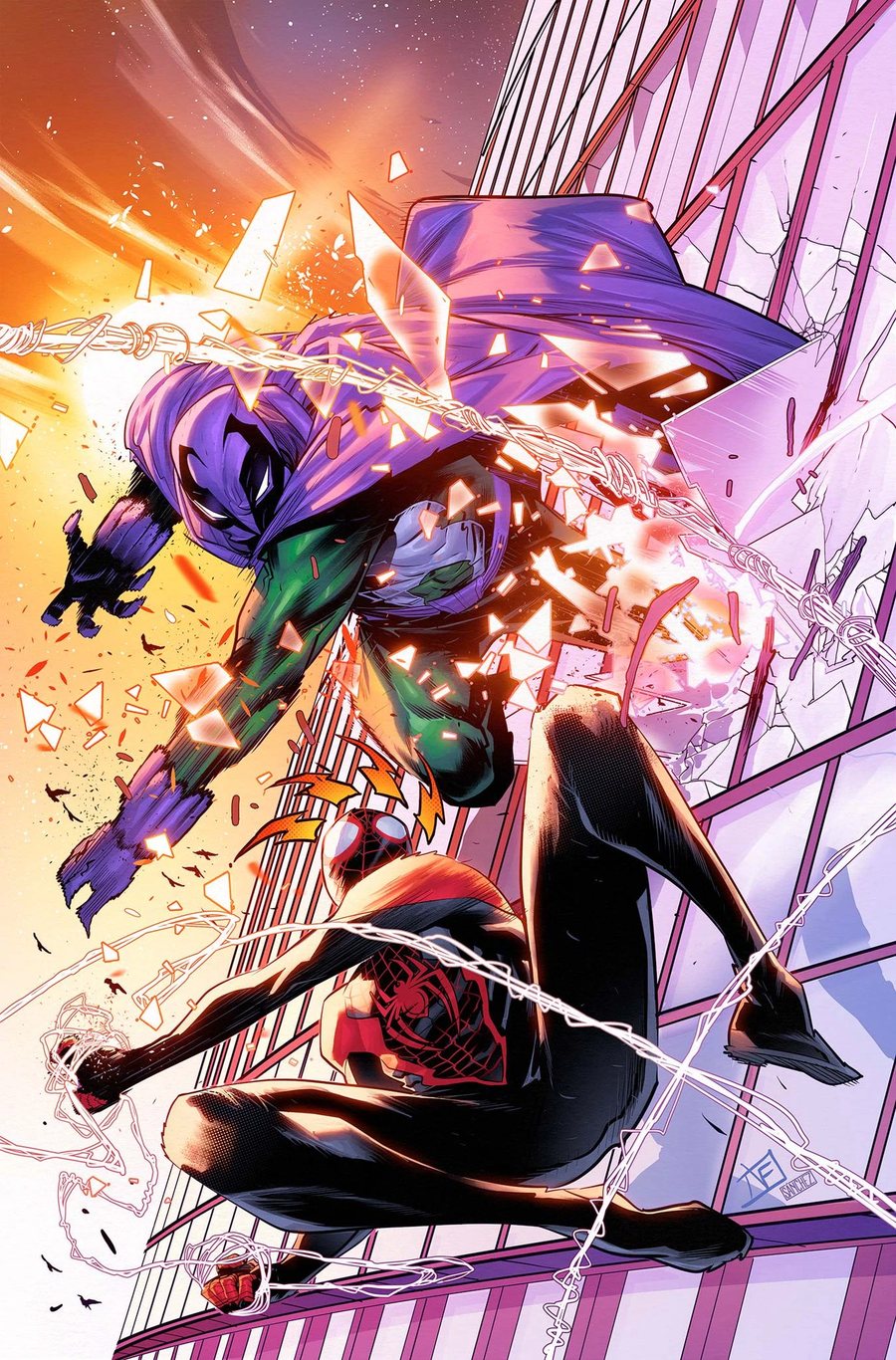
Early reviews have converged on one complaint: Revenant’s design is over-complicated and hard to read on the page. That criticism is fair, but it points at something bigger than one character sheet.
Miles Morales has existed since 2011. In fifteen years he has not accumulated a rogues gallery. Ask a casual reader to name a Peter Parker villain and you get five without pausing. Ask for a Miles villain and most people reach for the Prowler — who is his uncle, and who belongs to Peter’s history first. That is the structural cost of a legacy hero: he inherits the mantle, the city and the supporting cast, but villains are the one thing that cannot be handed down without making the new hero look like a guest star in someone else’s book.
A back-to-basics street-level relaunch therefore has to manufacture a rogue from scratch, immediately, in issue one — the hardest possible moment to do it, because the reader has no relationship with the character yet and every page spent on him is a page not spent on Miles. Revenant being over-designed is a symptom. The disease is that Miles needs three or four durable villains and has perhaps one.
How this compares to recent Spider-Man relaunches
| Relaunch | Approach | Scale of threat | Villain source |
|---|---|---|---|
| Miles Morales: Spider-Man #1 (2026) | Back to basics, Brooklyn | Family / street level | New character (Revenant) |
| Miles Morales in the Ultimate line | Alternate-universe reinvention | Line-wide | Reworked classics |
| Peter Parker relaunches | Status-quo shake-up | City to multiversal | Deep existing bench |
The comparison flatters Hill’s approach in one way and warns about it in another. Small stakes are the correct read on the character — Miles has always worked best as a kid whose biggest problem is his parents finding out. But Peter Parker’s relaunches can go small because a small story can still deploy the Vulture, Doc Ock or the Kingpin. Hill has to build the bench while playing the game.
Is it worth picking up?
If you bounced off Miles during the event years, this is the cleanest jumping-on point the character has had in a long time. Leon’s quieter character pages are drawing the strongest praise, and the friendly-neighbourhood framing is a genuine reset rather than a marketing line. The open question — and it will not be answered for six issues — is whether Hill can build a villain worth returning for. For more on how legacy characters inherit and reshape a mantle, see our look at legacy heroes in comics, and our history of Spider-Man’s original origin.
Frequently asked questions
Who writes and draws Miles Morales: Spider-Man #1?
Bryan Hill writes, with art by Nico Leon and Val De Landro and a cover by Simone Di Meo. Hill’s recent Marvel work includes Ultimate Black Panther and Blade: Red Band.
When did Miles Morales: Spider-Man #1 come out?
It released on August 12, 2026, as part of one of the busiest new-comic Wednesdays of the month.
Do I need to have read anything first?
No. The relaunch is built as a jumping-on point with no event or crossover prerequisites. Background on Miles’s origin helps but is not required.
Who is Revenant?
A new antagonist introduced in this issue, connected to Jefferson Morales’s past as a S.H.I.E.L.D. operative and motivated by revenge against the family rather than against Spider-Man specifically.
Sources: Marvel.com, AIPT, Screen Rant.