A Stand in JoJo’s Bizarre Adventure is a visual manifestation of its user’s life energy — a spirit-like figure that hovers beside them and carries a unique supernatural ability. Introduced in Part 3, Stardust Crusaders, Stands are usually invisible to non-users, and damage to a Stand injures its user.
What a Stand actually is
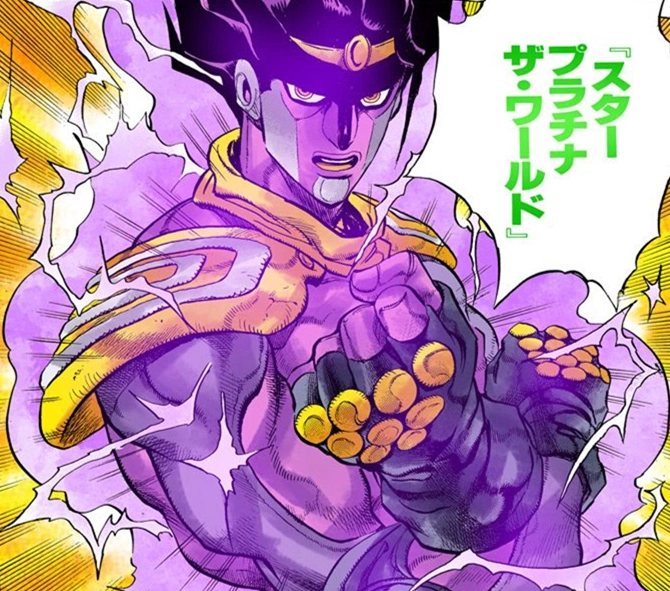
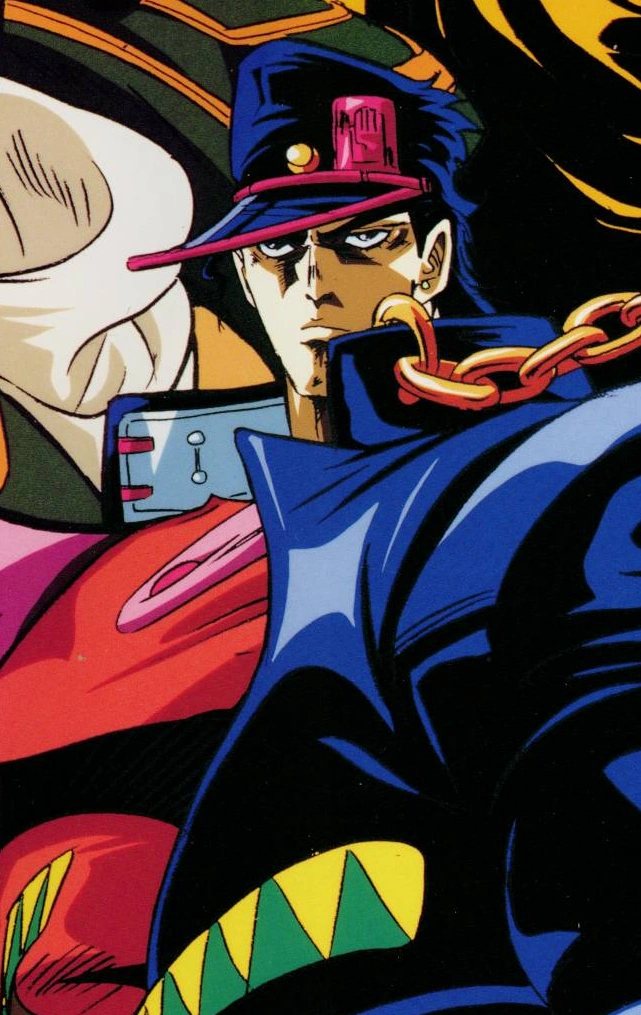
The Japanese term Hirohiko Araki uses is 幽波紋, literally “Ghostly Ripple,” printed with furigana that make it read as Sutando — Stand. The in-universe explanation comes from Joseph Joestar: what Jotaro Kujo mistook for an evil spirit is a vision generated by his own life energy, and because it stands next to him, it is called a Stand.
The rules that follow from that are consistent across the series:
- One per user. A Stand user has a single Stand, which they name themselves.
- Only users see them. Ordinary people cannot perceive a Stand, which is why so many JoJo fights look, from outside, like a man being beaten up by nothing.
- Shared damage. For most Stands, injuring the Stand injures the user and vice versa. Automatic and bound Stands are the main exceptions.
- Death is shared. Destroy a Stand and the user usually dies; kill a user and the Stand usually vanishes.
- One hard limit. No Stand can bring the dead back to life.
Stands are also a personality read. A Stand is the psyche given form, which is why they range from armoured humanoids to sentient boats to abstract phenomena — they are as varied as the people generating them.
Where Stands came from — in the story and out of it
In-universe, Stands trace to an alien virus in a meteorite that fell at Cape York, Greenland, tens of thousands of years ago. The virus kills most people it infects; the survivors gain a Stand. Arrowheads cut from that meteorite can force the awakening in anyone they pierce.
The out-of-universe reason is the more interesting one. Parts 1 and 2 ran on Hamon, or the Ripple — a breathing-based energy used to fight vampires. Once Araki moved past vampires, Hamon had a fatal problem as a manga power: it was invisible. A Hamon fight is two men standing still and glowing. Araki needed abilities he could draw.
Why externalising the power changed everything
This is the insight most explainers skip. Araki’s solution was not to make the energy more visible. It was to move the ability out of the body entirely and give it a face, a name and a body plan. That single decision is why JoJo fights read completely unlike the rest of shonen.
Once a power has a physical form on the page, its rules become visible. The reader can see how far it reaches, what it touches, how fast it moves. And visible rules can be exploited. That is why JoJo battles are puzzles rather than escalations: the winner is almost never the character with the higher output, but the one who correctly deduces the boundary conditions of the other’s ability and attacks the gap.
Contrast this with systems where the power stays internal. Nen in Hunter x Hunter and cursed energy in Jujutsu Kaisen both borrow the “specific personal ability with strict conditions” idea from Stands — but both keep the energy inside the fighter, and both consequently need pages of explanation to make a rule legible. A Stand explains itself by standing there.
Stand types
| Type | What it means | Trade-off |
|---|---|---|
| Close-Range Power | Fights with its own body at high speed and precision, near the user | Overwhelming up close; helpless against a hidden or distant enemy |
| Long-Distance Operation | Operates far from the user, sometimes kilometres away | Great for ambushes; physically weak, and the user is exposed |
| Automatic | Acts on preset instructions rather than commands | Cannot be interrogated or reasoned with; often does not share damage |
| Bound | Tied to an object or location rather than a person | Usually spares the user from feedback damage |
| Colony | Many small units acting as one Stand | Hard to destroy outright; individually fragile |
| Phenomenon | Manifests as an effect or event rather than a figure | Extremely hard to locate or target |
Stands are also graded on a stat block — Destructive Power, Speed, Range, Durability, Precision and Development Potential, each rated A to E. Araki uses these as much for characterisation as for combat maths: a Stand with A speed and E range tells you how its user thinks.
How Stands are named
The naming conventions shift with the parts, and the shift itself is revealing.
- Early Part 3: the Major Arcana of the Tarot, sometimes with a colour attached — Star Platinum, Magician’s Red, Hierophant Green, Death Thirteen.
- Later Part 3: Ancient Egyptian deities — Anubis, Osiris, Horus.
- Part 4 onward: musicians, bands, albums and songs, overwhelmingly from Western music.
- Protagonist Stands: a separate mineral thread — Star Platinum, Crazy Diamond, Gold Experience, Stone Free.
The tarot naming was not just flavour; it was a constraint. The Major Arcana has 22 cards, which handed Araki a fixed roster and pushed Stardust Crusaders into its famous road-trip structure of one enemy Stand per card. He abandoned the system the moment the story needed a 23rd villain — a good illustration of how a naming gimmick can quietly dictate a manga’s plot architecture.
Frequently asked questions
When were Stands introduced in JoJo’s Bizarre Adventure?
In Part 3, Stardust Crusaders, beginning with chapter 114 of the manga and episode 1 of the Stardust Crusaders anime.
Can normal people see Stands?
No. Only Stand users can perceive Stands, which is why bystanders see the effects of a Stand battle but not the combatants.
What happens if a Stand is destroyed?
For most Stands, the user dies. Damage is shared in both directions. Automatic and bound Stands are the main exceptions, and a user can occasionally survive their Stand’s destruction depending on the severity.
Can you have more than one Stand?
A user has one full Stand. The series contains a single documented case of a “sub-Stand,” which remained a part of the original rather than an independent second Stand.
Sources: JoJo’s Bizarre Wiki, JoJo’s Bizarre Encyclopedia, JoJo’s Bizarre Adventure (Hirohiko Araki, Shueisha).