In the world of serialized storytelling, few techniques are as powerful or as enduring as the comic book cliffhanger. It’s that heart-stopping final panel, that shocking reveal, or that impossible situation that leaves readers desperately counting the days until the next issue. From the Golden Age to the modern era, cliffhangers have been the engine that drives comic book narratives, ensuring that fans remain invested, engaged, and always hungry for more. But what makes a truly great cliffhanger? And how has this essential storytelling device evolved over the decades?
For decades, this technique has been a cornerstone of the medium, a vital tool for writers and artists to build suspense and keep their audience captivated. As former Marvel Comics Editor-in-Chief Jim Shooter explains, the classic approach taught by legendary DC editor Mort Weisinger was simple: “If a story continues in the next issue, end with a climactic cliffhanger.” [3] This principle, while seemingly obvious, is an art form in itself, one that has been mastered, subverted, and reinvented time and time again.
What Makes a Great Comic Book Cliffhanger?
A truly effective cliffhanger does more than just leave a story unfinished. It creates a powerful emotional response in the reader—be it shock, dread, or intense curiosity. According to Pastor Will Rose, a lifelong comic fan and theologian, a great cliffhanger “leaves you wondering what is going to happen next, when done well, leaves you wanting more.” [2] This can be achieved in several ways:
- The Impossible Predicament: Placing a hero in a seemingly inescapable deathtrap is the most classic form of cliffhanger. The question isn’t if they will escape, but how.
- The Shocking Reveal: Unmasking a villain, revealing a hidden connection between characters, or exposing a long-held secret can completely reframe the narrative.
- The Moral Dilemma: Forcing a character to make an impossible choice, where either option has dire consequences, creates deep personal stakes.
- The Unexpected Return: The sudden reappearance of a character thought to be dead or long-gone can instantly upend the status quo.
These moments are the lifeblood of serialized comics, turning a passive reading experience into an active, emotional investment. They are the moments that get fans talking, speculating, and, most importantly, coming back for the next installment.
[Image failed to load: The iconic cover of Amazing Spider-Man #33, featuring one of the most memorable cliffhangers in comic book history as Spider-Man is trapped under tons of debris.] Caption: The iconic cover of Amazing Spider-Man #33, featuring one of the most memorable cliffhangers in comic book history as Spider-Man is trapped under tons of debris. Credit: Marvel Comics Source: Marvel Database
The Golden Age of Cliffhangers: Setting the Standard
The history of comic book cliffhangers is a long and storied one, but it was during the Silver Age that the technique truly came into its own. In the early days, the Comics Code Authority actually frowned upon cliffhangers, as it meant that villains were not brought to justice within the same issue they appeared. [1] However, rule-breakers like Marvel Comics began to push the boundaries, and in doing so, created some of the most iconic moments in the medium’s history.
One of the most legendary examples comes from The Amazing Spider-Man #33 (1966). In a story titled “If This Be My Destiny…!”, Spider-Man is trapped beneath tons of heavy machinery, with the water rising and a life-saving serum for his Aunt May just out of reach. The final panels, showing a desperate and seemingly defeated hero, are a masterclass in suspense. It’s a moment of pure, unadulterated peril that has been seared into the memory of comic fans for generations.
Just a few years later, Stan Lee and Jack Kirby would redefine the cosmic scale of cliffhangers with the introduction of Galactus in Fantastic Four #48 (1966). The issue ends with the godlike being’s ominous declaration that Earth is doomed. This wasn’t just a hero in a deathtrap; it was the entire planet. This moment established a new formula for comic book storytelling: introduce an unstoppable threat at the end of one issue, and spend the next few figuring out how to stop them.
The Art of the Twist: Subverting Expectations
As the medium matured, so too did the art of the cliffhanger. Writers began to move beyond simple deathtraps and towards more complex, psychological forms of suspense. These cliffhangers relied not on physical peril, but on shocking twists that forced readers to re-evaluate everything they thought they knew.
Perhaps the most famous example of this is from Alan Moore and Dave Gibbons’ masterpiece, Watchmen #11 (1987). The supposed villain, Ozymandias, gathers the remaining heroes and explains his master plan to save the world by teleporting a genetically engineered monster into New York City, killing millions to unite humanity against a common foe. As the heroes prepare to stop him, he delivers one of the most chilling lines in comic book history: “Do it? Dan, I’m not a Republic serial villain. Do you seriously think I’d explain my masterstroke if there remained the slightest chance of you affecting its outcome? I did it thirty-five minutes ago.” [1]
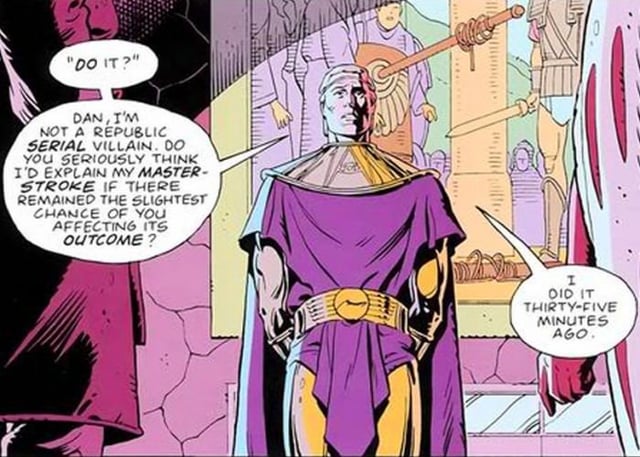 Caption: Ozymandias delivers one of the most shocking cliffhanger twists in comic book history in Watchmen #11, revealing “I did it thirty-five minutes ago.”
Credit: DC Comics / Alan Moore and Dave Gibbons
Source: Reddit
Caption: Ozymandias delivers one of the most shocking cliffhanger twists in comic book history in Watchmen #11, revealing “I did it thirty-five minutes ago.”
Credit: DC Comics / Alan Moore and Dave Gibbons
Source: Reddit
This was a game-changer. It subverted the classic trope of the monologuing villain and left readers in a state of genuine shock. The threat wasn’t coming; it had already arrived. This type of cliffhanger, the “too late” twist, has been imitated countless times since, but rarely with such devastating impact.
Another brilliant example of a twist cliffhanger came in Thunderbolts #1 (1997). In a world without the Avengers, a new team of heroes emerges to fill the void. They are brave, they are powerful, and they are the world’s new hope. But the final page reveals that these new heroes are actually the Masters of Evil in disguise, led by the Nazi villain Baron Zemo. This shocking reveal instantly turned the book into a must-read, as fans were desperate to see how this diabolical plan would unfold.
The Modern Cliffhanger: Character, Consequence, and the Long Game
Today, the art of the comic book cliffhanger is more nuanced than ever. While the classic deathtraps and villain reveals still have their place, modern writers often focus on character-driven cliffhangers that have long-lasting consequences. These are the moments that don’t just put a hero in physical danger, but challenge their very identity and beliefs.
Jim Shooter notes that many modern comics make the mistake of ending with a “tease” rather than a true cliffhanger. A villain simply appearing on the final page isn’t enough. For a cliffhanger to be effective, it must be the climax of the issue’s conflict, not just a preview of the next one. [3] A true cliffhanger is the culmination of the story you just read, while also being the hook for the one to come.
Modern comics have also embraced the idea of the “quiet” cliffhanger. These are not moments of explosive action, but of quiet, devastating revelation. A character learning a terrible truth, a relationship ending, or a hero making a morally compromising decision can be just as powerful as any exploding building. These are the moments that stick with readers, forcing them to grapple with complex emotional and ethical questions. For more on how comics can tackle these issues, check out our article on the psychology of supervillains.
 Caption: Batman faces off against the Joker in a dramatic cliffhanger moment from the Endgame storyline, showcasing how modern comics continue the tradition of suspenseful issue endings.
Credit: DC Comics / Scott Snyder and Greg Capullo
Source: Reddit
Caption: Batman faces off against the Joker in a dramatic cliffhanger moment from the Endgame storyline, showcasing how modern comics continue the tradition of suspenseful issue endings.
Credit: DC Comics / Scott Snyder and Greg Capullo
Source: Reddit
From the impossible peril of Spider-Man to the chilling machinations of Ozymandias, the comic book cliffhanger has proven to be one of the most versatile and effective tools in a writer’s arsenal. It is a testament to the power of serialized storytelling, and a promise to the reader that no matter how dire the situation, the story is not over yet. It’s the reason we keep turning the page, the reason we keep coming back, and the reason that, after all these years, we are still utterly and completely hooked. For a deeper dive into how these stories are made, explore our look at how comics are made from script to art.
References
- Juddery, Mark. “10 Great Comic Book Cliffhangers.” Mental Floss, 13 July 2012, www.mentalfloss.com/article/31185/10-great-comic-book-cliffhangers.
- Rose, Will. “Comics and the Art of the Cliffhanger.” Pop Culture and Theology, 4 Mar. 2019, popularcultureandtheology.com/2019/03/04/comics-and-the-art-of-the-cliffhanger/.
- Shooter, Jim. “How to Do Continued Stories and Next or Future Issue Teases – Part 1.” JimShooter.com, 1 Nov. 2011, jimshooter.com/2011/11/how-to-do-continued-stories-and-next-or.html/.