Comics are far more sophisticated than most people realize. While vibrant artwork and witty dialogue grab our attention, it’s the invisible language of sequential art that truly captivates readers and creates unforgettable stories. Every panel, gutter, and visual choice is carefully crafted to guide your emotional journey through the narrative.
For decades, comics were dismissed as simple entertainment for children. Thanks to pioneering theorists like Will Eisner and Scott McCloud, the medium has gained recognition as a complex art form deserving serious study. McCloud’s groundbreaking work Understanding Comics defines the medium as “juxtaposed pictorial and other images in deliberate sequence, intended to convey information and/or to produce an aesthetic response in the viewer.”
This definition reveals comics’ fundamental power: the art of visual storytelling through sequential images.
What Makes Comic Book Visual Storytelling Unique?
Visual storytelling in comics combines images and text to create experiences impossible in other media. Unlike prose, which relies solely on words, or film, which moves in real-time, comics leverage three core concepts that make them uniquely powerful.
Sequential art uses a series of images to tell stories. Each panel represents a frozen moment in time, and their arrangement creates narrative flow. Juxtaposition places these panels side-by-side, creating meaning through their relationship. Most importantly, closure occurs in the space between panels—the gutter—where readers’ minds fill in missing action, creating motion and time.
This reader participation makes comics an interactive medium. Your brain naturally connects the dots between panels, making you an active participant in the storytelling process.
The Foundation: How Panel Layouts Control Your Reading Experience
The panel is comics’ basic building block—a single moment frozen in time. But how these panels are arranged, sized, and shaped dramatically affects how you experience the story.
Small, tightly packed panels create urgency and fast-paced action. Large, sprawling panels slow the narrative, letting you linger on important moments or breathtaking visuals. Panel shapes also convey meaning: jagged, irregular borders suggest chaos or violence, while smooth, rounded panels evoke calm or nostalgia.
The space between panels—the gutter—is equally important. Wide gutters suggest longer time passages, while narrow gutters create rapid-fire action sequences. Master comic creators manipulate these elements to control pacing as precisely as a film director controls editing.

Caption: Different panel layouts demonstrate how comic creators control pacing and reader flow through strategic composition choices.
Credit: Image courtesy of Toons Mag
Source: https://www.toonsmag.com
Comic Book Cinematography: Directing the Reader’s Eye
Comic artists function as directors, using “camera” techniques borrowed from film to guide your eye and create emotional responses. These cinematographic choices are fundamental to effective visual storytelling.
Establishing shots set scenes and locations, often opening new sequences. Wide-angle shots show scale and character relationships within environments. Low-angle shots make characters appear powerful or intimidating by positioning the “camera” below them, while high-angle shots create vulnerability by looking down on subjects.
Close-ups focus on facial expressions and emotions, creating intimacy between reader and character. Medium shots balance character and environment, perfect for dialogue scenes. Each choice influences how you perceive characters and situations.
The most skilled comic artists vary their “camera” angles throughout stories, creating visual rhythm that keeps readers engaged while serving the narrative’s emotional needs.

Caption: Examples of different camera angles in comics, showing how perspective choices influence reader perception and emotional response.
Credit: Image courtesy of Rivkah LaFille
Source: https://www.rivkah.com
Mastering Time: Compression and Decompression Techniques
Comics possess unique abilities to manipulate time that neither prose nor film can match. Through compression and decompression, creators control narrative pacing with surgical precision.
Compressed storytelling uses few panels to convey large amounts of information or long time periods. This technique works perfectly for character introductions, montages, or moving quickly through familiar story beats. Think of how Jack Kirby could show cosmic battles spanning galaxies in just a few dynamic panels.
Decompressed storytelling spreads single moments across multiple panels, slowing time to emphasize important actions or emotions. Modern comics often use this technique for fight scenes, allowing readers to follow every punch and reaction, or for quiet character moments that need emotional weight.
The best comic creators blend both approaches, compressing familiar elements while decompressing the moments that matter most to their stories.
Character Development Through Visual Design
In comics, character personality emerges as much through visual design as dialogue. Artists communicate everything about characters through posture, clothing, facial expressions, and body language before they speak a single word.
Signature design elements ensure character recognition across different angles and expressions. Think of how Batman’s cape and cowl remain instantly recognizable, or how Spider-Man’s web pattern defines his silhouette. These visual shortcuts help readers track characters through complex action sequences.
Color psychology also plays crucial roles in character development. Heroes often wear primary colors suggesting strength and reliability, while villains gravitate toward darker palettes implying danger or mystery. For deeper insights into antagonist psychology, explore our analysis of the psychology of supervillains.
Body language and facial expressions convey emotional states without exposition. A slumped posture suggests defeat, while confident stances project power. Master artists can show character growth through subtle changes in how figures carry themselves across story arcs.
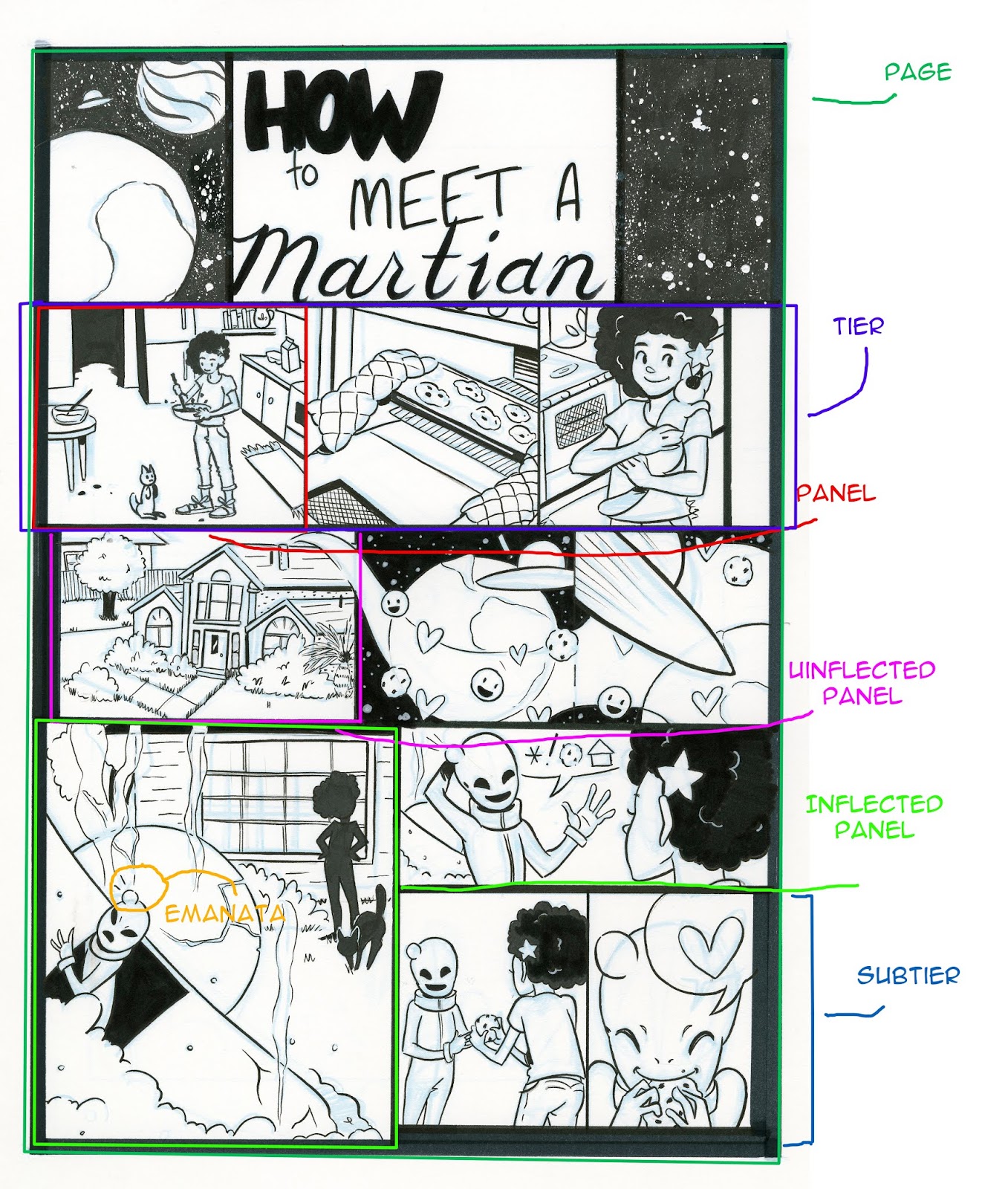
Caption: This educational diagram illustrates various visual storytelling techniques used in sequential art to guide reader attention and create narrative flow.
Credit: Image courtesy of Nattosoup
Source: http://nattosoup.blogspot.com
The Subtle Art of Color, Line, and Composition
Beyond obvious techniques like paneling and “camera” work, subtler visual elements contribute significantly to storytelling effectiveness.
Color palettes establish mood and atmosphere. Warm colors like reds and yellows suggest energy, passion, or danger, while cool blues and greens evoke calm, sadness, or mystery. Skilled colorists shift palettes throughout stories to support emotional arcs.
Line work affects how readers perceive action and tone. Thick, bold lines create energy and dynamism, perfect for superhero action. Thin, delicate lines suggest elegance or fragility, ideal for intimate character moments. Rough, sketchy lines can convey chaos or psychological instability.
Composition within each panel guides attention and creates visual balance or tension. Centered compositions feel stable and resolved, while off-center arrangements suggest movement or unease. Artists use these principles to subtly influence reader emotions.
Speech Bubbles and Sound Effects: The Language of Comics
Comics have developed unique visual languages for dialogue and sound that enhance storytelling beyond simple text.
Speech balloons vary in shape and style to convey different types of communication. Standard balloons indicate normal speech, while jagged edges suggest shouting or anger. Thought balloons (though less common in modern comics) show internal monologue, and special balloon designs indicate telepathy or electronic communication.
Sound effects serve as more than noise representation—they’re visual elements that enhance action and emotion. A well-placed “CRASH!” doesn’t just describe sound; it adds visual impact and rhythm to action sequences. The size, font, and placement of sound effects contribute to panel composition and pacing.
The Digital Revolution and Future of Visual Storytelling
Digital comics and webcomics have expanded visual storytelling possibilities beyond traditional print limitations. Interactive elements, animation, and infinite canvas formats allow creators to experiment with new narrative techniques.
Universities now offer courses studying comics as legitimate literature, recognizing the medium’s educational potential. Comics effectively convey complex information, making them valuable tools for instruction and communication beyond entertainment.
The medium continues evolving as creators push boundaries of what sequential art can achieve. To understand how comic art has developed over time, check out our comprehensive look at the evolution of comic book art.
Why Understanding Visual Storytelling Matters
Whether you’re a casual reader or aspiring creator, understanding comics’ visual language enhances appreciation for the medium’s artistry. Every panel represents countless decisions about pacing, emotion, and narrative flow.
Next time you read a comic, pay attention to panel sizes, “camera” angles, and color choices. Notice how creators guide your eye across pages and manipulate time to serve their stories. You’ll discover a rich, complex art form that deserves recognition alongside literature and film.
The hidden language of comics rewards careful study, revealing sophisticated storytelling techniques that make great comics truly unforgettable.
References
EBSCO Research Starters. (2024). Comics as Visual Storytelling. https://www.ebsco.com/research-starters/literature-and-writing/comics-visual-storytelling
LaFille, R. (2020). Camera Conventions in Graphic Novels. https://www.rivkah.com/lets-make-magic/camera-conventions-in-graphic-novels/
Franck, S. (2018). 13 Visual Storytelling Tips For Comics. 13th Dimension. https://13thdimension.com/13-visual-storytelling-tips-for-comics/