Kamala Khan is Ms. Marvel, a Jersey City teenager with Inhuman-and-mutant hard-light powers; Captain Marvel is Carol Danvers, a decorated Air Force officer turned cosmic-powered Avenger. Kamala idolized Carol as a kid, inherited the “Marvel” name Carol gave up, and later became her real protégée in the comics.
Last updated: September 10, 2026
Who Is Kamala Khan?
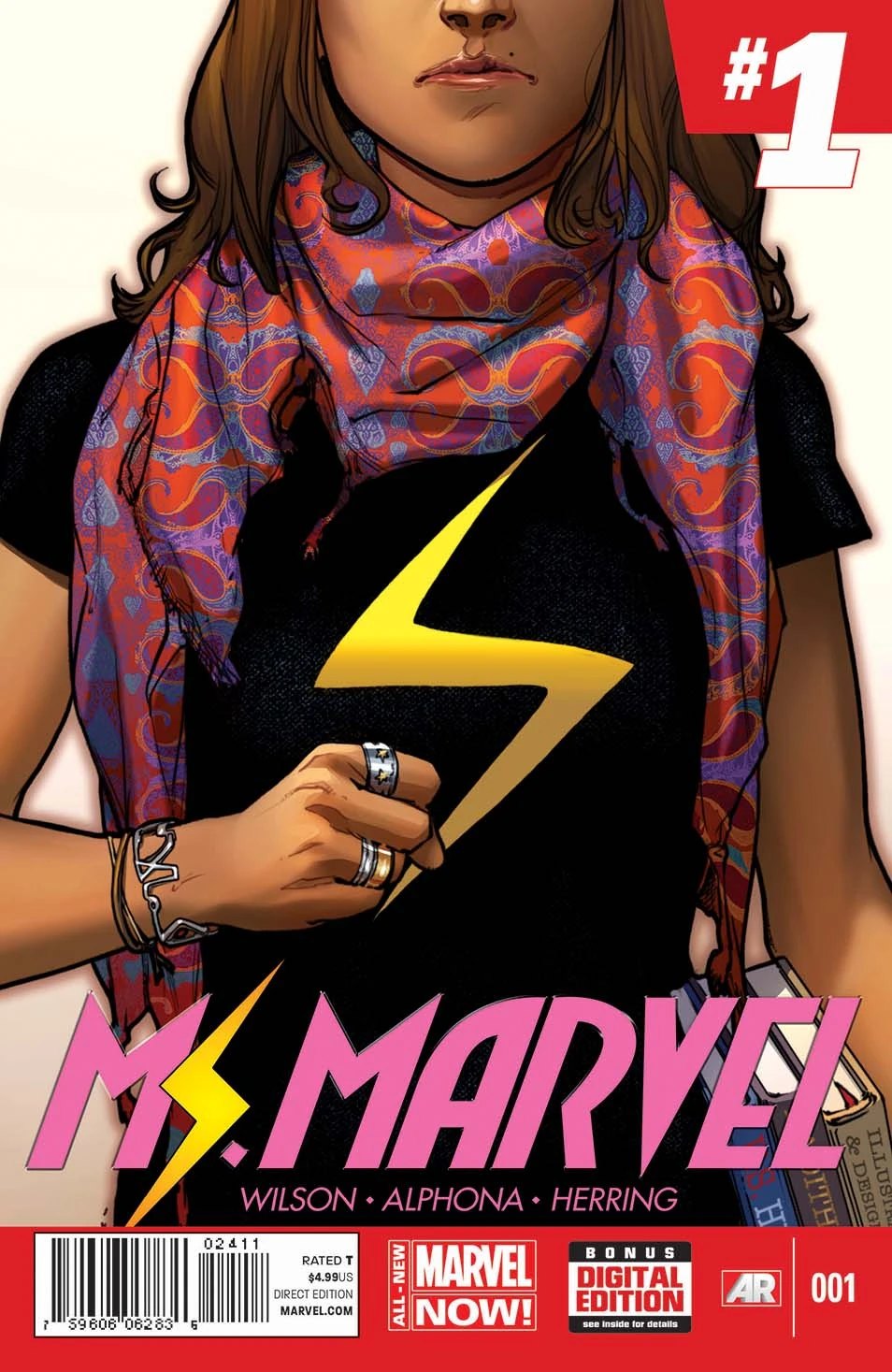
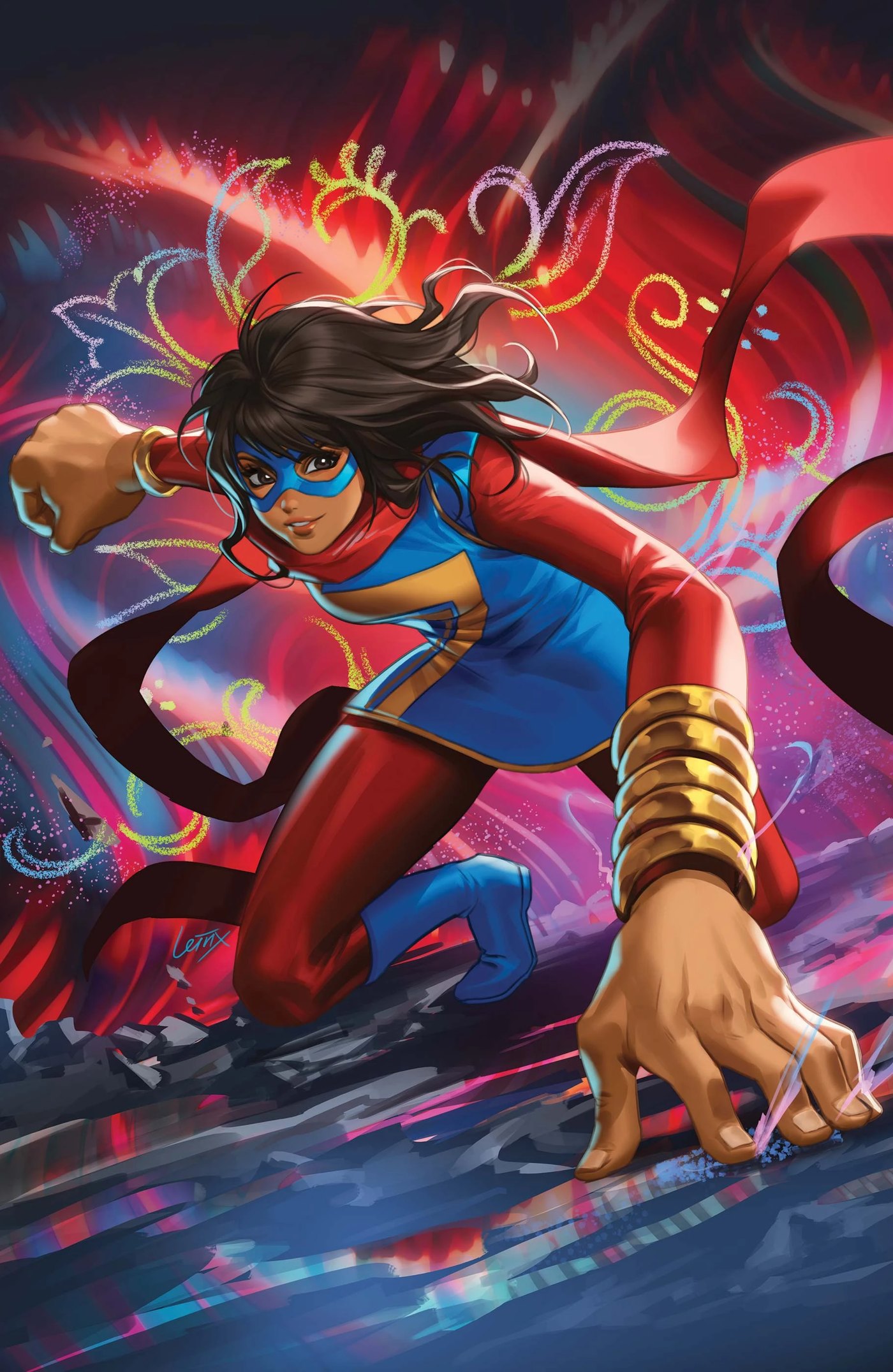
Kamala Khan is a Pakistani-American teenager from Jersey City who first appeared, unnamed, in the background of Captain Marvel #14 (August 2013) before headlining her own book as Ms. Marvel in Ms. Marvel #1 (February 2014), written by G. Willow Wilson with art by Adrian Alphona. She was the first Muslim character to headline a Marvel comic, co-created by writer G. Willow Wilson and Marvel editors Sana Amanat and Stephen Wacker. Kamala grew up obsessed with the Avengers, and specifically with Carol Danvers, whom she idolized for years before gaining powers of her own from a burst of Terrigen Mist that also revealed a latent mutant gene. She took the codename Ms. Marvel as a direct tribute to Carol, sewing her own version of Carol’s old costume before designing something more practical. Since then, Kamala has fought alongside the Avengers, co-founded the teen team the Champions, and grown into one of Marvel’s most prominent young heroes, with her own Disney+ series and a feature film appearance cementing her as an MCU mainstay alongside her comics career. For more on how she stacks up against the rest of Earth’s mightiest heroes, see our ranking of the most powerful Avengers.
Who Is Carol Danvers?
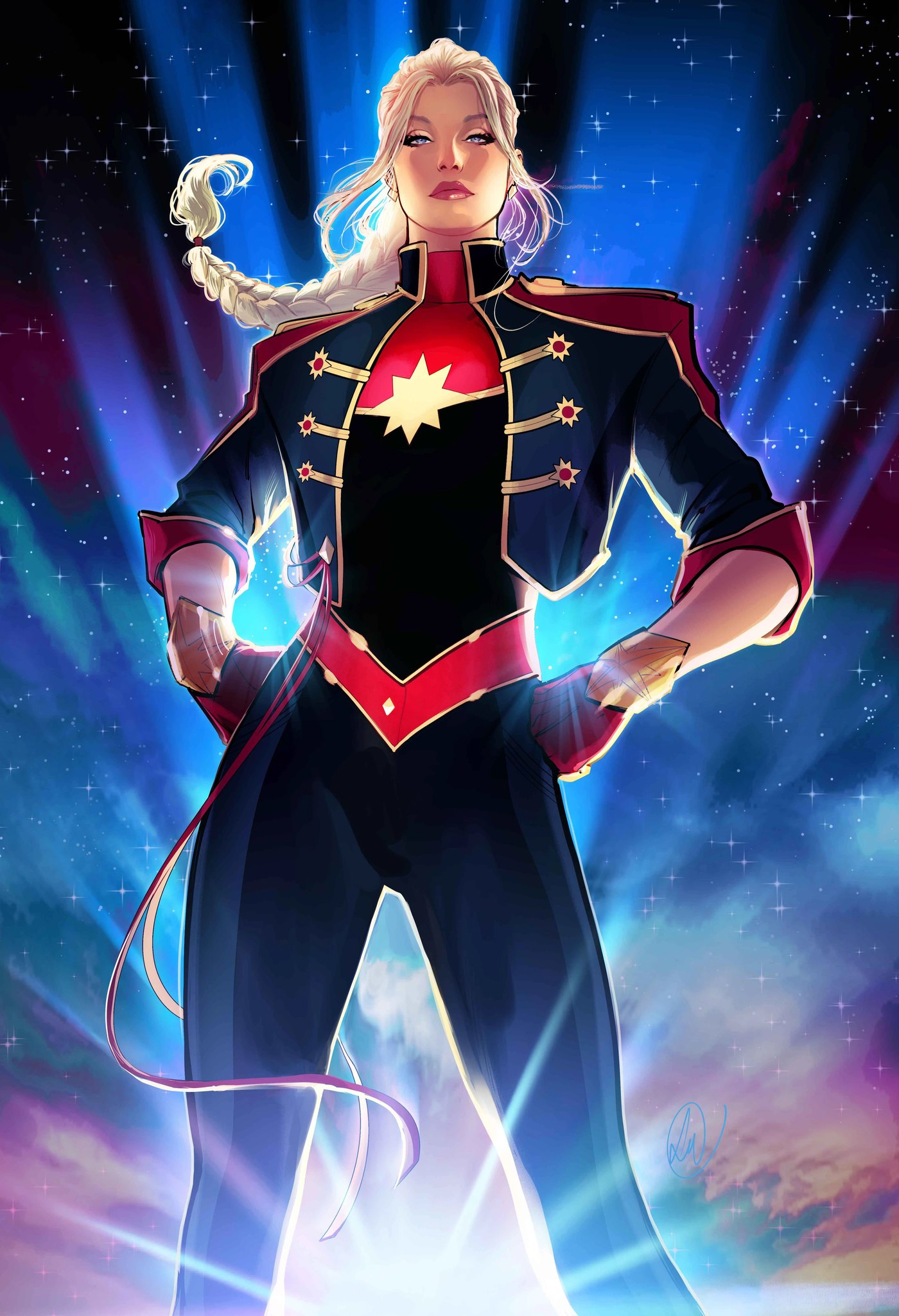
Carol Danvers debuted decades earlier, as a United States Air Force officer in Marvel Super-Heroes #13 (March 1968), working as head of security at a NASA facility infiltrated by the Kree operative Mar-Vell, Marvel’s original Captain Marvel. An explosion from an alien device called the Psyche-Magnitron fused her DNA with Mar-Vell’s, awakening latent Kree physiology and superhuman abilities. She first became a costumed hero as Ms. Marvel in her own self-titled series, Ms. Marvel #1 (January 1977), decades before Kamala Khan existed. Over the following years Carol cycled through several identities and power sets: Binary, after being cosmically empowered by a white hole; Warbird, after losing and regaining her powers; and finally Captain Marvel, a name she adopted in Avenging Spider-Man #9 and made permanent in Kelly Sue DeConnick’s Captain Marvel #1 (2012) as a tribute to her late friend and mentor Mar-Vell, who had died of cancer in the classic 1982 graphic novel The Death of Captain Marvel. Carol is now one of Marvel’s flagship cosmic heroes, a former Air Force colonel who leads Avengers teams and holds the Captain Marvel name as her permanent legacy identity — see Marvel.com’s official character profile for her full comics history.
Their Powers, Side by Side
The single biggest source of reader confusion is that these two characters have never had the same powers, and Kamala’s have actually changed twice. Originally, as an Inhuman, Kamala had a stretching, size-shifting “embiggen” power — she could grow her fists to giant size or shrink down to squeeze through gaps, much like a young Mister Fantastic. When Ms. Marvel premiered on Disney+ in June 2022, the show gave Kamala an entirely different power for the screen: bracelet-triggered hard-light constructs pulled from a “Noor dimension,” rather than stretching. Marvel Comics then folded that change back into the source material. Beginning with Ms. Marvel: The New Mutant and continuing in Ms. Marvel: Mutant Menace #1, which shipped March 6, 2024, Kamala was revealed to be both Inhuman and mutant, with her true power expressed as hard-light constructs that also amplify her older stretching ability rather than replace it.
Carol Danvers’ powers were never in question in the same way, but they are broader and more cosmic in scale. As a human-Kree hybrid, she has superhuman strength, durability, and near-light-speed flight, plus the signature ability to absorb and redirect nearly any form of energy — photon blasts, X-rays, gravitons, cosmic rays — as offensive attacks. During her years as Binary she also gained cosmic awareness, letting her perceive energy patterns and disturbances across space, an ability that resurfaces under the right conditions even though she lost the full Binary power set. Where Kamala’s toolkit is tactile and close-range (constructs she shapes with her hands), Carol’s is a firehose of raw astrophysical energy she can project across a battlefield or a solar system.
Kamala Khan vs. Captain Marvel: At a Glance
| Category | Kamala Khan (Ms. Marvel) | Carol Danvers (Captain Marvel) |
|---|---|---|
| Real name | Kamala Khan | Carol Susan Jane Danvers |
| First appearance | Captain Marvel #14 (Aug. 2013); named in Ms. Marvel #1 (Feb. 2014) | Marvel Super-Heroes #13 (March 1968) |
| Powers | Hard-light constructs, size/shape-shifting (“embiggen”), Inhuman and mutant physiology | Superhuman strength/flight, energy absorption and projection, cosmic awareness |
| Codename origin | Chose “Ms. Marvel” as a tribute to her idol, Carol Danvers, once Carol vacated the name | Took “Captain Marvel” in 2012 as a tribute to her late mentor, the original Captain Marvel, Mar-Vell |
| Current status | Active Avenger and mutant ally; star of Ms. Marvel: Mutant Menace (2024) and the MCU’s Ms. Marvel and The Marvels | Active Avenger and cosmic-tier hero; MCU’s Captain Marvel across four films |
Fangirl to Protégée: Their Real Relationship
Kamala Khan’s entire heroic identity starts with hero worship of Carol Danvers. In the comics, Kamala writes Avengers fan fiction, keeps a shrine of Carol memorabilia in her bedroom, and models her first costume directly on Carol’s old Ms. Marvel look before Bruno talks her into something more practical. The two didn’t actually meet for years of published continuity — their first real encounter came during the 2015 Secret Wars event — but once they did, the relationship deepened quickly. Carol brought Kamala onto the Avengers on a limited basis, effectively making her a protégée, and later gifted her a pendant bearing both of their insignias that doubled as a tracking device, a small but pointed symbol of mentorship.
That relationship wasn’t friction-free. During the 2016 Civil War II storyline, Kamala broke with Carol over Carol’s support for a predictive-justice program that used a young Inhuman’s visions to arrest people before they committed crimes; Kamala sided with Iron Man against her mentor, and the rift was serious enough that Kamala, Spider-Man (Miles Morales), and Nova quit the Avengers to found their own team, the Champions. The two eventually repaired the relationship, and Carol has continued to treat Kamala as something closer to a kid sister or protégée than a rank-and-file teammate — which is the dynamic Marvel leaned on hard when it built the MCU’s version of their bond.
Why Do They Both Use the Name “Marvel”?
The shared “Marvel” naming isn’t a coincidence, a licensing accident, or a case of Marvel running out of ideas — it’s a 60-year chain of in-universe tributes with a very real trademark story underneath it. Marvel Comics first published a hero called Captain Marvel in 1967 (Marvel Super-Heroes #12) largely to lock down the trademark, after rival publisher Fawcett Comics had been forced to stop publishing its own, much older Captain Marvel (the character now known as Shazam) following a 1953 settlement with DC Comics over copyright claims. Marvel’s Captain Marvel was the Kree soldier Mar-Vell, introduced in Marvel Super-Heroes #12 (1967) and given his own solo book in Captain Marvel #1 the following year — the same book in which Carol Danvers, then a supporting NASA character, was caught in the explosion that changed her biology.
Carol didn’t take a superhero name of her own until Ms. Marvel #1 (1977), deliberately chosen as the “female” counterpart title to Mar-Vell’s “Captain Marvel” — Marvel’s marketing playbook at the time for giving a hero and a spin-off character matching brand names. After Mar-Vell died in the 1982 graphic novel The Death of Captain Marvel, the “Captain Marvel” name sat unclaimed for three decades while other characters, including Monica Rambeau, briefly used it (see CBR’s full rundown of every character who has used the Ms. Marvel and Captain Marvel names). Carol herself cycled through Binary and Warbird before writer Kelly Sue DeConnick and editor Stephen Wacker finally moved her into the vacated Captain Marvel identity in 2012, explicitly as a tribute to Mar-Vell and a mark of her graduation into a leadership-tier hero.
That 2012 promotion is what created the opening Kamala Khan later filled. As Ms. Marvel co-creator Sana Amanat, Marvel’s Director of Content and Character Development, explained in an interview about the character’s origin: a teenage Carol Danvers fan in New Jersey would naturally gravitate toward idolizing her, and once Carol “had become Captain Marvel,” the Ms. Marvel name was sitting empty — “a really cool branding opportunity,” in Amanat’s words, since “people know what Ms. Marvel is.” Kamala didn’t inherit a random title; she inherited the specific one her hero had just outgrown, and Marvel’s editorial team designed the handoff on purpose.
How the MCU Versions Compare to the Comics
The MCU introduced both characters to a much wider audience but changed meaningful details for both. Carol Danvers arrived first, in 2019’s Captain Marvel, played by Brie Larson, with her Air Force and Kree backstory largely intact but her comics history with a male Mar-Vell swapped for a female Kree scientist, Mar-Vell (Annette Bening). Kamala Khan followed in Ms. Marvel, which premiered on Disney+ on June 8, 2022 and starred newcomer Iman Vellani, with Sana Amanat and Bisha K. Ali steering the adaptation. The show kept Kamala’s Jersey City setting, her family, and her Carol Danvers obsession, but swapped her Inhuman stretching powers for hard-light constructs and made her a mutant by the finale — a change Marvel then folded back into the comics rather than the usual direction of adaptation.
The two characters shared the screen for the first time in The Marvels, released November 10, 2023, alongside Teyonah Parris as Monica Rambeau (a third character who has also held the Captain Marvel and Photon codenames in the comics — proof the naming musical chairs is very much an MCU tradition too). The film leaned directly on the mentor dynamic from the comics, with Kamala as a superfan finally meeting her hero. Commercially, it struggled badly: The Marvels opened to roughly $46-47 million domestically over its November 10-12, 2023 opening weekend, the lowest opening weekend of any Marvel Cinematic Universe film to that point, undercutting the previous low set by 2008’s The Incredible Hulk ($55.4 million), and finished its run with about $206.1 million worldwide against a reported budget north of $200 million. Ms. Marvel’s Disney+ debut had also underperformed by raw streaming volume — Samba TV measured roughly 775,000 U.S. households in its first five days, the lowest of any MCU Disney+ premiere to that point, behind Loki (2.5 million), Moon Knight (1.8 million), The Falcon and the Winter Soldier (1.6 million) and Hawkeye (1.5 million). The same report cuts the other way on demographics, though: Ms. Marvel was Disney+’s strongest MCU premiere to date among viewers aged 20-24 and among Black, Hispanic and Asian households — a reminder that a headline “lowest-watched” number can describe a show that found exactly the audience it was built for.
Why the Confusion Actually Matters
Here’s the part most coverage skips: the 2022 decision to rewrite 60 years of Kamala Khan’s printed comics canon to match a TV show’s power set wasn’t really fan service — it was brand-confusion damage control. Marvel had spent a decade building Kamala as the “next” Ms. Marvel and Carol as the definitive Captain Marvel, and by 2022 the company was about to put both names in front of a mainstream streaming and theatrical audience that had never read a comic. Rather than risk casual viewers wondering why “Ms. Marvel” on Disney+ didn’t match “Ms. Marvel” in back-issue bins, Marvel edited the comic to match the show. That’s a rare reversal of the usual adaptation flow, and it’s arguably a tacit admission that the two-Marvels naming convention — however rich its 60-year editorial history — creates real audience friction, not just online debate.
It’s also a plausible, if unprovable, piece of why The Marvels underperformed the way it did: the film required audiences to already track three codenames (Ms. Marvel, Captain Marvel, Photon) across three characters with overlapping but distinct power sets, released the same year moviegoers rewarded Barbie‘s single, instantly legible premise with a billion-dollar gross. Clarity sold in 2023; the Marvel-name tangle didn’t help a film that needed word-of-mouth simplicity to recover from a bruised MCU brand.
Both characters are set to stay central to Marvel’s future. Carol Danvers remains one of the roster’s most powerful active Avengers on the page, and both she and Kamala are expected to factor into Marvel’s next wave of team-up films; see everything we know about Avengers: Doomsday for how the current MCU slate is shaping up.
Frequently Asked Questions
Is Kamala Khan the same person as Captain Marvel?
No. Kamala Khan is Ms. Marvel, a separate character with her own powers and comics/MCU appearances. Captain Marvel is the codename used by Carol Danvers, whom Kamala idolizes. The two have teamed up repeatedly but are not the same person and have never shared a codename.
Did Kamala Khan ever become Captain Marvel?
No. In mainline Marvel continuity, Kamala Khan has kept the Ms. Marvel identity since her 2014 debut. Other characters, including Monica Rambeau, have used the Captain Marvel name in the comics, but Kamala has not.
Why did Marvel change Kamala Khan’s powers from stretching to hard-light constructs?
Disney+’s Ms. Marvel (2022) gave Kamala hard-light powers instead of her original Inhuman stretching ability for the screen adaptation. Marvel Comics then wrote that change into the source material starting with Ms. Marvel: The New Mutant and Ms. Marvel: Mutant Menace #1 (March 6, 2024), revealing Kamala as both Inhuman and mutant.
Are Kamala Khan and Carol Danvers related?
No, they are not related by blood. Their bond is a mentor-and-protégée relationship built on Kamala’s lifelong fandom of Carol, which grew into a real friendship and Avengers partnership once the two met in the comics.