Spider-Man’s powers are wall-crawling, proportional superhuman strength, a precognitive “spider-sense,” enhanced agility and reflexes, accelerated healing, and the ability to shoot webbing — and roughly half of them are grounded in real arachnid biology. Peter Parker gained these abilities after a radioactive (later genetically altered) spider bite, but the fascinating part is how closely the fiction tracks actual science. Geckos and spiders really do cling to walls using molecular forces; spider silk really is tougher than steel by weight. What follows is an expert, myth-busting breakdown of every Spider-Man power, how it maps to real-world biology and physics, and — in our exclusive plausibility scorecard — exactly how much of the web-slinger is science fact versus comic-book fantasy.

Caption: Spider-Man swings through the city in this classic Marvel Comics cover art. Source: Marvel Comics
Spider-Man’s Powers at a Glance
Before the deep dive, here is a quick-reference table of every core Spider-Man ability, its real-world biological or physical parallel, and our expert verdict on how plausible it actually is in 2026.
| Power | What It Does | Real-World Parallel | Plausibility |
|---|---|---|---|
| Wall-Crawling | Clings to and climbs any surface | Gecko/spider setae & Van der Waals forces | Partly real |
| Web-Slinging | Shoots strong, elastic webbing | Spider silk; shear-thinning fluids | Mostly real |
| Superhuman Strength | Lifts ~10 tons, bends steel | Spider strength-to-weight ratio | Blocked by physics |
| Agility & Reflexes | Dodges bullets, acrobatic feats | Spider speed & hydraulic legs | Blocked by physics |
| Spider-Sense | Precognitive danger warning | Spider slit sensilla & sensory hairs | Science fiction |
| Accelerated Healing | Faster recovery, disease resistance | Enhanced metabolism (fictional) | Science fiction |
| Origin (Spider Bite) | Rewrites Peter’s DNA | Gene therapy / CRISPR-Cas9 | Science fiction |
Spider-Man may be one of the most iconic superheroes in pop culture, but what makes him truly fascinating is how much of his power set is rooted in real science. From his ability to scale walls to his superhuman reflexes, every aspect of Spider-Man’s abilities invites the question: could this actually happen in the real world?
Biologists, engineers, and physicists have long examined the plausibility of Spider-Man’s powers. While some abilities—like his spider-sense—remain firmly in the realm of fantasy, others, such as wall-crawling and web-slinging, have direct parallels in nature and material science. By exploring these powers through the lens of real-world biology and physics, we can see how Spider-Man is more than just a comic book creation—he’s a gateway into some of the most exciting frontiers of scientific research. For a broader look at how comic powers stack up, see our ranking of the most powerful comic book characters.
Wall-Crawling
Spider-Man’s wall-crawling ability is one of his most recognizable traits, often depicted with him scaling skyscrapers with ease. The idea isn’t purely fictional—scientists have been studying how creatures like geckos and spiders cling to walls for decades.
The Real Science
In nature, wall-crawling is made possible by microscopic hairs called setae, which are found on geckos and spiders. Each seta splits into hundreds of even smaller structures that create temporary molecular bonds with surfaces through Van der Waals forces. These are the same weak intermolecular forces that let geckos hang upside down or spiders cling effortlessly to ceilings—no glue or suction required.
The Human Challenge
Scaling this mechanism up to human size is the main problem. A human would need an absurdly large surface area of adhesive hairs on their hands and feet to generate enough grip to climb a wall. According to research published in PNAS, only creatures under a certain size can naturally achieve dry adhesion—anything larger than a gecko faces severe biological limitations, because grip scales with surface area while body weight scales with volume.
Real-World Innovations
Despite the challenges, scientists are making real progress. Engineers have developed gecko-inspired adhesives capable of holding significant weight, with applications in climbing robots, reusable medical bandages, and even space-debris capture tools. Stanford’s “gecko gripper” has already let a person climb a glass wall in the lab. These breakthroughs show that while Spider-Man’s exact wall-crawling isn’t yet possible for a full-grown human, the inspiration is driving genuine innovation.
👉 Learn more about the physics of wall-crawling in National Geographic’s coverage of gecko adhesion.
Superhuman Strength
One of the most exciting aspects of Spider-Man’s character is his superhuman strength. In the comics he can lift roughly ten tons, bend steel, and trade blows with villains many times his size. The idea stems from the real-world observation that many spiders can lift and haul prey many times their own body weight.
The Square-Cube Law Problem
The problem arises when we scale that proportional strength up to human size. The square-cube law, a principle in physics, explains why. As a creature grows larger, its volume (and therefore mass) increases much faster than its cross-sectional muscle area. For a spider, being small means its muscles easily support its weight. For a human-sized Spider-Man, the sheer mass of his body would make true spider-like strength impossible without shattering bones or tearing muscle from tendon—the very muscles doing the lifting would be the first thing to fail.
Real-World Parallels
While genuine spider strength isn’t feasible for humans, researchers are working on ways to artificially boost human lifting power. The most promising development is powered exoskeletons—wearable robotic suits that augment strength and endurance. Already deployed by militaries and industrial warehouse workers, these technologies show how science is solving a similar challenge by bypassing biology with engineering. For characters who shatter these limits entirely, compare Spider-Man to our list of the most powerful Omega-level mutants.
Web-Slinging
Perhaps Spider-Man’s most iconic ability is his web-slinging. His webs are described as incredibly strong, flexible, and able to support massive weights while remaining elastic. Surprisingly, this power has the strongest real-world parallel of any in his arsenal: spider silk.
Spider Silk in Nature
Spider silk is one of the strongest natural materials known, frequently cited as tougher than steel by weight while remaining extraordinarily elastic. Real spiders produce it through specialized glands called spinnerets, extruding a liquid protein that solidifies on contact with air. They use it for hunting, shelter, egg protection, and even airborne “ballooning.” That combination of tensile strength and stretch makes silk the perfect natural blueprint for Spider-Man’s web fluid.
The Synthetic Web Concept
In the comics, the teenage-genius Peter Parker invents a synthetic shear-thinning liquid web fluid—a concept not far off from modern materials science. Shear-thinning fluids, used in everything from paint to 3D-printing inks, become less viscous when stress is applied, making them easy to eject through a nozzle and then set quickly, remarkably similar to how Spider-Man’s mechanical web-shooters behave.
Scientific Progress Today
Modern biotechnology companies are producing lab-grown spider silk using genetically modified yeast, bacteria, and silkworms, aiming to replicate silk’s strength-and-flexibility combination at industrial scale. The applications are enormous—from surgical sutures and biodegradable textiles to aerospace-grade composites—showing that Spider-Man’s webs may be closer to reality than we think.
👉 Companies like Bolt Threads and Kraig Biocraft are already creating synthetic spider silk for real-world use.
Spider-Sense
Spider-Man’s mysterious spider-sense is one of his most cinematic powers, buzzing at the base of his skull to warn him of danger before it strikes. Thrilling on screen—but this ability is firmly science fiction.
The Biological Inspiration
Real spiders do have highly advanced sensory systems. They use specialized hairs and slit sensilla across their bodies and legs to detect tiny vibrations, air currents, and even chemical cues. These senses let them react with astonishing speed to threats or prey—but they stop well short of predicting danger before it occurs.
Why Precognition Doesn’t Work
Unlike comic-book precognition, known biology doesn’t allow for genuine “early warning” of future events. Spider sensory systems operate through ultra-sensitive mechanical and chemical detection in the present moment. If Spider-Man’s power were rewritten to be realistic, it would read as hyper-attuned perception and lightning reaction time—not literal foresight.
Scientific Connections
Modern science is exploring ways to enhance human sensory input through neural implants and prosthetics. By mimicking the sensory hairs of spiders, researchers could one day build bio-inspired sensors capable of detecting vibrations, chemical traces, or airflow changes with extreme precision—a real, if far more modest, echo of the spider-sense.
👉 Real spiders rely on mechanosensory hairs to detect vibrations, providing the closest natural basis for Spider-Man’s spider-sense.
Agility and Reflexes
Another hallmark of Spider-Man’s powers is his unmatched agility and reflexes. He flips, twists, and dodges gunfire with athleticism far beyond Olympic levels.
The Spider Advantage
Spiders achieve their remarkable agility thanks to their small size and unusual physiology. Certain ground spiders can sprint at speeds that, relative to body size, outpace a cheetah. Their lightweight bodies and hydraulic leg systems—spiders extend their legs using blood pressure rather than paired muscles—give them explosive bursts of movement and extreme maneuverability.
The Human Limitation
Unfortunately, humans don’t scale the same way. The square-cube law returns: increasing body size makes movement relatively less efficient and slower. A literal human-sized spider would not only lose its agility, it might struggle to move at all under its own weight—its hydraulic legs could not generate the pressure needed to lift such mass.
Modern Science and Engineering
While biology sets hard limits, engineering offers alternatives. Advances in biomechatronics and robotics are pushing human agility forward—robotic exoskeletons, powered suits, and prosthetics designed to mimic animal motion. These technologies offer glimpses of what enhanced agility might look like, even if it never comes naturally.
👉 Researchers in biomechatronics are already studying how to merge robotics with human movement to push agility beyond natural limits.
Accelerated Healing and Durability
Often overlooked in the “science of Spider-Man” conversation are two powers that quietly keep Peter alive: accelerated healing and enhanced durability. In the comics his skeleton, muscle, and connective tissue are toughened well beyond human norms, letting him shrug off impacts that would hospitalize an ordinary person, and he recovers from injury and illness faster than normal.
Where Biology Ends
Some animals genuinely do heal in ways that dwarf humans—axolotls regrow entire limbs, and certain lizards regenerate tails—but spiders are not known for extraordinary regeneration, and nothing in arachnid biology explains Peter’s recovery rate. This power is best understood as narrative necessity: a hero who takes this much punishment needs a healing factor to keep the story going. It lands squarely in science-fiction territory, though regenerative-medicine research into stem cells and tissue engineering is the closest real-world cousin.
Genetics of a “Spider-Man”
At the heart of Spider-Man’s origin is a radioactive (later genetically modified) spider bite that rewrites Peter Parker’s DNA. It makes for compelling storytelling, but the science is far more complicated.
Why the Bite Doesn’t Work
In reality, a spider bite cannot transfer genetic traits to a human. Rewriting an organism at that scale would require editing DNA across every cell in the body, which is realistically only possible at the embryonic stage of development. Even then, splicing spider genes into a human genome wouldn’t grant powers—it would more likely produce nonfunctional traits or, as geneticists joke, simply a very hairy person.
The Real Science of Gene Editing
Modern genetics has given us powerful tools like CRISPR-Cas9, which lets scientists cut and edit DNA with high precision. Researchers already use it to treat genetic diseases and to explore enhancements in agriculture and medicine. Nowhere near creating superheroes, of course—but these breakthroughs show how gene editing is reshaping our understanding of biology, and why Peter’s origin resonates with a generation that grew up hearing about designer genes.
Original Insight: The Spider-Man Power Plausibility Scorecard
Most “science of Spider-Man” articles hand-wave a verdict of “some real, some fake.” As comic historians and lifelong Spidey readers, we wanted to be more rigorous. Below is our original plausibility scorecard, rating each power on a 0–10 scale where 10 means “already achievable or clearly on the horizon” and 0 means “physically impossible as depicted.” We score two things: how well the fiction is inspired by real biology, and how reproducible it actually is for a human today.
| Power | Biological Inspiration (0–10) | Human Reproducibility (0–10) | Verdict |
|---|---|---|---|
| Web-Slinging | 10 | 7 | The most scientifically honest power — silk exists, shear-thinning fluid is real, and mechanical shooters sidestep biology entirely. |
| Wall-Crawling | 9 | 5 | Real physics (Van der Waals), real prototypes; only the scale-up to full body weight remains unsolved. |
| Superhuman Strength | 6 | 2 | Inspired by real spider ratios but hard-blocked by the square-cube law; exoskeletons are the workaround. |
| Agility & Reflexes | 6 | 2 | Spider speed is real at small scale; impossible at human mass. |
| Accelerated Healing | 3 | 1 | Not a spider trait at all; pure narrative device with a faint nod to regenerative medicine. |
| Spider-Sense | 4 | 1 | Loosely inspired by real spider mechanosensing, but precognition breaks causality. |
| Origin (DNA-altering bite) | 2 | 0 | The least plausible element — the one thing that makes everything else happen is the one thing that cannot. |
The expert takeaway: Spider-Man is not equally fictional across the board. There is a clean gradient. The powers Stan Lee and Steve Ditko built around materials and mechanics — webs and wall-crawling — hold up remarkably well and actively inspire modern engineering. The powers built around the body itself — strength, agility, healing — run headfirst into the square-cube law. And the powers built around information — the spider-sense and the origin bite — are the pure fantasy. Ironically, the single most unrealistic element is the premise itself: the bite. Everything downstream of it is more scientifically defensible than the event that supposedly caused it. That inversion is what makes Spider-Man such a durable teaching tool for real biology and physics classrooms. For a different powers debate, see how symbiote abilities compare in our ranking of Marvel’s most powerful symbiotes.
Organic vs. Mechanical Webs: The Great Spidey Debate
One question splits Spider-Man fandom more than almost any other: does Peter shoot webs from his wrists organically, or from mechanical web-shooters he built himself? The answer depends on the version—and it matters scientifically.
In the classic comics (from Amazing Fantasy #15 onward), Peter is a chemistry prodigy who invents both the web fluid and the wrist-mounted shooters. Sam Raimi’s 2002 film gave Tobey Maguire’s Peter organic web-shooters as a biological mutation, while the Ultimate comics and the MCU’s Tom Holland returned to mechanical shooters (Stark-upgraded, in Holland’s case). From a “science of Spider-Man” standpoint, the mechanical version is far more defensible: it separates the hard-to-explain biology (a human producing gallons of silk) from the very-explainable engineering (a nozzle ejecting a shear-thinning fluid). The organic version is cinematically elegant but biologically messy—where does the protein come from, and how does Peter not run out?
Collector’s Corner: Key Spider-Man First Appearances
For collectors, Spider-Man’s canon is anchored by some of the most valuable books in the hobby. If you are chasing the origin of these powers on the page, these are the grails to know:
| Issue | Significance | Publisher | Year |
|---|---|---|---|
| Amazing Fantasy #15 | First appearance and origin of Spider-Man; the radioactive spider bite | Marvel Comics | 1962 |
| The Amazing Spider-Man #1 | First issue of his solo series; establishes web-shooters and status quo | Marvel Comics | 1963 |
| The Amazing Spider-Man #300 | First full appearance of Venom, a symbiote powered by Peter’s own abilities | Marvel Comics | 1988 |
Amazing Fantasy #15 is widely regarded as the most important Silver Age comic outside of DC’s Golden Age keys, and high-grade certified copies have set record auction prices. Because it is the book where every power discussed above first appears, it remains the single most sought-after Spider-Man collectible—expert collector context, no affiliate links here, just the facts you’d want before you ever open your wallet.
Creators and Cast
- Creators: Stan Lee (writer) and Steve Ditko (artist) are the legendary creators of Spider-Man, first introducing him in Amazing Fantasy #15 in 1962.
- Key scientific voices in the real-world debate:
- Shu Yang: A biomaterials engineer at the University of Pennsylvania who has researched materials that could mimic wall-crawling.
- Rod Crawford: An arachnologist and curator at the Burke Museum who offers expert analysis on real spider abilities.
- Nade Abazova & Johanna Bischof: EMBL researchers who have broken down the genetics and cell biology behind Spider-Man’s powers.
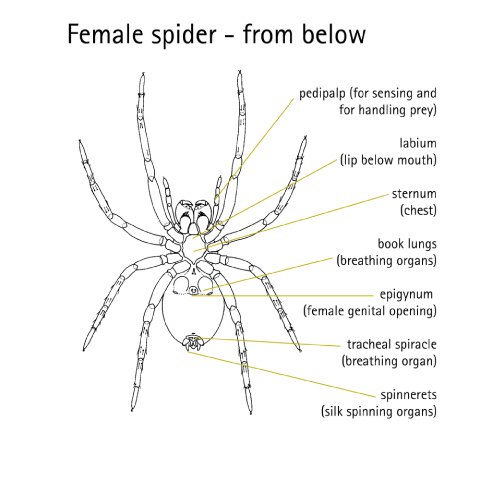
Caption: A look at the real-life anatomy of a spider, including the spinnerets that produce silk. Source: The Australian Museum
Where to Find Spider-Man
Spider-Man is a character with a rich history across multiple media. Here’s where you can find him:
- Comics: Read Spider-Man’s latest adventures in the ongoing The Amazing Spider-Man series from Marvel Comics, available at comic shops and on digital platforms like Marvel Unlimited.
- Films: His most recent solo outing in the Marvel Cinematic Universe is Spider-Man: No Way Home, with a new MCU film on the way. The animated Spider-Verse films offer a distinctive, multiverse-spanning take on the character.
- TV Shows: Numerous animated series exist, from the classic 1960s show to The Spectacular Spider-Man, Ultimate Spider-Man, and Disney+’s Your Friendly Neighborhood Spider-Man.
Bigger Context
Spider-Man isn’t just a popular superhero; he’s a cultural icon whose stories explore responsibility, sacrifice, and the messy work of growing up. His powers, while fantastical, are rooted enough in the natural world to make him a unique bridge between science fiction and science fact. That connection has made him a favorite subject for scientific analysis, letting experts use a beloved character to engage the public in real conversations about biology, physics, and engineering.
From a publishing perspective, Spider-Man remains one of Marvel’s most valuable properties. His evergreen status means his comics, merchandise, and film adaptations consistently perform, making him a cornerstone of the Marvel brand. The scientific accuracy—or lack thereof—of his powers only adds to his appeal, sparking curiosity and debate among fans of every age. If you enjoy powers grounded in real forces, you may also like our guide to the best electricity superheroes.
Frequently Asked Questions
Q: What are Spider-Man’s powers?
A: Spider-Man’s core powers are wall-crawling, proportional superhuman strength (he can lift roughly ten tons), a precognitive spider-sense that warns him of danger, enhanced agility and reflexes, accelerated healing and durability, and web-slinging — either through self-built mechanical web-shooters (classic comics and the MCU) or organic wrist-webbing (the Raimi films). About half of these have real biological or material-science parallels.
Q: Could a person really get superpowers from a spider bite?
A: No. Geneticists explain that while it is theoretically possible to transfer genes using a virus (a process called transduction), the venom would have to rewrite the DNA in every single cell of the body, which realistically could only happen at the embryonic stage. Even then, the likely result would be a very hairy person—not a superhero.
Q: Is spider silk really as strong as the movies show?
A: Yes, and then some. Spider silk is the strongest known natural fiber, tougher than steel by weight and more elastic than nylon. Scientists have calculated that a single strand could support a human, and a web could plausibly handle the weight of a bus—making web-slinging Spider-Man’s most scientifically defensible power.
Q: What about his spider-sense? Is that a real spider ability?
A: The precognition is pure science fiction. Real spiders have incredibly sensitive hairs and slit sensilla that detect minute vibrations in the air and on their webs, but they possess no ability to foresee future events or receive a danger warning before something happens.
Q: Does Spider-Man shoot webs from his body or from a device?
A: It depends on the version. In the original Stan Lee and Steve Ditko comics, Peter Parker is a science whiz who builds mechanical web-shooters and invents his own web fluid. Sam Raimi’s 2002 film gave him organic web-shooters as a mutation, while the Ultimate comics and the MCU’s Tom Holland returned to mechanical shooters. Scientifically, the mechanical version is far more plausible.