Fire has fascinated humanity since the first spark lit our caves. In comics, TV, movies, and anime, fire-powered heroes channel that same primal force—creation and destruction, hope and danger—into iconic abilities. From Marvel’s Phoenix Force and DC’s Firestorm to anime legends like Natsu Dragneel and classics like the Human Torch, these characters showcase fire’s beauty and terror in countless forms.
But the greatest fire-based superheroes aren’t just walking flamethrowers—they’re defined by powerful stories, cultural impact, and the balance between fire’s creative and destructive potential.
In this ranking, we spotlight 30 of the most legendary fire-wielders across all media. From street-level pyros to cosmic entities that reshape reality, these heroes prove why fire remains one of storytelling’s most captivating elements.
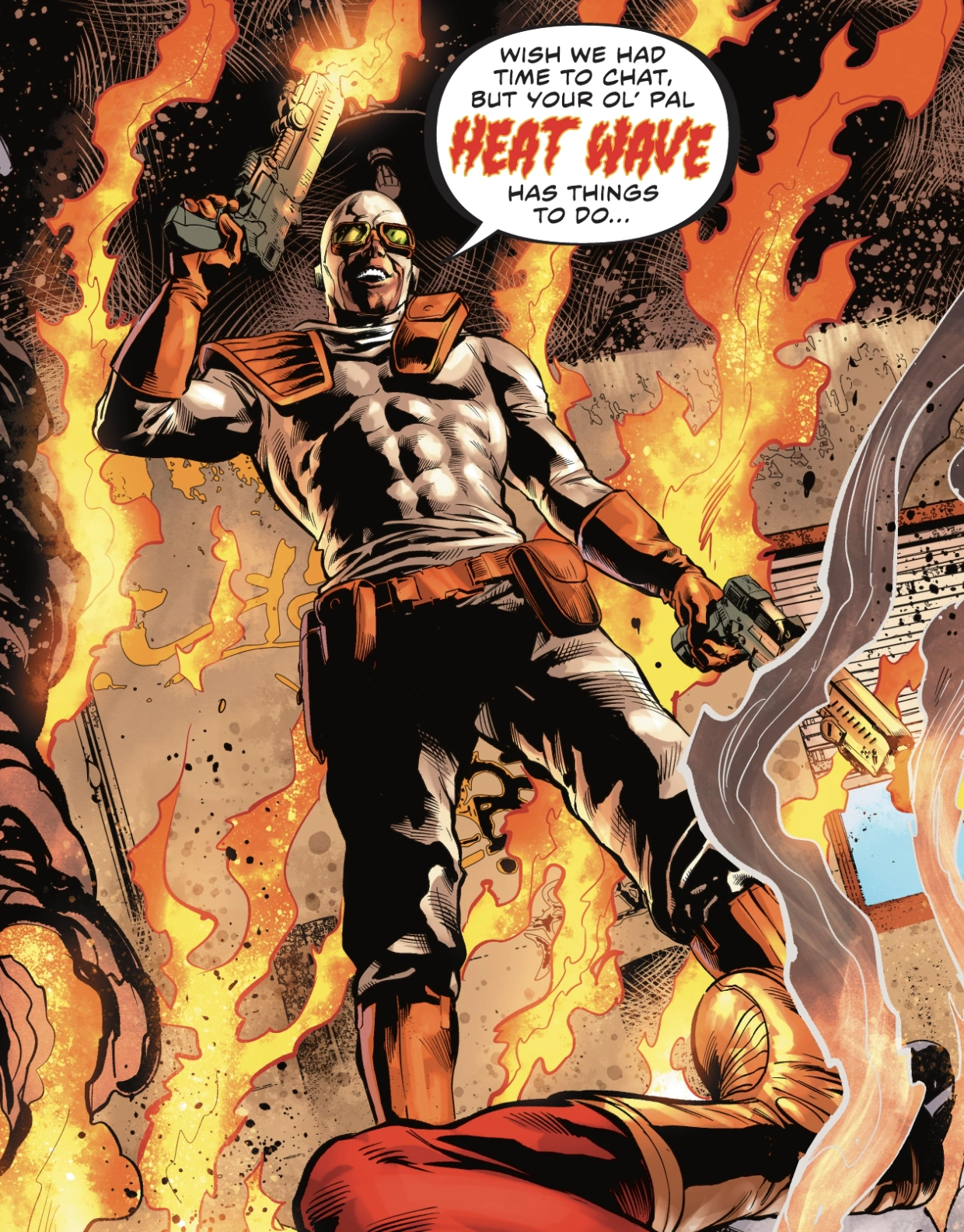
30. Heat Wave – The Pyromaniac Who Burns Bright in The Flash’s Rogues Gallery
Source: dc.fandom.com
Mick Rory’s transformation into Heat Wave represents one of comic books’ most psychologically complex fire-based characters. Unlike heroes who gained their powers through cosmic accidents or genetic mutations, Heat Wave’s abilities stem from pure human obsession with fire, making him a uniquely grounded yet dangerous adversary in The Flash’s rogues gallery.
Heat Wave’s origin story reads like a psychological thriller. As a child, Mick Rory became fascinated with fire to an unhealthy degree, ultimately burning down his family home in a moment of pyromaniacal compulsion. The trauma was compounded when he was locked in a freezer as punishment, developing an intense fear of cold that would define his criminal career. This psychological foundation makes Heat Wave more than just another villain with a gimmick—he’s a character driven by genuine mental illness and obsession.
In his original incarnation, Heat Wave possessed no metahuman abilities, relying instead on advanced pyrotechnic technology. His signature flamethrower could project flames exceeding 900 degrees Fahrenheit, hot enough to melt The Flash’s friction-proof boots—no small feat considering the speed force protection they provide. His asbestos suit not only protected him from his own flames but could project heat to counter cold attacks, neutralize projectiles, or melt through virtually any barrier.
The New 52 continuity elevated Heat Wave’s threat level by giving him actual metahuman abilities. After merging his DNA with his flamethrower technology, he gained the power to project and manipulate fire directly from his body, transforming him from a well-equipped criminal into a genuine fire-powered supervillain. This evolution demonstrates how even established characters can be reinvented while maintaining their core identity.
Heat Wave’s role in The Flash’s rogues gallery cannot be overstated. As the pyromaniacal counterpart to Captain Cold, he represents fire’s chaotic, destructive potential. His strategic mind, combined with his intimate knowledge of fire and pyrotechnics, makes him a formidable opponent even for the Fastest Man Alive. The Rogues’ code of honor and their complex relationship with Central City adds layers to Heat Wave’s character that elevate him beyond simple villainy.
His appearances in the Arrowverse, particularly in “The Flash” and “Legends of Tomorrow” television series, brought Heat Wave to mainstream audiences. Dominic Purcell’s portrayal emphasized the character’s working-class background and psychological complexity, making him surprisingly sympathetic despite his criminal nature. This adaptation proved that even lower-tier comic book characters could find new life in different media when their core concepts are strong.
Heat Wave earns his place at number 30 not for raw power, but for his unique perspective on fire as both weapon and obsession. He represents the dangerous allure of flame and the thin line between fascination and destruction. In a genre filled with cosmic-powered beings, Heat Wave reminds us that sometimes the most compelling characters are those driven by very human obsessions taken to superhuman extremes.
29. Burnout – The Plasma-Powered Heart of Gen 13

Source: writeups.org
Robert “Bobby” Lane, known as Burnout, emerged from the creative explosion of 1990s comics as a founding member of Gen 13, one of WildStorm’s most successful superhero teams. As the son of John Lynch, a super-powered member of the legendary Team 7, Bobby inherited a legacy of power that would define his role as one of comics’ most versatile fire-wielders.
Burnout’s powers stem from the Gen 13 experiments, part of Project: Genesis, which triggered his latent abilities inherited from his father’s genetic modifications. Unlike many fire-based heroes who simply generate flames, Burnout possesses true pyrokinesis—the ability to create high-energy plasma that bursts into flame when exposed to oxygen. This scientific approach to fire powers sets him apart from more mystical or mutation-based fire heroes.
The versatility of Burnout’s abilities places him among the most tactically flexible fire-powered heroes. His plasma generation allows him to create searing thermal energy blasts for offense, protective fire shields for defense, and even achieve flight by superheating the air around him, reaching speeds over 388 kilometers per hour. His ability to produce radiation and generate intense heat without direct contact makes him effective in both close combat and long-range engagements.
What makes Burnout particularly compelling is his role within Gen 13’s team dynamic. While characters like Grunge provided comic relief and Fairchild served as the team’s heart, Burnout often acted as the group’s conscience and emotional anchor. His powers, while destructive, were always tempered by his strong moral compass and protective instincts toward his teammates. This balance between power and responsibility exemplifies the best traditions of superhero storytelling.
Burnout’s character development through major WildStorm events showcased his resilience and growth. During the Worldstorm event, he demonstrated his ability to adapt and evolve with changing circumstances. The World’s End storyline, where he was blinded but continued to assist his teammates, proved that his heroism transcended his physical abilities. This character growth from a relatively simple fire-powered teenager to a mature hero facing cosmic-level threats illustrates the potential for character development in team-based comics.
The WildStorm Universe’s integration into the DC Comics continuity has given Burnout’s legacy new relevance. As part of the rich tapestry of characters that Jim Lee, Brandon Choi, and J. Scott Campbell created, Burnout represents the 1990s comic book industry’s willingness to experiment with new concepts and character dynamics. His plasma-based powers and team-first mentality influenced subsequent generations of fire-powered heroes.
Burnout’s ranking at number 29 reflects his significant but specialized impact on comic book history. While he may not possess the cosmic-level powers of higher-ranked characters, his comprehensive control over plasma and fire, combined with his role in one of the decade’s most popular superhero teams, secures his place among the great fire-based heroes. His story demonstrates that heroism isn’t just about raw power—it’s about how that power is used to protect others and grow as a person.
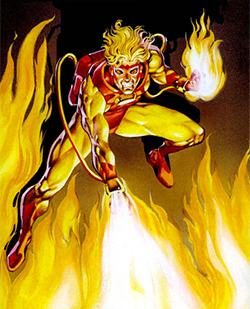
28. Pyro – The Fire-Shaping Master of Mutant Mayhem
Source: Wikipedia
St. John Allerdyce, better known as Pyro, represents one of the most tactically sophisticated fire-wielders in the Marvel Universe. Unlike heroes who generate their own flames, Pyro’s unique limitation—his inability to create fire, only manipulate existing flames—has forced him to develop an unparalleled mastery over fire control that sets him apart from other pyrokinetic characters.
Pyro’s origin as an Australian mutant whose powers manifested at puberty follows the classic X-Men template, but his character development took a distinctly different path. Rather than joining Xavier’s school or becoming a traditional superhero, Allerdyce drifted through various careers, including journalism and novel writing, before finding his true calling as a member of Mystique’s Brotherhood of Evil Mutants. This background as a creative professional adds intellectual depth to his character that many fire-based villains lack.
The sophistication of Pyro’s fire manipulation abilities cannot be overstated. While he cannot generate flames, his control over existing fire is absolute and artistically inspired. He can cause flames to grow exponentially in size and intensity, shape them into complex constructs like gigantic claws, birds, or humanoid golems, and even solidify his fiery creations to physically grasp and manipulate objects or enemies. This level of control requires not just power, but genuine artistic vision and tactical intelligence.
Pyro’s fire invulnerability adds another layer to his abilities. He can absorb and redirect any flames he has placed under his control, making him nearly impossible to defeat using fire-based attacks. This defensive capability, combined with his offensive versatility, makes him a formidable opponent even for heroes with superior raw power. His battles with the X-Men and Avengers have consistently demonstrated that tactical skill can overcome brute force.
The character’s evolution through different team affiliations showcases his complexity. His time with the Brotherhood of Evil Mutants established him as a credible threat to the X-Men, while his later service with Freedom Force as a federal agent added moral ambiguity to his character. This willingness to work within the system, even temporarily, suggests depths beyond simple villainy and reflects the complex political themes that make X-Men comics compelling.
Pyro’s struggle with the Legacy Virus added tragic dimension to his character. Watching this master of fire slowly succumb to a disease that his powers couldn’t combat provided powerful storytelling opportunities and humanized a character who could have remained a one-dimensional villain. His eventual death and subsequent resurrection by Selene, followed by his recruitment into the Marauders on Krakoa, demonstrates the character’s enduring appeal and narrative potential.
The character’s portrayal in the X-Men film series, while significantly different from his comic book counterpart, introduced Pyro to mainstream audiences and showcased the visual spectacular potential of his powers. The films’ emphasis on his fire manipulation abilities, even if they simplified his character, proved that Pyro’s unique power set could translate effectively to other media.
Pyro earns his position at number 28 through his unmatched precision and artistry in fire manipulation. While other characters may generate more powerful flames or possess additional abilities, few can match Pyro’s tactical flexibility and creative application of his powers. His character represents the idea that limitations can breed innovation, and that mastery comes not from raw power but from understanding and skill. In a universe filled with cosmic-level threats, Pyro proves that a well-trained mutant with a specific skill set can still be a force to be reckoned with.
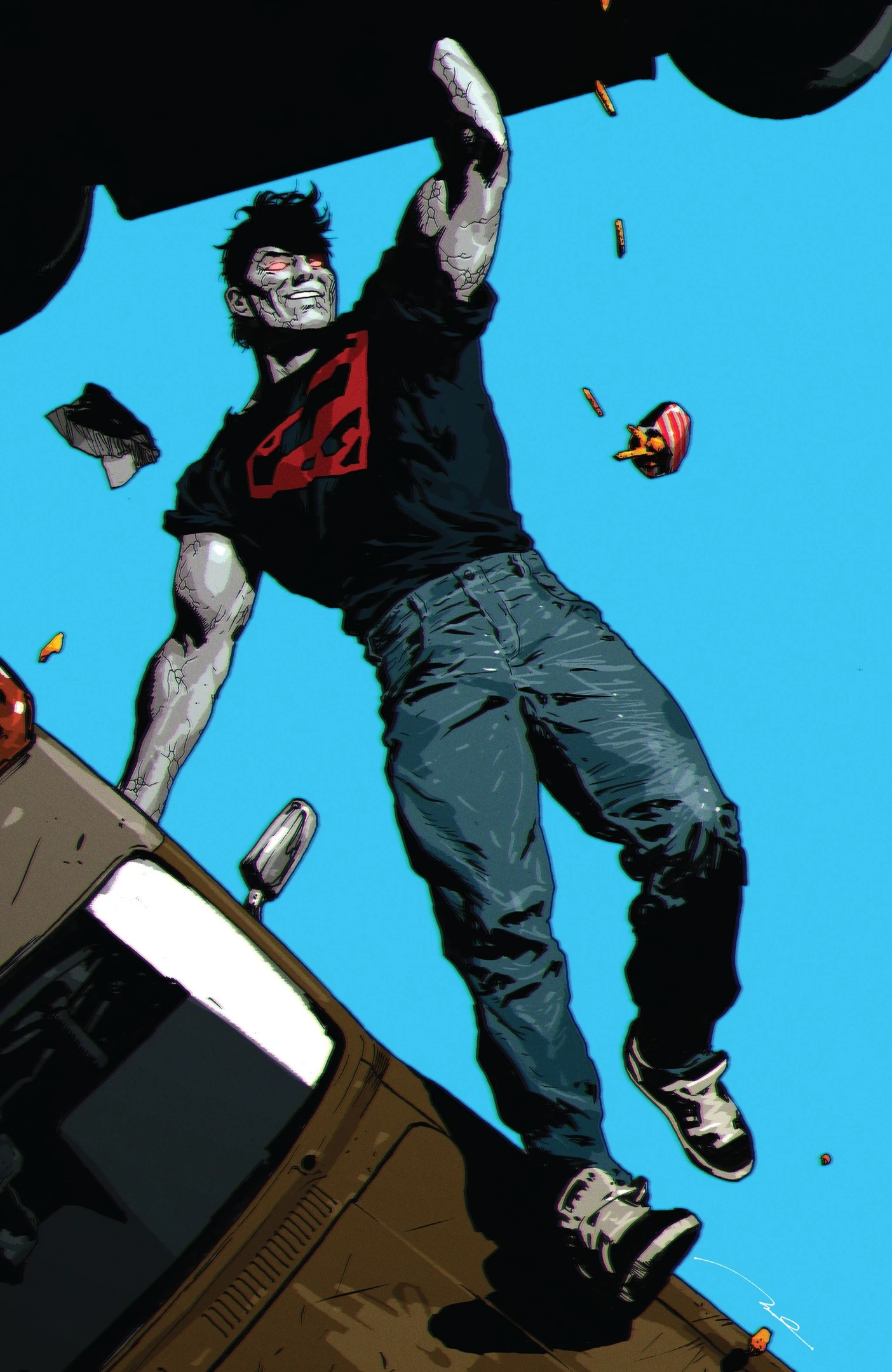
27. Match – The Imperfect Clone Seeking Perfect Heroism
Source: DC Comics
In the complex world of superhero cloning, few characters embody the struggle for identity and purpose as poignantly as Match. Created by the criminal organization Agenda as an improved version of Superboy, Match’s journey from brainwashed weapon to heroic Suicide Squad member represents one of DC Comics’ most compelling explorations of what it means to be human when you’re anything but.
Match’s origin story delves deep into the ethical implications of cloning and genetic manipulation. Unlike Superboy, who was created with the best intentions by Project Cadmus, Match was designed by criminals specifically to be “better and stronger” than the original. Initially brainwashed to believe he was the real Superboy, Match was treated with experimental serums to stabilize his appearance and speech, highlighting the artificial nature of his existence and the lengths his creators went to perfect their weapon.
The revelation of his true nature as an imperfect clone marked a turning point in Match’s character development. Learning that he was essentially a Bizarro-like duplicate of Superboy could have driven him to villainy or despair, but instead, Match chose the path of heroism. This decision to define himself by his actions rather than his origins speaks to the character’s inherent nobility and represents a powerful message about self-determination and personal growth.
Match’s heat vision, while a standard Kryptonian ability, takes on special significance in the context of his character arc. As an imperfect clone struggling with his Bizarro-like transformation, his mastery of this fire-based power becomes a symbol of his determination to be a hero despite his flawed creation. The precision and control he maintains over his heat vision, even as other aspects of his physiology become unstable, demonstrates his unwavering commitment to using his powers responsibly.
His recruitment into the Suicide Squad adds another layer to Match’s story. Task Force X traditionally recruits villains and anti-heroes, but Match’s inclusion suggests that even heroes can find themselves in morally ambiguous situations. His willingness to work with criminals and killers to serve the greater good showcases his pragmatic approach to heroism and his understanding that sometimes doing the right thing requires difficult choices.
The visual impact of Match’s Bizarro-like transformation cannot be understated. His deteriorating appearance serves as a constant reminder of his artificial nature and the instability inherent in his creation. Yet rather than hiding from his condition, Match embraces it as part of his identity. This acceptance of his flaws while striving to be better makes him a compelling character for readers who struggle with their own imperfections.
Match’s relationship with Conner Kent (Superboy) provides rich storytelling opportunities. As clones of the same genetic template, they share a unique bond while representing different paths that artificial life can take. Match’s respect for Conner and his determination to forge his own heroic legacy, rather than compete with or replace the original, demonstrates remarkable maturity and self-awareness.
In the broader context of DC’s clone characters, Match stands out for his positive character development. While characters like Bizarro often serve as comic relief or tragic figures, Match has consistently chosen growth and heroism. His evolution from brainwashed weapon to willing hero represents hope for redemption and the power of choice over circumstance.
Match earns his position at number 27 not for the raw power of his heat vision, but for what his character represents. In a genre often focused on the naturally gifted or the accidentally empowered, Match reminds us that heroism is a choice that must be made daily, regardless of one’s origins or limitations. His story proves that even imperfect creations can achieve perfect moments of heroism.
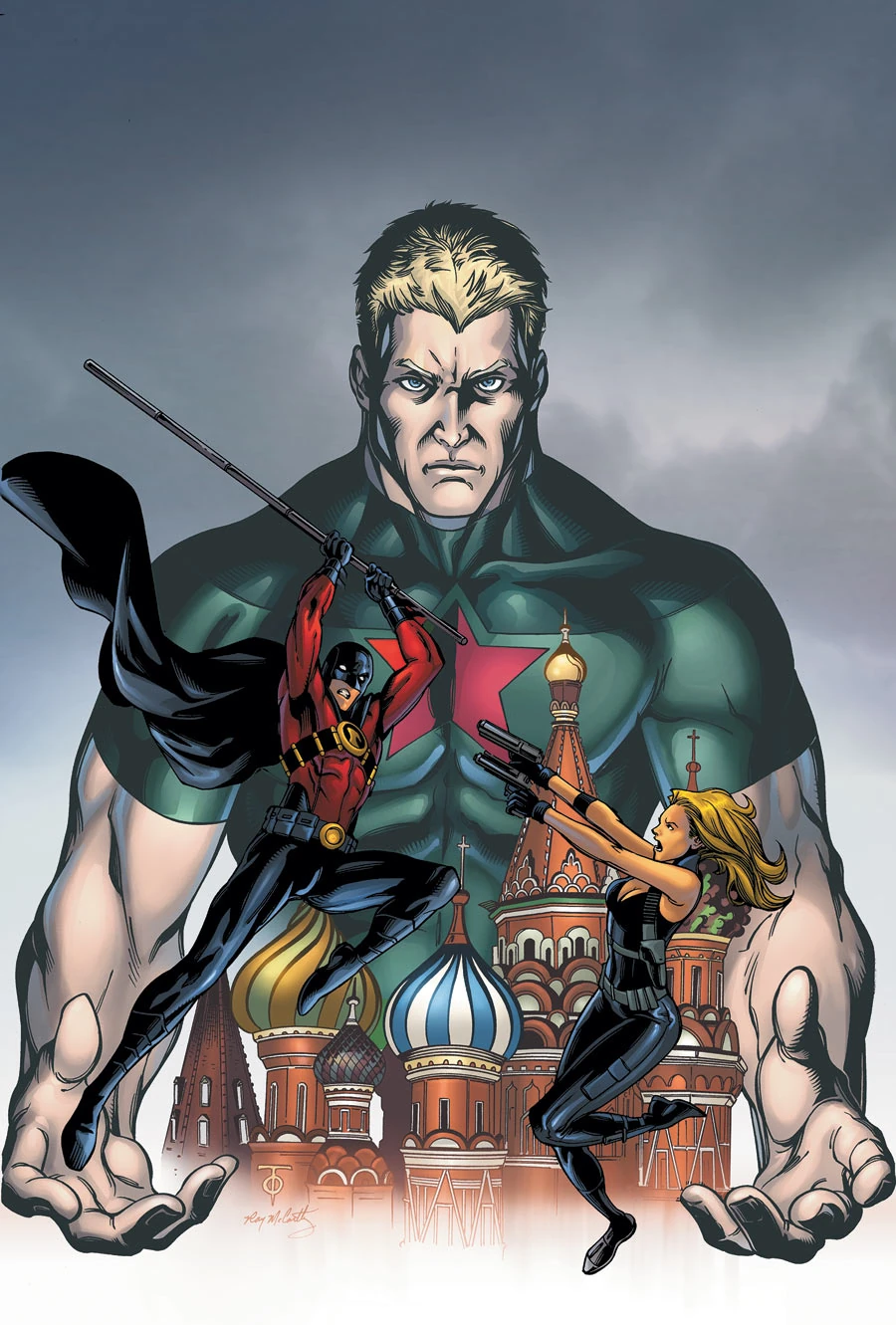
26. Red Star – The Soviet Superhero Who Bridged Two Worlds
Source: DC Comics
Leonid Konstantinovitch Kovar, known as Red Star, holds the distinction of being the first official Russian superhero in the DC Universe. His journey from Soviet patriot to Teen Titans member represents not just personal growth, but a fascinating exploration of how superhero comics can reflect and transcend real-world political tensions during one of history’s most divisive periods.
Red Star’s origin story perfectly captures the science fiction sensibilities of the Silver Age while providing a uniquely international perspective. As a teenager, Leonid and his father investigated a crashed alien spaceship—a scenario that could have happened to any young hero. However, the explosion that granted him his powers occurred in the Soviet Union, immediately setting him apart from his American counterparts and establishing him as a representative of a different ideological system.
The scope of Red Star’s abilities extends far beyond simple fire generation. His pyrokinesis is complemented by heat generation and radiation manipulation, creating a power set that reflects both the promise and the danger of atomic energy. This combination of abilities makes him particularly formidable, as he can attack with fire, defend with heat barriers, and potentially cause long-term damage through radiation exposure. His powers serve as a metaphor for the nuclear age and the double-edged nature of atomic energy.
Red Star’s initial codename, Starfire, and his subsequent change to Red Star, illustrates the evolving nature of comic book characters and their need to establish unique identities. The name change also reflects his strong patriotic beliefs and communist ideology, which initially caused friction with other heroes but ultimately added depth to his character. His willingness to work with capitalist heroes despite ideological differences demonstrates that heroism transcends political systems.
His integration into the Teen Titans marked a significant moment in DC Comics history. During the height of the Cold War, having a Soviet superhero join an American superhero team was a bold storytelling choice that reflected hopes for international cooperation and understanding. Red Star’s presence on the team challenged both his teammates and readers to look beyond political labels and focus on shared values of justice and protection of the innocent.
Red Star’s appearances in major DC events, including the JLA/Titans miniseries, Infinite Crisis, and Doomsday Clock, demonstrate his lasting relevance in the DC Universe. His consistent portrayal as a hero who puts global welfare above national interests makes him particularly valuable in stories dealing with international threats. His unique perspective as someone from outside the traditional American superhero establishment adds authenticity to global storylines.
The character’s design and visual presentation effectively communicate his Soviet origins while maintaining superhero appeal. His costume incorporates elements of Russian military tradition while featuring the bright colors and dynamic styling typical of superhero comics. This balance between cultural authenticity and genre conventions makes Red Star instantly recognizable while respecting his heritage.
Red Star’s radiation-based powers add a scientific complexity to his fire abilities that sets him apart from more straightforward pyrokinetic characters. His understanding of atomic energy and its applications makes him valuable not just in combat situations, but in scenarios requiring scientific knowledge or dealing with nuclear threats. This intellectual component to his powers elevates him beyond simple muscle and establishes him as a strategic asset.
His relationships with other international heroes, particularly his fellow Teen Titans, showcase his ability to build bridges across cultural divides. Red Star’s loyalty to his teammates, despite occasional ideological conflicts, demonstrates that personal bonds can overcome political differences. His character serves as a reminder that heroism is a universal concept that transcends national boundaries.
Red Star claims position number 26 through his unique combination of powerful abilities, cultural significance, and historical importance. As the first Soviet superhero in mainstream American comics, he broke new ground and opened doors for more diverse international representation in the genre. His radiation-enhanced fire powers, combined with his role as a cultural ambassador and bridge-builder, make him a distinctive and valuable member of the fire-powered hero community.
25. Atomic Skull – The Radioactive Menace with Purple Fire

The Atomic Skull represents one of DC Comics’ most enduring symbols of nuclear anxiety, embodying the fears and fascination surrounding atomic energy that defined much of the Cold War era. Joseph Martin’s transformation from promising student to radioactive supervillain serves as a cautionary tale about the uncontrolled power of atomic energy and its potential to corrupt both body and mind.
Joseph Martin’s origin story reads like a science fiction horror tale. As a student at S.T.A.R. Labs, he was exposed to an intense blast of energy from the Dominators’ gene-bomb, an event that granted him superhuman abilities while simultaneously damaging his brain. This duality—gaining power while losing humanity—makes Atomic Skull a tragic figure whose villainy stems from mental illness rather than pure evil. His adoption of the Atomic Skull persona from a film serial he admired adds a layer of pop culture commentary to his character.
The visual impact of Atomic Skull cannot be overstated. His skeletal appearance, glowing with radioactive energy, creates an immediately recognizable and genuinely frightening antagonist. The purple atomic energy that emanates from his form serves both as a power source and a constant reminder of the radiation that created and sustains him. This design effectively communicates the character’s atomic theme while creating a memorable visual that has endured across multiple decades and continuities.
Atomic Skull’s powers center around his ability to project powerful blasts of purple atomic energy from his hands or mouth. These energy projections are not merely destructive—they represent the raw power of atomic fission made manifest. The purple coloration of his energy blasts distinguishes them from other energy-based attacks in the DC Universe and creates a unique visual signature that makes his appearances instantly recognizable.
His immense strength, stamina, and durability complement his energy projection abilities, making him a formidable physical threat even without his atomic powers. This combination of brute force and energy manipulation has made him a recurring challenge for Superman, one of the few heroes capable of withstanding both his physical assaults and his radioactive attacks. The fact that he can pose a genuine threat to the Man of Steel speaks to the considerable power level he represents.
The character’s enhancement during the “Underworld Unleashed” storyline, where he gained additional powers from the demon Neron, demonstrates his potential for growth and evolution. His brief attempt to become a superhero during this period adds complexity to his character and suggests that his villainy may be more circumstantial than inherent. This moral ambiguity makes him more interesting than a simple monster and provides opportunities for redemption storylines.
The New 52 continuity’s reimagining of Atomic Skull as a S.T.A.R. Labs scientist who gained powers from experimental radiation during a submarine crash shows the character’s adaptability to different storytelling approaches. This version maintains the core concept of atomic-powered abilities while updating the origin for modern audiences. The consistency of his atomic theme across different continuities demonstrates the strength of his core concept.
Atomic Skull’s role as a reflection of nuclear anxiety gives him cultural significance beyond his individual storylines. Created during an era when nuclear war was a constant threat and atomic energy represented both promise and peril, he embodies society’s complex relationship with atomic power. His character serves as a reminder that scientific advancement without proper safeguards can lead to catastrophic consequences.
His appearances in various DC media, including animated series and video games, have helped maintain his relevance for new generations of fans. These adaptations often emphasize his visual spectacle and his role as a powerful antagonist, proving that his core concept translates well across different media formats. His consistent portrayal as a formidable foe helps establish his place in DC’s rogues gallery.
The character’s mixed critical reception reflects the challenges of balancing his symbolic importance with compelling storytelling. While some view him as a one-dimensional monster, others appreciate his role as a symbol of atomic age fears and his potential for character development. This divided opinion actually adds to his complexity and ensures ongoing discussion about his place in DC continuity.
Atomic Skull earns position number 25 through his unique combination of atomic-powered abilities, striking visual design, and cultural significance. While he may not possess the heroic qualities of higher-ranked characters, his role as a symbol of nuclear anxiety and his formidable power set make him an important figure in the landscape of fire and energy-based characters. His purple atomic fire represents a distinctive take on energy manipulation that sets him apart from other radioactive characters in comics.
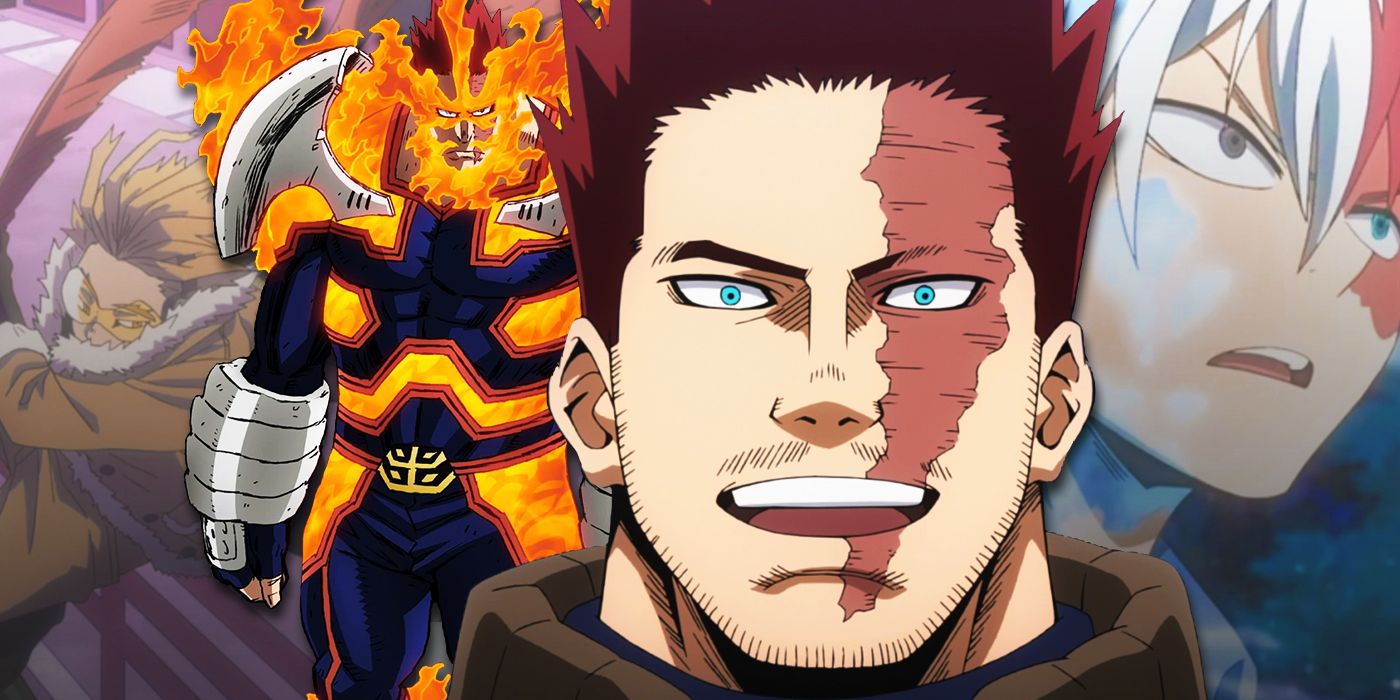
24. Endeavor – The Flawed Hero Burning Bright with Hellflame
Source: CBR
Enji Todoroki, known professionally as Endeavor, represents one of anime’s most complex and controversial fire-powered heroes. As the wielder of the “Hellflame” Quirk and the current No. 1 Pro Hero in My Hero Academia, Endeavor’s journey from obsessed rival to reluctant Symbol of Peace showcases how even the most flawed individuals can strive for redemption while wielding incredible power.
Endeavor’s origin story is rooted in obsession and the corrupting nature of unchecked ambition. His desperate desire to surpass All Might led him down a dark path of eugenics and abuse, as he sought to create the “perfect” hero through selective breeding. His marriage to Rei, an ice Quirk user, was calculated to produce a child with both fire and ice abilities who could achieve what he could not. This utilitarian approach to family and heroism makes him one of the most morally complex characters in superhero fiction.
The “Hellflame” Quirk represents one of the most visually spectacular and versatile fire-based powers in any medium. Endeavor can generate and manipulate intense flames from his body, primarily his hands and feet, with temperatures that far exceed normal fire. His flames are not merely hot—they’re described as hellish in their intensity, capable of melting through virtually any material and creating devastating area-of-effect attacks that can level city blocks.
The tactical applications of Endeavor’s Hellflame abilities demonstrate his strategic mind and professional expertise. He can create fiery projectiles for ranged combat, enhance his physical attacks with superheated flames, and propel himself through the air with controlled flame bursts. His ability to control both the temperature and intensity of his flames allows for precise applications, from surgical strikes to overwhelming area denial. This level of control reflects decades of professional hero experience and training.
Endeavor’s signature techniques showcase the full potential of his Quirk. “Prominence Burn,” his ultimate attack, concentrates his flames into a devastating blast of superheated energy capable of defeating even the most powerful villains. “Flashfire Fist” demonstrates his tactical innovation, rapidly igniting and extinguishing his flames to deliver punches with explosive force. These techniques prove that raw power alone isn’t enough—true mastery requires creativity and strategic thinking.
The character’s rise to the No. 1 Hero position following All Might’s retirement creates a compelling narrative tension. Unlike All Might, who was beloved by the public and served as an inspiring Symbol of Peace, Endeavor must overcome his reputation as a harsh, results-focused hero who lacks the charisma and moral authority of his predecessor. His struggle to fill All Might’s shoes while dealing with his own past mistakes adds depth to his character arc.
Endeavor’s relationship with his family, particularly his son Shoto, provides the emotional core of his character development. His recognition of the abuse he inflicted and his genuine efforts to make amends demonstrate that even deeply flawed individuals can change. His journey toward becoming a better father and husband while maintaining his effectiveness as a hero creates compelling internal conflict that elevates him beyond a simple power fantasy.
His battles against high-level threats like the High-End Nomu Hood and his participation in the war against All For One showcase his incredible combat capabilities. These fights demonstrate not just his raw power, but his tactical acumen, leadership skills, and willingness to sacrifice himself for others. His performance in these critical moments proves that despite his personal failings, he possesses the skills and determination necessary to protect society.
The cultural impact of Endeavor’s character extends beyond typical superhero narratives. His story addresses themes of toxic masculinity, the cycle of abuse, and the possibility of redemption that resonate with adult audiences. His character arc suggests that people can change and grow, even after causing significant harm, while acknowledging that redemption requires genuine effort and may never fully erase past mistakes.
Endeavor’s visual design perfectly communicates his character themes. His flame-covered beard and intense expression convey both power and barely contained emotion, while his professional hero costume suggests competence and authority. The way his flames respond to his emotional state—burning brighter when he’s determined, dimming when he’s uncertain—creates a visual language that enhances storytelling without requiring dialogue.
His role as a mentor to younger heroes, including his son Shoto and other students, demonstrates his capacity for growth and his understanding that true heroism involves nurturing the next generation. His teaching methods, while still demanding, show more consideration for his students’ emotional well-being than his earlier parenting approach, suggesting genuine personal development.
Endeavor claims position number 24 through his combination of overwhelming power, complex character development, and cultural significance. His Hellflame Quirk ranks among the most impressive fire-based abilities in any medium, while his journey from flawed individual to reluctant hero provides compelling storytelling that transcends typical superhero narratives. His character proves that heroism isn’t about perfection—it’s about the willingness to acknowledge mistakes, strive for improvement, and use one’s power to protect others, regardless of personal cost.
23. Roy Mustang – The Flame Alchemist’s Precise Inferno
Source: Reddit
Colonel Roy Mustang, the Flame Alchemist, stands as one of anime’s most tactically sophisticated fire-wielders and a masterclass in how scientific principles can enhance supernatural abilities. His flame alchemy represents not just raw destructive power, but a precise, calculated approach to combat that combines chemistry, strategy, and showmanship in equal measure.
Mustang’s origin story is deeply rooted in the military culture and political intrigue of the Fullmetal Alchemist universe. Raised by his paternal aunt Madame Christmas after his parents’ death, he later apprenticed under Berthold Hawkeye to learn alchemy. His experiences in the Ishval Civil War fundamentally shaped his worldview, transforming him from an idealistic young soldier into a pragmatic leader determined to reform the military from within. This background gives weight to his use of destructive power and explains his careful consideration of when and how to employ his abilities.
The mechanics of Mustang’s flame alchemy demonstrate a sophisticated understanding of combustion science. Rather than generating fire from nothing, he manipulates the oxygen density in the air using alchemical transmutation, creating pathways of highly concentrated oxygen. His special ignition cloth gloves create sparks when he snaps his fingers, igniting these oxygen-rich pathways to produce controlled explosions and flame jets. This scientific approach to fire manipulation sets him apart from more mystical fire-wielders and adds intellectual depth to his combat style.
The precision of Mustang’s flame control is perhaps his most impressive attribute. He can create everything from surgical strikes that target specific enemies without harming nearby allies to widespread explosions that can level entire buildings. His ability to delegate different flame effects to each hand showcases his dexterity and tactical flexibility. This level of control requires not just alchemical knowledge but also exceptional spatial awareness and strategic thinking.
Mustang’s role in the Elric brothers’ story provides multiple opportunities to demonstrate his abilities and character growth. Initially appearing as their superior officer with his own agenda, he evolves into a key ally whose support proves crucial in their quest. His major storylines, including his involvement in the Ishval Civil War, his ambition to become Führer, and his confrontations with the Homunculi, showcase different aspects of his character and abilities.
The character’s confrontation with Envy represents one of anime’s most emotionally powerful displays of fire-based revenge. When he discovers that Envy killed his best friend Maes Hughes, Mustang’s controlled demeanor gives way to terrifying fury. His systematic incineration of Envy, while morally questionable, demonstrates the full extent of his power and the danger of his emotional investment in his goals. This scene perfectly balances spectacular action with character development and moral complexity.
Mustang’s leadership style and political ambitions add layers to his character that extend beyond his combat abilities. His goal of becoming Führer to reform Amestris from within shows his understanding that lasting change requires institutional power, not just individual strength. His ability to inspire loyalty in his subordinates, particularly his team of specialists, demonstrates leadership skills that complement his alchemical abilities.
The visual presentation of Mustang’s flame alchemy is consistently spectacular throughout the series. The distinctive snapping gesture that triggers his attacks has become iconic, while the precise, controlled nature of his flames creates visually striking combat sequences. The contrast between his calm demeanor and the devastating power he wields creates dramatic tension that enhances every scene he appears in.
His relationship with Riza Hawkeye adds emotional depth to his character and provides insight into his moral compass. As his bodyguard and closest confidant, Hawkeye serves as both his protector and his conscience, willing to kill him if he strays too far from his ideals. This relationship demonstrates that even the most powerful individuals need others to keep them grounded and accountable.
Mustang’s character development throughout the series shows his growth from a ambitious officer to a true leader. His willingness to sacrifice his eyesight to save his friends during the final battle against Father demonstrates that he has learned to value relationships over personal ambition. This character growth, combined with his formidable abilities, makes him a compelling and well-rounded character.
The cultural impact of Roy Mustang extends far beyond the Fullmetal Alchemist series. His combination of military bearing, strategic intelligence, and devastating power has influenced numerous subsequent anime characters. His flame alchemy has become a benchmark for how scientific principles can enhance supernatural abilities, inspiring similar approaches in other series.
Roy Mustang earns position number 23 through his unique combination of scientific fire manipulation, tactical brilliance, and compelling character development. His flame alchemy represents one of the most intellectually sophisticated approaches to fire-based powers in any medium, while his role in Fullmetal Alchemist’s complex political narrative demonstrates how powerful abilities can serve larger storytelling purposes. His character proves that the most memorable fire-wielders are those who combine spectacular abilities with genuine depth and growth.
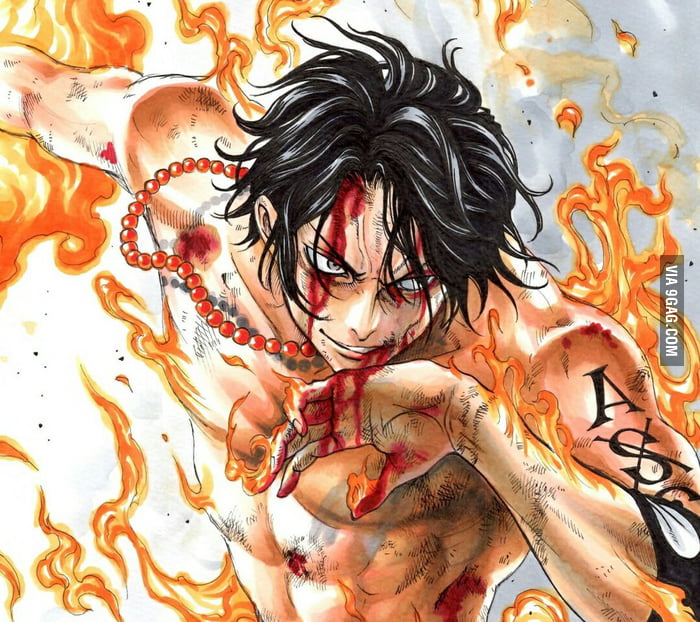
22. Ace – The Flame-Flame Fruit’s Burning Legacy
Source: 9GAG
Portgas D. Ace, known as “Fire Fist Ace,” represents one of anime’s most beloved and tragic fire-powered characters. As the wielder of the Flame-Flame Fruit (Mera Mera no Mi) in the One Piece universe, Ace’s mastery over fire and his role as Luffy’s sworn brother created some of the series’ most emotionally resonant moments while showcasing the spectacular potential of Devil Fruit powers.
Ace’s origin story is intricately woven into One Piece’s larger mythology, particularly the legacy of the Pirate King Gol D. Roger. As Roger’s son, Ace carried the burden of his father’s reputation while struggling to forge his own identity as a pirate. His adoption by the Whitebeard Pirates and his relationship with Monkey D. Luffy provided him with the family connections that defined his character and motivated his actions throughout his appearances in the series.
The Flame-Flame Fruit granted Ace complete control over fire, allowing him to generate, manipulate, and transform into flames at will. As a Logia-type Devil Fruit, it provided him with the ability to become intangible by transforming his body into fire, making most physical attacks pass harmlessly through him. This defensive capability, combined with his offensive fire powers, made him one of the most formidable pirates in the One Piece world.
Ace’s signature techniques demonstrate the creative potential of fire-based Devil Fruit powers. His “Fire Fist” attack could launch devastating columns of flame over vast distances, while “Flame Commandment” created walls of fire for both offense and defense. His “Great Flame Commandment: Flame Emperor” represented his ultimate technique, creating a massive fireball capable of devastating entire areas. These attacks showcased not just raw power but tactical versatility and creative application of his abilities.
The visual spectacle of Ace’s fire powers contributed significantly to One Piece’s reputation for dynamic action sequences. His flames were consistently portrayed as vibrant and alive, responding to his emotions and intentions in ways that enhanced the storytelling. The contrast between his calm demeanor and the explosive nature of his powers created compelling visual drama that made his fight scenes memorable and impactful.
Ace’s role in the Marineford War arc represents one of anime’s most emotionally devastating storylines. His capture and scheduled execution brought together the series’ most powerful characters in a massive battle that showcased the full extent of his abilities while building toward his tragic sacrifice. His final moments, protecting Luffy from Admiral Akainu’s magma attack, demonstrated that his greatest strength was not his fire powers but his love for his brother.
The character’s relationship with Luffy provides the emotional core of his story arc. Their bond as sworn brothers, forged in childhood and maintained despite their different paths as pirates, adds depth to both characters and creates stakes that extend beyond simple power levels. Ace’s protective instincts toward Luffy and his willingness to sacrifice himself for his brother’s safety demonstrate that his fire powers were always secondary to his capacity for love and loyalty.
Ace’s membership in the Whitebeard Pirates showcased his abilities in the context of one of the world’s most powerful pirate crews. His position as a division commander demonstrated his leadership capabilities and tactical acumen, while his interactions with other crew members revealed his charismatic personality and natural ability to inspire others. His loyalty to Whitebeard and his crew added another layer to his character beyond his individual abilities.
The philosophical implications of Ace’s powers and his struggle with his heritage add intellectual depth to his character. His fire abilities served as a metaphor for his passionate nature and his burning desire to prove himself worthy of love and respect despite his father’s legacy. His journey from self-doubt to self-acceptance, tragically cut short by his death, provides a compelling character arc that resonates with audiences.
Ace’s influence on the One Piece narrative extends far beyond his individual story arc. His death serves as a catalyst for Luffy’s character development and motivates many subsequent storylines. The Flame-Flame Fruit’s eventual consumption by Sabo creates ongoing connections to Ace’s legacy and ensures that his impact on the series continues even after his death.
The character’s design effectively communicates his fire-based abilities and his personality. His orange hat with sad and happy face badges, his shirtless appearance showing his Whitebeard tattoo, and his confident posture all contribute to a memorable visual that instantly identifies him as a fire-wielder. His character design balances approachability with power, making him both relatable and formidable.
Ace’s cultural impact within the One Piece fandom cannot be overstated. His death remains one of the series’ most shocking and emotionally affecting moments, generating ongoing discussion and analysis among fans. His character represents themes of family, legacy, and sacrifice that resonate across cultural boundaries and contribute to One Piece’s global appeal.
The technical aspects of Ace’s fire manipulation demonstrate Eiichiro Oda’s creativity in developing Devil Fruit powers. The Flame-Flame Fruit’s abilities are logically consistent while allowing for spectacular visual displays and creative combat applications. This balance between scientific plausibility and fantastical spectacle exemplifies One Piece’s approach to supernatural abilities.
Ace claims position number 22 through his combination of powerful fire abilities, compelling character development, and significant cultural impact. His mastery of the Flame-Flame Fruit represents one of anime’s most comprehensive displays of fire-based powers, while his role in One Piece’s narrative demonstrates how supernatural abilities can serve larger themes of family, sacrifice, and personal growth. His tragic story proves that the most memorable fire-wielders are those whose flames burn brightest in service of others.
21. Natsu Dragneel – The Dragon Slayer’s Roaring Flames

Source: Pinterest
Natsu Dragneel, the Fire Dragon Slayer of Fairy Tail, embodies the passionate, never-give-up spirit that defines shonen anime protagonists while wielding some of the most versatile and powerful fire magic ever depicted in the medium. His unique Dragon Slayer abilities, combined with his fierce loyalty to his guild and friends, have made him one of anime’s most recognizable and beloved fire-wielding heroes.
Natsu’s origin story intertwines personal tragedy with mystical destiny in classic fairy tale fashion. Raised by the fire dragon Igneel after losing his parents, Natsu learned Dragon Slayer magic that granted him not just the ability to wield fire, but to consume it for sustenance and power. This unique relationship with fire—treating it as both weapon and nourishment—sets him apart from other fire-wielders and creates interesting tactical possibilities in combat.
The scope of Natsu’s fire magic extends far beyond simple flame generation. His Dragon Slayer abilities allow him to breathe fire like a dragon, consume flames to restore his magical power, and enhance his physical capabilities with draconic strength and speed. His signature “Fire Dragon’s Roar” attack demonstrates the raw power of his abilities, while techniques like “Fire Dragon’s Iron Fist” show how he can combine fire magic with hand-to-hand combat for devastating effect.
Natsu’s emotional connection to his magic creates a unique power scaling system where his abilities grow stronger based on his feelings and determination. This emotional component to his fire magic means that his most spectacular displays of power often coincide with moments of intense personal stakes, creating natural climaxes in storytelling that feel both earned and spectacular. His flames literally burn brighter when he’s fighting for his friends and guild.
The evolution of Natsu’s abilities throughout the Fairy Tail series showcases impressive character growth and power development. From his initial Dragon Slayer magic to his acquisition of Lightning Flame Dragon Mode and eventually his transformation into END (Etherious Natsu Dragneel), his fire abilities have consistently expanded and adapted to meet greater challenges. This progression keeps his character relevant and exciting throughout the series’ long run.
Natsu’s role as a guild member of Fairy Tail adds a crucial social dimension to his character that many fire-wielders lack. His fierce loyalty to his guildmates and his willingness to risk everything for their safety demonstrates that his greatest strength isn’t his fire magic but his capacity for friendship and sacrifice. His relationships with characters like Lucy, Erza, and Gray provide emotional anchors that ground his spectacular abilities in human connections.
The visual presentation of Natsu’s fire magic consistently delivers spectacular action sequences that showcase the full potential of animated fire effects. His flames are portrayed as living, breathing entities that respond to his emotions and intentions, creating dynamic combat scenes that feel both powerful and personal. The distinctive pink color of some of his flames adds a unique visual signature that makes his attacks instantly recognizable.
Natsu’s battles against other Dragon Slayers and powerful enemies demonstrate the tactical applications of his fire magic. His ability to consume other types of fire to gain new abilities, such as his Lightning Flame Dragon Mode gained by consuming Laxus’s lightning, shows creative problem-solving and adaptability. These power combinations create visually stunning attacks while demonstrating his strategic thinking in combat.
The character’s personality perfectly complements his fire-based abilities. His hot-headed nature, passionate dedication to his friends, and tendency to rush into danger without thinking all reflect the impulsive, consuming nature of fire itself. This alignment between character traits and magical abilities creates a cohesive character design that feels natural and authentic.
Natsu’s relationship with Igneel provides emotional depth and mythological weight to his fire abilities. The mystery surrounding his adoptive dragon father’s disappearance drives much of his character motivation, while the eventual revelation of their connection adds layers to his magical abilities. This relationship demonstrates how fire powers can serve larger narrative purposes beyond simple combat applications.
The cultural impact of Natsu’s character extends throughout the anime and manga community. His distinctive appearance, memorable catchphrases, and spectacular fire magic have made him a popular character for cosplay, fan art, and merchandise. His influence can be seen in subsequent fire-wielding anime protagonists who combine elemental powers with strong emotional connections to their abilities.
Natsu’s guild mark, located on his right shoulder, serves as a constant reminder of his loyalties and values. This visual element reinforces that his fire magic is not just about individual power but about protecting and serving something larger than himself. The guild system in Fairy Tail demonstrates how magical abilities can be channeled toward community service and mutual protection.
The technical aspects of Natsu’s Dragon Slayer magic create interesting limitations and opportunities for storytelling. His motion sickness, his need to consume fire to maintain his power, and his emotional dependence on his friends all create vulnerabilities that prevent him from being overpowered while adding depth to his character. These limitations make his victories feel earned rather than inevitable.
Natsu’s various transformation modes, including his Dragon Force and END forms, showcase the full potential of his fire abilities while exploring themes of power and identity. These transformations raise questions about the cost of power and the importance of maintaining one’s humanity even when wielding incredible abilities. His struggle to control these forms adds internal conflict to complement his external battles.
Natsu Dragneel claims position number 21 through his unique combination of Dragon Slayer fire magic, compelling character development, and significant cultural impact within the anime community. His fire abilities represent one of the most comprehensive and emotionally connected power sets in anime, while his role as Fairy Tail’s heart demonstrates how supernatural abilities can serve themes of friendship, loyalty, and personal growth. His character proves that the most memorable fire-wielders are those whose flames are fueled by love and determination rather than mere power.
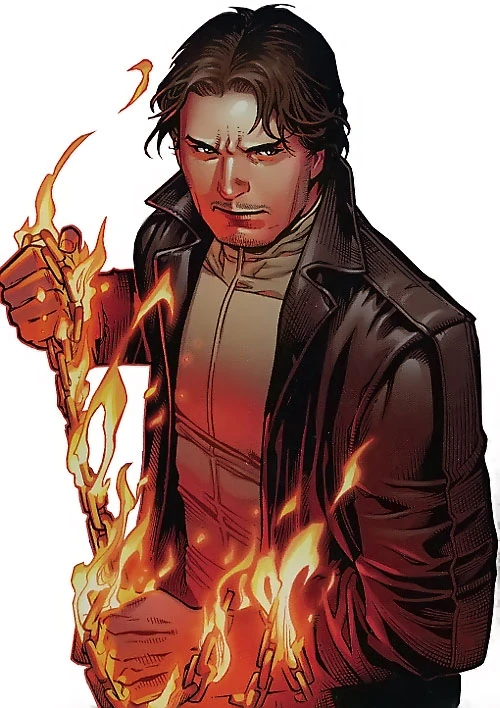
20. J.T. James (Hellfire) – The Phantom Rider’s Burning Legacy
Source: Comic Crossroads
J.T. James, known by his codename Hellfire, represents a fascinating intersection of Marvel’s supernatural and espionage storylines. As a descendant of Carter Slade, the original Phantom Rider, and a member of Nick Fury’s Secret Warriors, Hellfire brings a unique combination of mystical heritage and modern tactical training to his role as one of Marvel’s more specialized fire-wielders.
The character’s full name, James Taylor James, immediately establishes him as someone caught between different worlds and identities. This naming convention reflects the complexity of his character—someone trying to honor his supernatural heritage while operating in the modern world of international espionage and superhuman conflicts. His connection to the Phantom Rider legacy provides him with both power and responsibility that extends beyond typical superhero origins.
Hellfire’s abilities center around his power to ignite and manipulate chains, creating weapons that combine the practical utility of restraint with the destructive potential of fire. This unique power set requires both tactical thinking and supernatural control, as he must consider not just the offensive applications of his flaming chains but also their utility for mobility, defense, and crowd control. His enhanced reflexes complement these abilities, allowing him to wield his unusual weapons with precision and effectiveness.
The inheritance of his powers from Carter Slade adds mythological weight to Hellfire’s abilities. Rather than gaining his powers through accident or experimentation, he represents a continuation of a supernatural legacy that stretches back to the Old West. This connection to Marvel’s Western heroes provides him with a unique place in the company’s continuity and links him to stories and themes that extend far beyond contemporary superhero narratives.
Nick Fury’s recruitment of J.T. James for the Secret Warriors demonstrates the character’s potential and the respect his abilities command from Marvel’s premier spymaster. The Secret Warriors, designed to combat the Skrull infiltration during Secret Invasion, required members with both supernatural abilities and the psychological profile necessary for covert operations. Hellfire’s selection for this elite team speaks to his tactical value and personal reliability.
The revelation of Hellfire’s status as a Hydra double agent adds a tragic dimension to his character and demonstrates the complex moral landscape of Marvel’s espionage stories. His betrayal of the Secret Warriors wasn’t motivated by evil but by the deep infiltration and manipulation tactics that make Hydra such a persistent threat. This storyline explores themes of loyalty, manipulation, and the difficulty of maintaining one’s identity when operating in the world of international espionage.
Hellfire’s flaming chains create visually distinctive combat sequences that set him apart from other fire-wielders. Unlike characters who project flames or transform into fire, his abilities require physical weapons that he must manipulate with skill and precision. This creates action sequences that combine supernatural spectacle with tactical weapon use, resulting in combat scenes that feel both magical and grounded.
The character’s role in the Secret Warriors showcases his abilities in team combat situations. His chains can be used to restrain enemies, create barriers, provide mobility for himself and teammates, and deliver devastating attacks. This versatility makes him valuable in the varied mission profiles that the Secret Warriors encounter, from stealth infiltration to open combat against superhuman threats.
Hellfire’s supernatural heritage connects him to Marvel’s broader mystical community while his Secret Warriors membership links him to the espionage and military aspects of the Marvel Universe. This dual connection allows him to serve as a bridge character who can operate effectively in both supernatural storylines and more grounded military/espionage narratives.
The visual design of Hellfire’s powers creates memorable imagery that combines Western and supernatural themes. His flaming chains evoke both the practical tools of the Old West and the supernatural weapons of ghost stories and horror tales. This combination of familiar and fantastical elements makes his abilities instantly recognizable while maintaining an air of mystery and danger.
His enhanced reflexes complement his chain-based abilities perfectly, allowing him to react quickly to changing combat situations and manipulate his weapons with supernatural precision. This combination of enhanced physical capabilities and mystical weapons creates a balanced power set that is formidable without being overwhelming.
The character’s brief but impactful presence in Marvel continuity demonstrates how even specialized characters can make lasting impressions when their abilities and story roles are well-defined. His betrayal of the Secret Warriors and subsequent disappearance from active storylines creates an air of tragedy and unfulfilled potential that makes him memorable despite his limited appearances.
Hellfire’s connection to the Phantom Rider legacy provides opportunities for future storylines that could explore his supernatural heritage more deeply. The rich history of the Phantom Rider characters in Marvel’s Western comics offers numerous possibilities for expanding his background and developing his abilities further.
The tactical applications of his flaming chains in modern combat situations showcase how traditional supernatural abilities can be adapted for contemporary threats. His ability to use his chains for restraint, mobility, and offense makes him valuable in the varied mission profiles that modern superhero teams encounter.
J.T. James claims position number 20 through his unique combination of supernatural heritage, specialized abilities, and tragic character arc. His flaming chains represent a distinctive approach to fire-based powers that combines practical utility with supernatural spectacle, while his role in the Secret Warriors demonstrates his tactical value and personal complexity. His character proves that even brief appearances can create lasting impact when abilities and story roles are well-integrated and meaningful.
19. Jubilee – The Pyrotechnic Mutant with Explosive Potential

Source: Marvel Comics
Jubilation Lee, better known as Jubilee, represents one of Marvel’s most underestimated fire-based mutants, whose seemingly simple “fireworks” powers mask incredible destructive potential that has been recognized by some of the most powerful telepaths in the Marvel Universe. Her journey from mall rat to X-Man to vampire and back again showcases remarkable character growth while exploring the true scope of her pyrokinetic abilities.
Jubilee’s origin story perfectly captures the 1990s era of X-Men comics, when the team was expanding to include younger, more diverse characters who reflected contemporary youth culture. Discovered using her powers to evade mall security, she represented a new generation of mutants who grew up in a world where the X-Men were already established heroes. This background gave her a unique perspective on mutant life and allowed her to serve as a bridge between the X-Men and ordinary teenagers.
The true nature of Jubilee’s powers has been one of Marvel’s best-kept secrets for decades. While her abilities appear to be simple pyrotechnic displays—colorful explosions that resemble fireworks—Emma Frost revealed that Jubilee’s powers actually operate on a subatomic level. She can detonate matter at the atomic level, meaning her “fireworks” are actually controlled nuclear explosions. This revelation transforms her from a seemingly minor character into one of the most potentially dangerous mutants alive.
Jubilee’s emotional control over her abilities creates a fascinating power dynamic where her psychological state directly affects her destructive potential. Her natural optimism and desire to avoid harming others has unconsciously limited her powers to their “fireworks” level, preventing her from accessing their full nuclear potential. This psychological limitation serves as both a safety mechanism and a source of internal conflict as she struggles with the knowledge of what she could do if she lost control.
Her role as Wolverine’s surrogate daughter added emotional depth to both characters while showcasing her abilities in various contexts. Logan’s protective instincts toward Jubilee and his recognition of her potential made their relationship one of the X-Men’s most compelling mentor-student dynamics. Her powers proved useful not just in combat but in providing light, distraction, and psychological support during their adventures together.
The evolution of Jubilee’s abilities throughout her comic book appearances demonstrates impressive character development. From her initial simple fireworks displays to her brief period accessing her full nuclear potential, to her time as a vampire when her mutant powers were suppressed, each phase of her character development brought new understanding of her abilities and their applications.
Jubilee’s membership in various X-Men teams showcased her abilities in different tactical contexts. Her time with Generation X allowed her to develop her powers in a more controlled environment, while her participation in major X-Men storylines demonstrated her combat effectiveness and team value. Her ability to provide both offensive firepower and defensive screening made her valuable in various mission profiles.
The visual spectacle of Jubilee’s powers has made her a favorite among artists and animators. Her colorful, explosive displays create dynamic action sequences that are both beautiful and destructive. The contrast between the playful appearance of her “fireworks” and their actual destructive potential creates interesting visual storytelling opportunities that have been exploited effectively across various media.
Her transformation into a vampire temporarily suppressed her mutant abilities, creating an interesting exploration of identity and power. During this period, she had to rely on vampire abilities instead of her pyrotechnic powers, demonstrating her adaptability and proving that her value as a character extended beyond her mutant abilities. Her eventual return to her mutant powers and her role as a mother added new dimensions to her character.
Jubilee’s cultural impact extends beyond her individual storylines to her role as representation for Asian-American characters in comics. As one of the few prominent Asian-American X-Men, she has served as an important figure for readers seeking diverse representation in superhero comics. Her character has evolved to address various social issues while maintaining her core identity as a powerful mutant.
The technical aspects of Jubilee’s powers create interesting storytelling possibilities. Her ability to control the size, intensity, and timing of her explosions allows for precise tactical applications, from creating distractions to delivering devastating attacks. Her powers can be used for illumination, communication, crowd control, and direct combat, making her one of the most versatile fire-based characters in comics.
Her relationship with other young mutants, particularly through her time with Generation X and the New Warriors, demonstrated her leadership potential and her ability to inspire others. Her optimistic personality and determination to see the best in people made her an effective team player and mentor figure, proving that her greatest strength might be her ability to bring out the best in others.
The psychological implications of Jubilee’s powers add depth to her character beyond simple combat applications. Living with the knowledge that she could theoretically destroy entire cities if she lost control creates constant internal tension that informs her personality and decision-making. Her choice to maintain conscious limitations on her abilities demonstrates remarkable self-control and moral responsibility.
Jubilee’s appearances in various X-Men animated series and films have helped maintain her visibility and relevance for new generations of fans. These adaptations often emphasize her youthful energy and spectacular powers while exploring her relationships with other X-Men members, particularly Wolverine.
The character’s design effectively communicates her personality and abilities. Her bright, colorful costume and youthful appearance contrast with the serious nature of her true potential, creating visual irony that enhances her character concept. Her signature yellow coat and sunglasses have become iconic elements that make her instantly recognizable.
Her role as a mother in recent comics has added new dimensions to her character while exploring how her powers might be passed on to the next generation. This development demonstrates the ongoing evolution of her character and provides opportunities for future storylines that could explore the full potential of her abilities.
Jubilee claims position number 19 through her unique combination of seemingly simple powers with incredible destructive potential, compelling character development, and significant cultural impact. Her pyrokinetic abilities represent one of comics’ most cleverly disguised power sets, while her role in X-Men continuity demonstrates how characters can grow and evolve while maintaining their core identity. Her story proves that the most interesting fire-wielders are often those whose true potential remains carefully controlled and thoughtfully applied.
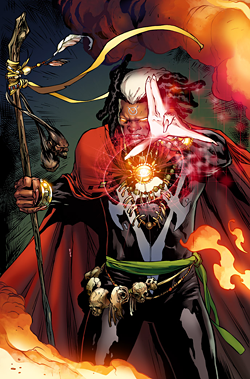
18. Doctor Voodoo – The Sorcerer Supreme’s Mystical Flames
Source: Wikipedia
Jericho Drumm, known as Doctor Voodoo, represents one of Marvel’s most sophisticated approaches to magical fire manipulation. As both a trained psychologist and a powerful sorcerer who briefly held the title of Sorcerer Supreme, Doctor Voodoo brings a unique combination of scientific understanding and mystical knowledge to his mastery of fire-based spells and supernatural abilities.
Doctor Voodoo’s origin story combines personal tragedy with mystical destiny in a way that gives weight to his supernatural abilities. After his brother Daniel was killed by a rival voodoo sorcerer, Jericho abandoned his career as an accredited psychologist to study under Papa Jambo, learning the mystical arts that would allow him to avenge his brother and protect others from supernatural threats. This transformation from man of science to master of magic creates interesting internal conflicts that inform his character.
The scope of Doctor Voodoo’s fire-based abilities extends far beyond simple flame generation. His mastery of voodoo magic allows him to call upon various loa (spirits) to enhance his fire spells, create protective barriers of mystical flame, and manipulate hellfire for both offensive and defensive purposes. His spells can range from subtle manipulations of existing flames to spectacular displays of supernatural fire that can affect both physical and spiritual targets.
His unique position as both a psychologist and a sorcerer gives Doctor Voodoo insights into the psychological aspects of fire magic that other characters lack. He understands that fire represents not just physical destruction but psychological transformation, purification, and renewal. This deeper understanding allows him to use his fire magic not just as a weapon but as a tool for healing and spiritual cleansing.
Doctor Voodoo’s connection to his deceased brother Daniel adds a spiritual dimension to his abilities that sets him apart from other fire-wielders. Daniel’s spirit serves as both advisor and power source, allowing Jericho to access abilities and knowledge beyond his individual training. This partnership between the living and the dead creates unique storytelling opportunities and demonstrates how fire magic can bridge the gap between life and death.
His brief tenure as Sorcerer Supreme demonstrated the full scope of his magical abilities and his worthiness to wield some of Marvel’s most powerful mystical artifacts. During this period, his fire magic was enhanced by the Eye of Agamotto and other mystical tools, allowing him to face cosmic-level threats and protect Earth from supernatural invasion. His performance in this role proved that his abilities extended far beyond regional voodoo practices.
The cultural authenticity of Doctor Voodoo’s powers adds depth and respect to his character that many magical heroes lack. His abilities are rooted in actual Haitian voodoo traditions, and his creators have generally treated these cultural elements with respect and accuracy. This grounding in real-world spiritual practices gives his fire magic a sense of authenticity and cultural weight that enhances his storytelling potential.
Doctor Voodoo’s work alongside other Marvel heroes, including Doctor Strange and the Avengers, showcases his abilities in various contexts. His fire magic has proven effective against supernatural threats, alien invaders, and mystical entities, demonstrating its versatility and power. His ability to combine voodoo practices with other forms of magic makes him valuable in team situations where diverse magical approaches are needed.
The visual presentation of Doctor Voodoo’s fire magic often incorporates elements of Haitian voodoo symbolism and imagery. His flames may take the form of spiritual entities, incorporate voodoo symbols, or manifest in colors and patterns that reflect his cultural background. This distinctive visual style makes his magic instantly recognizable and adds cultural richness to his appearances.
His psychological training enhances his effectiveness as a magical practitioner by giving him insights into human nature and motivation that pure mystics might lack. This combination of scientific understanding and mystical power allows him to approach magical problems from multiple angles and find solutions that might elude other sorcerers.
Doctor Voodoo’s fire magic serves multiple functions beyond combat applications. He can use flames for divination, communication with spirits, purification rituals, and healing ceremonies. This versatility makes him valuable not just as a superhero but as a spiritual advisor and healer who can address problems that conventional heroes cannot solve.
The character’s design effectively communicates his dual nature as both modern professional and traditional practitioner. His costume incorporates elements of both contemporary superhero design and traditional voodoo imagery, creating a visual identity that honors his cultural background while fitting into the Marvel Universe aesthetic.
His relationship with the loa (spirits) that empower his magic adds complexity to his abilities and creates ongoing storylines about the responsibilities and costs of wielding supernatural power. These spiritual entities have their own agendas and personalities, making Doctor Voodoo’s magic more than just a tool—it’s a relationship that requires constant negotiation and respect.
The international scope of Doctor Voodoo’s adventures reflects the global nature of mystical threats and his role as a protector of humanity rather than just American interests. His Haitian background and his understanding of various magical traditions make him valuable in storylines that span multiple cultures and continents.
His academic background as a psychologist provides him with analytical skills that complement his mystical abilities. He can understand the psychological impact of supernatural threats and develop strategies that address both the magical and mental health aspects of mystical conflicts.
Doctor Voodoo’s fire magic often incorporates elements of spiritual cleansing and purification that go beyond simple destruction. His flames can burn away spiritual corruption, cleanse cursed objects, and purify contaminated areas, making him valuable in storylines dealing with supernatural pollution and spiritual threats.
Doctor Voodoo claims position number 18 through his unique combination of psychological training, authentic cultural magic, and sophisticated fire-based abilities. His mystical flames represent one of comics’ most intellectually and culturally grounded approaches to fire magic, while his role as a bridge between science and magic demonstrates how different forms of knowledge can enhance supernatural abilities. His character proves that the most compelling fire-wielders are those whose abilities are rooted in genuine understanding of both human nature and mystical principles.
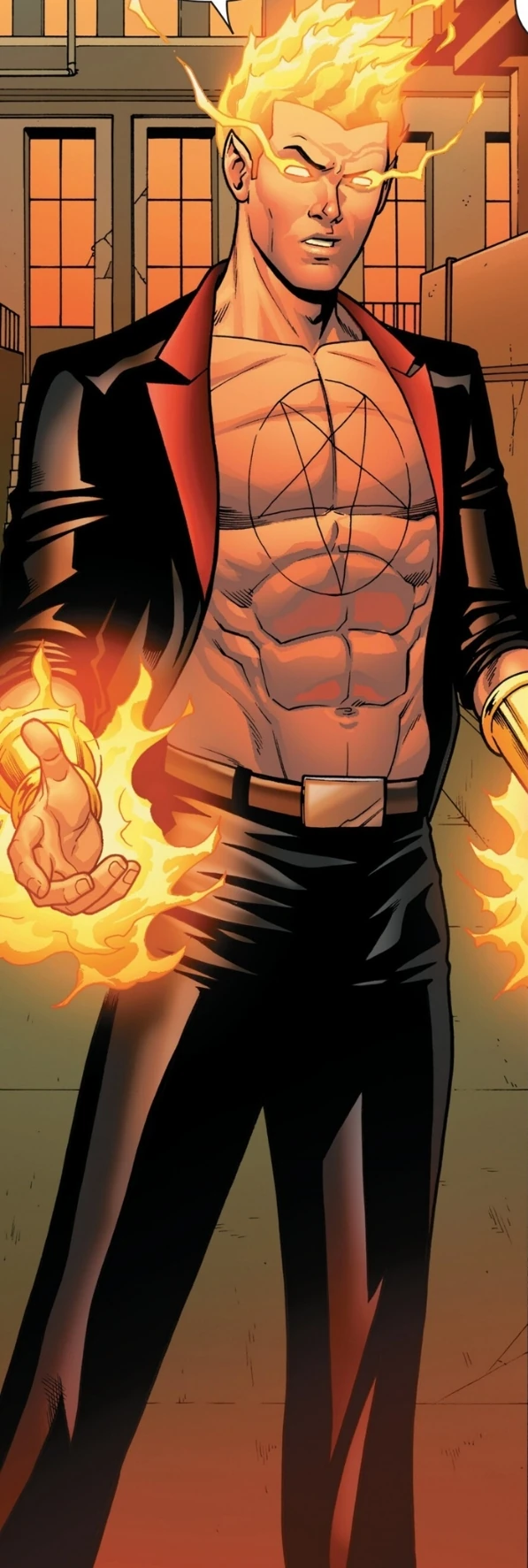
17. Daimon Hellstrom – The Son of Satan’s Infernal Mastery
Source: Marvel Comics
Daimon Hellstrom, the Son of Satan, represents one of Marvel’s most complex and morally ambiguous fire-wielders. Born with the literal fires of Hell at his command yet choosing to fight for humanity’s protection, Hellstrom embodies the eternal struggle between inherited nature and chosen destiny. His mastery of hellfire and mystical abilities makes him one of the most powerful supernatural heroes in the Marvel Universe.
Hellstrom’s origin story explores themes of nature versus nurture through the lens of supernatural horror. As the son of Satan himself, Daimon inherited incredible demonic powers including the ability to control and manipulate hellfire. However, unlike his sister Satana who embraced their demonic heritage, Daimon rejected his father’s influence and chose to use his powers to protect humanity from the very forces he was born to serve. This fundamental conflict between his nature and his choices defines his character.
The scope of Daimon’s hellfire abilities extends far beyond conventional fire manipulation. His flames are not merely hot—they are infused with supernatural properties that can affect both physical and spiritual targets. His hellfire can burn souls as well as bodies, making it effective against supernatural entities that might be immune to conventional attacks. This spiritual component to his fire powers makes him uniquely valuable in battles against demonic and mystical threats.
Hellstrom’s role as an occult investigator adds a detective element to his character that sets him apart from other supernatural heroes. His combination of demonic heritage, mystical knowledge, and investigative skills makes him ideally suited to uncover and combat supernatural threats that other heroes might not even recognize. His work protecting humanity from occult dangers demonstrates that his greatest battles are often fought in shadows rather than in public.
The internal conflict between Hellstrom’s demonic nature and his heroic choices creates ongoing character tension that enhances every storyline. His constant struggle to maintain his humanity while wielding the powers of Hell adds psychological depth to his character and creates stakes that go beyond simple victory or defeat. His choices matter not just for their immediate consequences but for what they say about his soul and his ultimate destiny.
His relationship with his father Satan provides ongoing antagonist potential while exploring themes of family, rebellion, and redemption. Unlike heroes who face external threats, Hellstrom must constantly battle against his own heritage and the expectations that come with being the Son of Satan. This personal dimension to his conflicts makes his victories more meaningful and his failures more tragic.
Hellstrom’s hellfire manipulation includes both offensive and defensive applications that showcase his tactical intelligence. He can create barriers of supernatural flame, project devastating attacks, summon demonic entities, and even travel through mystical fire portals. His ability to combine these various applications in creative ways demonstrates that his power is limited more by his imagination and moral constraints than by any inherent limitations.
The visual presentation of Hellstrom’s powers consistently emphasizes their supernatural origin. His hellfire is typically portrayed as darker and more ominous than conventional flames, often incorporating supernatural imagery like skulls, demons, or mystical symbols. This distinctive visual style immediately communicates the otherworldly nature of his abilities and creates memorable imagery that sets him apart from other fire-wielders.
His work alongside other supernatural heroes like Doctor Strange and Ghost Rider showcases his abilities in team contexts while highlighting his unique perspective on mystical threats. His demonic heritage gives him insights into supernatural enemies that other heroes might lack, making him valuable not just for his power but for his knowledge and understanding of mystical forces.
Hellstrom’s struggle with his demonic heritage has led to various character developments including periods where he has lost his powers, gained new abilities, or faced corruption from his own nature. These changes keep his character dynamic and prevent him from becoming static, while also exploring the costs and consequences of wielding supernatural power.
The character’s design effectively communicates his dual nature as both hero and demon. His costume incorporates both heroic and demonic elements, while his appearance can shift between human and more obviously supernatural depending on how much of his demonic nature he allows to surface. This visual flexibility allows artists to emphasize different aspects of his character depending on story needs.
His knowledge of mystical lore and supernatural threats makes Hellstrom valuable beyond his combat abilities. He can serve as an expert consultant on occult matters, identify supernatural threats that others might miss, and provide strategic advice based on his understanding of mystical forces and demonic tactics.
The psychological complexity of Hellstrom’s character extends to his relationships with other heroes and civilians. His demonic heritage makes others suspicious of his motives, while his heroic actions often surprise those who expect him to be evil. This constant need to prove himself and overcome others’ expectations adds social complexity to his character interactions.
His hellfire abilities often serve metaphorical as well as literal functions in storytelling. The flames can represent purification, judgment, temptation, or transformation depending on the context, allowing writers to use his powers to explore various themes and concepts beyond simple combat applications.
Hellstrom’s connection to various mystical dimensions and realms gives him access to knowledge and resources that other heroes lack. His ability to travel between dimensions, summon mystical entities, and access forbidden knowledge makes him valuable in storylines that span multiple realities or involve cosmic-level mystical threats.
The moral ambiguity of Hellstrom’s powers creates interesting ethical questions about the use of evil means for good ends. His hellfire is literally infernal in origin, raising questions about whether such power can truly be used for purely good purposes or whether its use inevitably corrupts the wielder.
Daimon Hellstrom claims position number 17 through his unique combination of incredible supernatural power, complex moral positioning, and rich character development potential. His hellfire abilities represent one of comics’ most literally infernal power sets, while his choice to fight for humanity despite his demonic nature creates compelling internal conflict that enhances every appearance. His character proves that the most interesting fire-wielders are often those who must constantly choose between the easy path of destruction and the difficult path of protection.
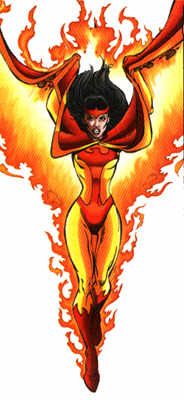
16. Firebird – The Radioactive Avenger’s Blazing Flight
Source: Wikipedia
Bonita Juarez, known as Firebird, represents one of Marvel’s most unique fire-powered heroes, combining radioactive energy manipulation with the ability to manifest as a giant flame bird. Her origin story, rooted in both science fiction and Native American mythology, creates a distinctive character whose powers reflect her cultural heritage while serving her role as a dedicated Avenger and protector of the American Southwest.
Firebird’s origin story perfectly captures the cosmic scope of Marvel’s universe while grounding her character in earthly concerns. When a radioactive comet landed near her location, dousing her in alien energies, Bonita gained incredible powers that she initially interpreted through the lens of Native American legend. Her assumption that her abilities were connected to the American Indian legend of the firebird demonstrates how individuals interpret extraordinary events through their cultural framework.
The scope of Firebird’s abilities extends far beyond simple fire generation to encompass heat manipulation, energy projection, and physical transformation. Her power to generate and manipulate extreme heat allows her to create devastating attacks, protective barriers, and environmental effects. Her ability to manifest as a giant flame bird provides both spectacular visual impact and practical advantages in terms of flight, reconnaissance, and psychological warfare.
Her membership in the Avengers showcases her abilities on a global stage while demonstrating her commitment to protecting humanity beyond her regional concerns. Her time with Earth’s Mightiest Heroes proved that her powers were sufficient to contribute meaningfully to cosmic-level threats while her dedication and moral character earned her the respect of veteran heroes like Captain America and Iron Man.
Firebird’s connection to her cultural heritage adds depth and authenticity to her character that many fire-based heroes lack. Her interpretation of her powers through Native American mythology provides a unique perspective on superhuman abilities and demonstrates how different cultures might understand and contextualize extraordinary phenomena. This cultural grounding gives her character weight and significance beyond her individual power level.
The visual spectacle of Firebird’s transformation into her flame bird form creates some of Marvel’s most striking imagery. Her ability to become a giant bird composed entirely of fire provides artists with opportunities to create dynamic, mythological imagery that combines superhero action with spiritual symbolism. This transformation serves both practical and symbolic functions in storytelling.
Her work with regional teams like the Texas Rangers demonstrates her commitment to protecting her local community while showcasing her abilities in different tactical contexts. These smaller-scale adventures allow for more personal storytelling while proving that her powers are effective against street-level threats as well as cosmic menaces.
The mystery surrounding the true origins of Firebird’s abilities adds ongoing intrigue to her character. While the radioactive comet provided the immediate cause of her transformation, the deeper source of her powers and their connection to Native American mythology remains largely unexplored. This mystery provides potential for future storylines that could delve deeper into her background and abilities.
Firebird’s heat generation abilities create tactical advantages that extend beyond simple combat applications. She can provide warmth in hostile environments, melt through barriers, create thermal updrafts for flight assistance, and even provide light in dark situations. This versatility makes her valuable in various mission profiles beyond direct confrontation.
Her flight capabilities, achieved through her flame bird transformation, provide both mobility and psychological impact. The sight of a giant bird made of fire descending from the sky creates immediate visual drama while providing tactical advantages in terms of reconnaissance, rapid response, and battlefield mobility.
The character’s design effectively communicates her cultural background and her fire-based abilities. Her costume incorporates elements that suggest both Native American heritage and avian imagery, while her flame bird form creates unmistakable visual impact. This design consistency helps establish her unique identity within Marvel’s diverse roster of heroes.
Firebird’s dedication to protecting the American Southwest gives her a clear geographical focus that distinguishes her from heroes with more general mandates. This regional connection creates opportunities for storylines that explore local issues, environmental concerns, and cultural conflicts while showcasing her abilities in familiar terrain.
Her energy projection abilities allow for both offensive and defensive applications that demonstrate tactical flexibility. She can create focused beams for precision attacks, wide-area blasts for crowd control, or protective barriers for defense. This range of applications makes her effective in various combat situations.
The radioactive nature of Firebird’s powers adds a science fiction element to her abilities that complements their mythological aspects. This combination of scientific and spiritual elements creates a unique power set that can be approached from multiple storytelling angles depending on the needs of individual narratives.
Her role as one of the few prominent Latina superheroes in Marvel Comics gives her cultural significance that extends beyond her individual abilities. Her representation of Hispanic and Native American communities provides important diversity in superhero comics while demonstrating that heroism transcends ethnic and cultural boundaries.
The environmental implications of Firebird’s powers create interesting storytelling possibilities. Her connection to natural forces and her ability to manipulate heat and energy could be used to address environmental themes, climate issues, or ecological threats in ways that other heroes might not be equipped to handle.
Her transformation abilities raise questions about the relationship between human and animal consciousness that could be explored in future storylines. The psychological and spiritual implications of becoming a giant bird of fire provide rich material for character development and philosophical exploration.
Firebird claims position number 16 through her unique combination of radioactive powers, cultural authenticity, and distinctive visual presentation. Her heat manipulation and flame bird transformation represent one of comics’ most mythologically grounded power sets, while her role as a regional protector and Avenger demonstrates her versatility and dedication. Her character proves that the most memorable fire-wielders are often those whose abilities reflect their cultural heritage while serving universal themes of protection and heroism.
15. Jim Hammond (Original Human Torch) – The Android Who Lit the Golden Age

Source: Reddit
Jim Hammond, the original Human Torch, holds the distinction of being Marvel’s first fire-powered superhero and one of the most historically significant characters in comic book history. Created during the Golden Age of comics, Hammond’s adventures alongside Captain America and Namor the Sub-Mariner helped establish the foundations of the Marvel Universe while showcasing the spectacular potential of fire-based superpowers.
Hammond’s origin as an artificial being created by Professor Phineas T. Horton reflects the science fiction optimism of the late 1930s while exploring themes of artificial intelligence and humanity that remain relevant today. Unlike heroes who gained their powers through accident or mutation, Hammond was deliberately designed with his fire abilities, making him one of comics’ first examples of successful artificial superhuman creation. This origin gives his powers a sense of purpose and design that sets him apart from more randomly empowered heroes.
The scope of Hammond’s fire abilities established many of the conventions that subsequent fire-powered heroes would follow. His power to generate and control flames, achieve flight through flame propulsion, and become completely immune to fire damage created a template that influenced countless later characters. His signature cry of “Flame on!” became one of comics’ most recognizable catchphrases and established the dramatic potential of fire-based transformation sequences.
Hammond’s role as one of the original Invaders during World War II demonstrates the historical significance of his character and his abilities. Fighting alongside Captain America, Bucky, and Namor against Nazi forces, Hammond proved that fire powers could be effective against real-world threats as well as fantastic menaces. His wartime service established him as a true American hero and demonstrated the patriotic potential of superhuman abilities.
The partnership between Hammond and his sidekick Toro created one of comics’ first successful mentor-student relationships between fire-powered heroes. Toro’s ability to generate flames complemented Hammond’s more advanced fire manipulation, creating tactical opportunities and visual spectacle that enhanced both characters. This partnership demonstrated how fire powers could work in team situations and established precedents for future fire-powered partnerships.
Hammond’s deactivation after World War II and his subsequent reactivation in the modern Marvel Universe explores themes of obsolescence, adaptation, and the passage of time that add depth to his character. His struggle to find relevance in a world that has moved beyond his original purpose creates compelling character conflicts while showcasing how classic heroes can be updated for contemporary audiences.
His membership in teams like the West Coast Avengers and the All-New Invaders demonstrates his continued relevance and effectiveness despite his Golden Age origins. These modern team affiliations prove that his abilities and character remain valuable in contemporary superhero narratives while honoring his historical significance.
The visual impact of Hammond’s fire powers helped establish many of the artistic conventions for depicting flame-based abilities in comics. His transformation from normal appearance to flaming form created dramatic visual contrasts that artists could exploit for maximum impact. The techniques developed for illustrating his powers influenced how fire abilities would be portrayed throughout comic book history.
Hammond’s artificial nature creates unique storytelling opportunities that explore what it means to be human. His lack of biological needs, his programmed personality, and his artificial origins raise questions about consciousness, emotion, and identity that add philosophical depth to his adventures. These themes remain relevant in an era of increasing artificial intelligence development.
His relationship with other Golden Age heroes provides connections to Marvel’s historical continuity while demonstrating how classic characters can interact with modern heroes. His friendships with characters like Captain America create bridges between different eras of Marvel history and provide opportunities for stories that span multiple decades.
The character’s design, with his red costume and flaming appearance, created one of comics’ most iconic visual presentations. His look influenced numerous subsequent fire-powered heroes while establishing visual conventions that remain effective today. The simplicity and clarity of his design demonstrate the power of strong visual concepts in superhero character creation.
Hammond’s role in establishing Marvel’s Golden Age continuity cannot be overstated. As one of the company’s first successful superheroes, he helped prove that the superhero concept could sustain ongoing publication and audience interest. His success paved the way for the creation of countless other Marvel characters and helped establish the company as a major force in comic book publishing.
His fire immunity and heat resistance abilities provide defensive capabilities that complement his offensive fire powers. This combination of offensive and defensive fire-based abilities creates a well-rounded power set that remains effective across various threat levels and combat situations.
The character’s longevity, spanning from the 1930s to the present day, demonstrates the enduring appeal of his core concept and abilities. His ability to remain relevant across multiple decades of comic book evolution proves the strength of his fundamental character design and the universal appeal of fire-based superpowers.
Hammond’s influence on subsequent fire-powered heroes, particularly Johnny Storm who adopted his catchphrase and similar abilities, shows how successful character concepts can inspire and influence later creations. His legacy lives on not just in his own adventures but in the characters he inspired.
His role as a bridge between artificial and human consciousness provides ongoing opportunities for character development and philosophical exploration. His journey from programmed android to fully realized individual mirrors humanity’s own questions about consciousness, free will, and what it means to be truly alive.
Jim Hammond claims position number 15 through his historical significance, foundational influence on fire-powered heroes, and enduring character appeal. As Marvel’s first fire-wielding superhero, he established many of the conventions and possibilities that subsequent characters would build upon, while his own adventures continue to demonstrate the timeless appeal of well-designed fire-based abilities. His character proves that the most influential fire-wielders are often those who establish the foundations that others build upon.
14. Crystal – The Inhuman Elemental Master’s Fiery Precision

Source: Comic Book Religion
Crystalia Amaquelin, known simply as Crystal, represents one of Marvel’s most versatile elemental manipulators and a crucial bridge between the Inhuman Royal Family and the broader superhero community. Her mastery over the four classical elements—including fire—combined with her roles as an Avenger, Fantastic Four member, and Inhuman princess, makes her one of the most tactically flexible and politically significant heroes in the Marvel Universe.
Crystal’s origin as a member of the Inhuman Royal Family immediately establishes her as nobility with both the privileges and responsibilities that come with royal birth. Her exposure to the Terrigen Mists, the transformative catalyst that grants Inhumans their abilities, resulted in her gaining control over earth, air, fire, and water. This comprehensive elemental mastery makes her unique among heroes, as few characters can claim such broad control over fundamental forces of nature.
The precision of Crystal’s fire manipulation sets her apart from heroes who rely on raw power or emotional intensity to fuel their flames. Her scientific understanding of combustion, heat transfer, and molecular behavior allows her to create highly specific fire effects tailored to particular situations. She can generate flames of precise temperatures, create fire constructs with exact specifications, and manipulate existing flames with surgical precision.
Her membership in the Fantastic Four during the period when Sue Storm temporarily left the team demonstrated her ability to fill the role of a core superhero team member. Her elemental powers proved valuable in the team’s scientific adventures and cosmic threats, while her royal background added diplomatic elements to their missions. Her relationship with Johnny Storm during this period created interesting romantic dynamics while showcasing how different fire-wielders can complement each other.
Crystal’s role as an Avenger further proved her versatility and heroic credentials. Her elemental abilities provided the team with tactical options that few other heroes could offer, while her royal status and diplomatic training made her valuable in situations requiring negotiation or cultural sensitivity. Her time with Earth’s Mightiest Heroes demonstrated that her powers were effective at the highest levels of superhero activity.
The tactical applications of Crystal’s fire abilities extend far beyond simple combat. She can use controlled flames for illumination, heating, welding, or creating thermal barriers. Her ability to combine fire with her other elemental powers creates unique tactical opportunities—she can create steam by combining fire and water, use fire to create air currents, or heat earth to create glass or ceramic constructs.
Her marriage to Quicksilver and their subsequent relationship challenges created personal stakes that enhanced her character development while exploring themes of duty versus desire. The conflict between her responsibilities to the Inhuman people and her personal relationships with human heroes added emotional complexity to her character and created ongoing tension that enhanced her storylines.
Crystal’s role in Inhuman society as both princess and active superhero creates unique storytelling opportunities. Her position gives her access to advanced Inhuman technology and knowledge while her heroic activities keep her connected to human concerns. This dual perspective makes her valuable as a cultural bridge and diplomatic liaison between different communities.
The visual presentation of Crystal’s elemental powers, particularly her fire manipulation, creates spectacular action sequences that showcase her tactical intelligence. Artists can exploit the contrast between her refined appearance and the raw power of her elemental abilities, while her precise control allows for intricate visual effects that demonstrate both power and finesse.
Her scientific approach to her elemental abilities reflects the advanced Inhuman understanding of natural forces. Rather than relying on instinct or emotion, Crystal applies scientific principles to maximize the effectiveness of her powers. This intellectual approach to elemental manipulation sets her apart from more intuitive heroes and creates opportunities for problem-solving that goes beyond brute force.
Crystal’s fire abilities serve both offensive and defensive functions in her overall tactical approach. She can create flame barriers for protection, use fire attacks to control enemy movement, or combine fire with her other elements to create complex battlefield effects. This versatility makes her valuable in team situations where adaptability is crucial.
Her relationship with her sister Medusa and the rest of the Inhuman Royal Family adds political dimensions to her character that most heroes lack. Her actions as a superhero reflect not just on herself but on the entire Inhuman nation, creating stakes that extend beyond personal heroics to international relations and species diplomacy.
The character’s design effectively communicates her royal status and elemental abilities. Her costume incorporates elements that suggest both nobility and natural forces, while her confident bearing reflects her training and background. This visual presentation immediately establishes her as someone accustomed to both power and responsibility.
Crystal’s role in major Marvel events, including the Kree-Skrull War and various Inhuman-focused storylines, demonstrates her importance to Marvel’s cosmic continuity. Her abilities and political position make her valuable in stories that span multiple worlds and species, while her heroic credentials ensure her involvement in Earth-based threats.
Her motherhood and family responsibilities add contemporary relevance to her character while exploring how superheroic duties intersect with personal obligations. Her efforts to balance her roles as hero, princess, and mother create relatable conflicts that ground her fantastic abilities in human concerns.
The environmental applications of Crystal’s fire powers create opportunities for stories that address ecological themes. Her ability to control natural forces gives her unique insights into environmental balance and the consequences of human activity on natural systems.
Her training in both Inhuman science and superhero tactics gives Crystal a unique skill set that combines advanced technology with practical heroic experience. This combination makes her valuable in situations that require both technical knowledge and field experience.
Crystal’s diplomatic immunity and royal status provide her with resources and access that most heroes lack. Her ability to operate in political spheres while maintaining her heroic identity creates opportunities for stories that explore the intersection of politics and superheroics.
Her elemental mastery includes not just the ability to generate and control fire but also to understand its role in natural cycles and ecological systems. This comprehensive understanding makes her fire abilities more than just weapons—they’re tools for understanding and protecting the natural world.
Crystal claims position number 14 through her unique combination of precise elemental mastery, royal heritage, and proven heroic credentials across multiple teams and contexts. Her fire manipulation represents one of comics’ most scientifically grounded and tactically flexible approaches to flame control, while her role as a bridge between Inhuman and human communities demonstrates how supernatural abilities can serve diplomatic and cultural functions. Her character proves that the most valuable fire-wielders are often those who combine raw power with intelligence, training, and a deep understanding of their responsibilities to others.
13. Magma – The Geo-Thermokinetic New Mutant’s Molten Power
Source: Marvel Comics
Amara Juliana Olivians Aquilla, known as Magma, represents one of the most geologically powerful fire-wielders in the Marvel Universe. Her unique combination of geo-thermokinetic abilities—the power to manipulate both earth and fire through geological processes—makes her a formidable force whose powers operate on a scale that can literally reshape landscapes and create new landmasses.
Magma’s origin story combines ancient Roman culture with modern superhero narratives in a way that gives her character both historical weight and contemporary relevance. As a citizen of Nova Roma, a hidden city where ancient Roman culture survived into the modern era, Amara brings a unique cultural perspective to the superhero community. Her transformation into Magma occurred when she was thrown into a lava pit as a sacrifice, only to emerge with incredible powers over molten rock and geological forces.
The scope of Magma’s abilities extends far beyond simple fire generation to encompass control over the fundamental geological processes that shape the Earth itself. She can generate and manipulate lava, create volcanic eruptions, control tectonic activity, and even create new landmasses through her manipulation of molten rock. Her powers operate on a scale that few other heroes can match, making her capable of both incredible destruction and remarkable creation.
Her membership in the New Mutants provided her with a team context that helped develop her character while showcasing her abilities alongside other young heroes. Her time with the team demonstrated that despite her incredible power level, she could work effectively with others and contribute to team objectives beyond simple overwhelming force. Her relationships with teammates like Cannonball and Sunspot added personal dimensions to her character.
The visual spectacle of Magma’s powers creates some of the most dramatic imagery in superhero comics. Her transformation from normal human appearance to a being of living lava and rock provides artists with opportunities to create stunning visual effects that combine human form with geological forces. Her ability to create volcanic eruptions and manipulate molten rock produces action sequences that operate on an epic scale.
Magma’s connection to geological processes gives her abilities a scientific foundation that adds credibility to her fantastic powers. Her manipulation of tectonic forces, volcanic activity, and molten rock reflects actual geological phenomena, making her powers feel grounded in natural processes even as they operate on a superhuman scale. This scientific basis enhances the believability of her abilities.
Her cultural background as a citizen of Nova Roma adds depth and authenticity to her character that many heroes lack. Her ancient Roman perspective on modern situations creates interesting character conflicts and provides opportunities for stories that explore cultural differences and adaptation. This background makes her more than just a powerful mutant—she’s a representative of a lost civilization.
The defensive applications of Magma’s powers are as impressive as her offensive capabilities. She can create barriers of molten rock, generate protective lava flows, and even create underground shelters by manipulating geological structures. Her ability to control the very ground beneath her feet gives her tactical advantages that few other heroes can match.
Magma’s powers have environmental implications that create opportunities for stories addressing ecological themes. Her ability to create new landmasses and alter geological structures could be used to address issues like rising sea levels or environmental destruction, while her connection to natural forces gives her insights into ecological balance.
Her relationship with the X-Men and their extended family of teams demonstrates her value to the mutant community while showcasing her abilities in various contexts. Her powers have proven effective against both human and superhuman threats, while her unique perspective as someone from outside modern culture adds valuable diversity to team dynamics.
The character’s design effectively communicates her geological powers and her cultural background. Her costume and appearance when using her powers incorporate elements that suggest both Roman heritage and volcanic forces, creating a visual identity that is both distinctive and appropriate to her abilities and background.
Magma’s ability to create and manipulate lava gives her access to temperatures that exceed those of most other fire-wielders. Lava can reach temperatures of over 2,000 degrees Fahrenheit, making her attacks among the hottest and most destructive available to any hero. This extreme heat generation sets her apart from heroes who rely on conventional flames.
Her geological knowledge, whether innate or learned through her powers, gives her insights into Earth’s structure and processes that make her valuable beyond her combat abilities. She can predict volcanic activity, understand seismic events, and potentially prevent geological disasters through her manipulation of tectonic forces.
The scale of Magma’s potential impact makes her one of the most powerful heroes in terms of raw destructive capability. Her ability to create volcanic eruptions or trigger earthquakes gives her the theoretical power to affect entire regions or continents, making her a strategic asset of incredible importance.
Her powers’ connection to creation as well as destruction adds positive dimensions to her abilities. While she can cause incredible devastation, she can also create new land, form useful geological structures, and potentially help with construction or terraforming projects. This dual nature makes her powers more than just weapons.
Magma’s role as one of the few heroes whose powers operate on a geological scale gives her unique responsibilities and challenges. The potential consequences of her actions are so significant that she must exercise incredible restraint and judgment, adding psychological pressure that enhances her character development.
Her ability to survive in extreme environments, including the interior of volcanoes or areas of intense heat, gives her access to locations and situations that other heroes cannot reach. This environmental immunity makes her valuable for rescue operations or missions in hostile geological conditions.
The mythological associations of her powers, connecting her to ancient concepts of earth goddesses and volcanic deities, add symbolic weight to her character. Her abilities tap into primal human fears and fascinations with geological forces, making her powers resonate on a deep psychological level.
Magma claims position number 13 through her unique combination of geological and thermal powers that operate on a scale few other heroes can match. Her geo-thermokinetic abilities represent one of comics’ most scientifically grounded and environmentally significant power sets, while her cultural background and team affiliations demonstrate her value as both a powerful hero and a unique individual. Her character proves that the most impressive fire-wielders are often those whose abilities connect to fundamental natural forces and operate on scales that can reshape the world itself.
12. Etrigan the Demon – Hell’s Rhyming Champion of Justice
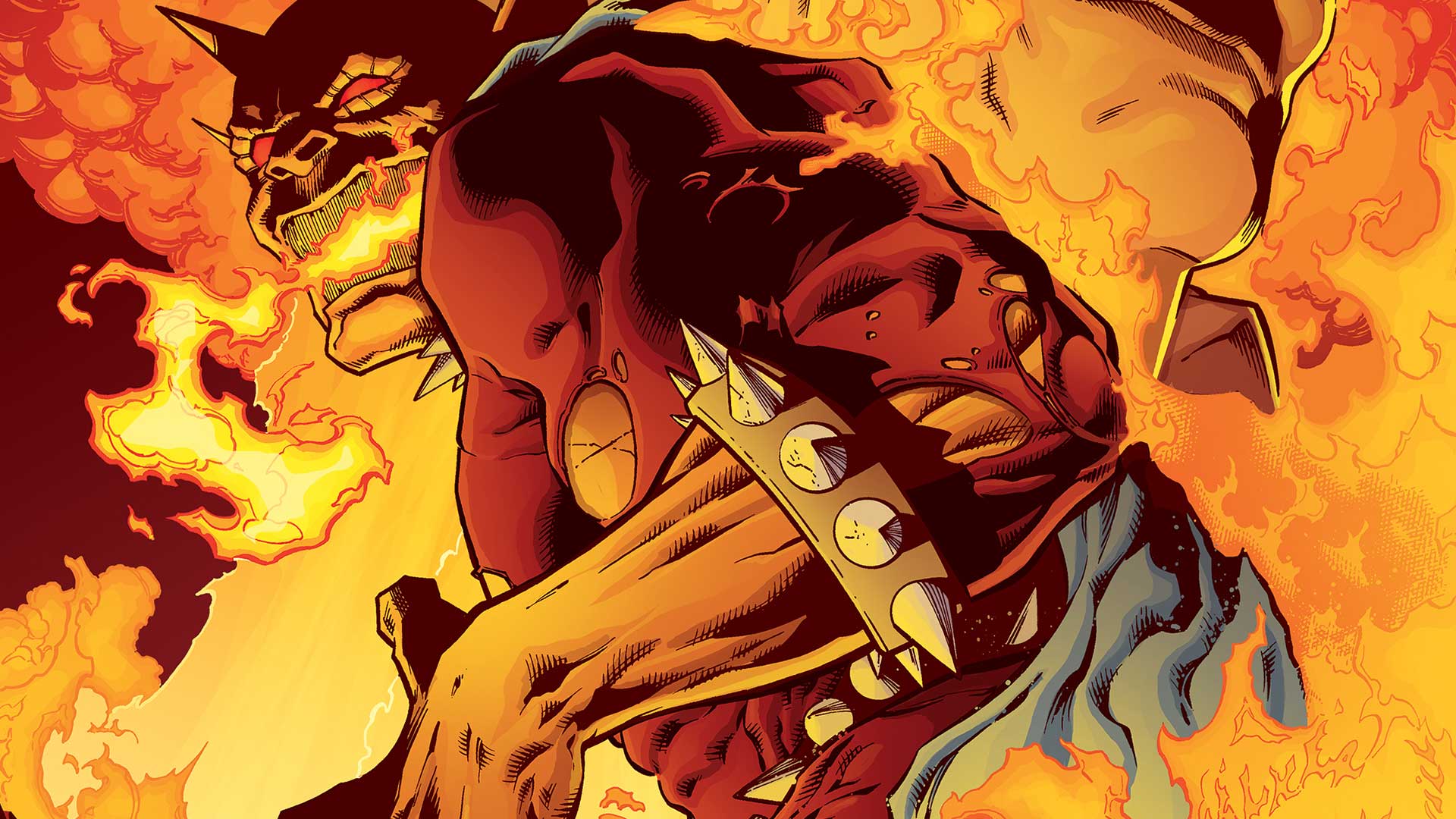
Source: DC Database – Fandom
Etrigan the Demon stands as one of DC Comics’ most unique and compelling supernatural characters, combining the raw power of Hell’s flames with an unexpected dedication to protecting humanity. Bound to the mortal Jason Blood and speaking exclusively in rhyme, Etrigan represents a fascinating paradox—a demon who fights for justice while wielding the very fires of damnation.
Etrigan’s origin, created by the legendary Jack Kirby, establishes him as a being of incredible age and power. Summoned from Hell and bound to the mortal Jason Blood by the wizard Merlin during the fall of Camelot, Etrigan has existed for centuries, accumulating knowledge, power, and a complex relationship with both his human host and his infernal nature. This ancient origin gives him a perspective on human history and supernatural threats that few other characters can match.
The scope of Etrigan’s hellfire abilities encompasses both the traditional destructive power associated with demonic flames and more sophisticated applications that reflect his intelligence and experience. His hellfire can burn both physical and spiritual targets, making it effective against supernatural entities that might be immune to conventional attacks. His flames can also serve mystical functions, including divination, communication with other supernatural beings, and manipulation of magical energies.
Etrigan’s distinctive speech pattern—speaking exclusively in rhyme—sets him apart from every other character in comics and adds a theatrical, almost Shakespearean quality to his appearances. This unique characteristic makes his dialogue instantly recognizable while adding an element of dark poetry to his adventures. His rhymes often contain threats, prophecies, or mystical knowledge, making his speech both entertaining and plot-relevant.
The visual impact of Etrigan’s design creates one of comics’ most memorable supernatural characters. His demonic appearance, complete with horns, fangs, and a muscular physique, immediately communicates his infernal nature, while his ability to breathe hellfire creates spectacular visual effects. His costume design, with its medieval-inspired elements, reflects his connection to Arthurian legend and his ancient origins.
Etrigan’s relationship with Jason Blood creates ongoing internal conflict that adds depth to both characters. Blood’s desire for redemption and normal life conflicts with Etrigan’s demonic nature and supernatural responsibilities, creating tension that enhances every storyline. This dual identity explores themes of good versus evil, redemption versus damnation, and the struggle between human and supernatural nature.
His role in DC’s supernatural community places him alongside characters like Doctor Fate, Zatanna, and John Constantine, where his demonic perspective provides unique insights into mystical threats. His knowledge of Hell’s hierarchy, supernatural law, and demonic politics makes him valuable in stories dealing with infernal invasions or supernatural conflicts that threaten the mortal world.
The character’s moral complexity sets him apart from traditional heroes and villains. While he is literally a demon from Hell, Etrigan often fights to protect humanity and oppose greater supernatural threats. This moral ambiguity creates interesting storytelling opportunities and challenges readers’ expectations about good and evil, heroism and villainy.
Etrigan’s hellfire breathing ability provides him with both offensive and defensive capabilities that are enhanced by his supernatural nature. His flames can melt through virtually any material, create barriers of infernal fire, and even affect intangible or spiritual targets. The supernatural properties of his hellfire make it effective against enemies that might be immune to conventional attacks.
His immortal nature and extensive experience give Etrigan knowledge and perspective that prove valuable in dealing with ancient threats or mystical problems. His memories span centuries of human history and supernatural conflicts, making him a repository of knowledge about threats that other heroes might not even recognize.
The character’s connection to Arthurian legend through his binding by Merlin adds mythological weight to his stories and connects him to one of literature’s most enduring legendary cycles. This connection provides rich source material for stories and establishes Etrigan as part of a larger mythological framework.
His physical strength and durability, enhanced by his demonic nature, complement his hellfire abilities to make him formidable in direct combat. His supernatural physiology allows him to survive attacks that would destroy normal beings, while his strength enables him to engage powerful enemies in physical confrontation when his hellfire alone isn’t sufficient.
Etrigan’s role as a reluctant protector of humanity creates interesting character dynamics. Unlike heroes who are motivated by altruism or personal conviction, Etrigan’s protection of mortals often stems from his binding to Jason Blood or his opposition to greater supernatural threats. This reluctant heroism adds complexity to his motivations.
The theatrical nature of Etrigan’s character, emphasized by his rhyming speech and dramatic appearance, makes him well-suited to stories that embrace the more fantastical elements of superhero comics. His presence immediately signals that a story will deal with supernatural themes and larger-than-life conflicts.
His knowledge of Hell’s politics and supernatural law gives Etrigan insights into the motivations and limitations of other supernatural entities. This knowledge makes him valuable not just as a combatant but as a strategic advisor in conflicts involving demons, angels, or other mystical beings.
The character’s design allows for spectacular action sequences that combine physical combat with supernatural effects. His hellfire breathing, combined with his strength and durability, creates opportunities for visually stunning battles that operate on both physical and mystical levels.
Etrigan’s hellfire abilities often serve symbolic as well as literal functions in storytelling. His flames can represent judgment, purification, damnation, or transformation depending on the context, allowing writers to use his powers to explore various themes beyond simple combat applications.
His ancient origins and supernatural nature make Etrigan valuable in stories that span multiple time periods or deal with threats that have existed for centuries. His perspective on historical events and his knowledge of ancient supernatural conflicts provide unique storytelling opportunities.
Etrigan the Demon claims position number 12 through his unique combination of hellfire powers, distinctive character voice, and complex moral positioning. His infernal flames represent one of comics’ most literally supernatural power sets, while his rhyming speech and demonic appearance create an instantly memorable character that stands apart from all others. His character proves that the most compelling fire-wielders are often those who combine incredible power with unique personality traits and moral complexity that challenges simple categorization as hero or villain.
11. Fire (Green Flame) – The Global Guardian’s Emerald Inferno
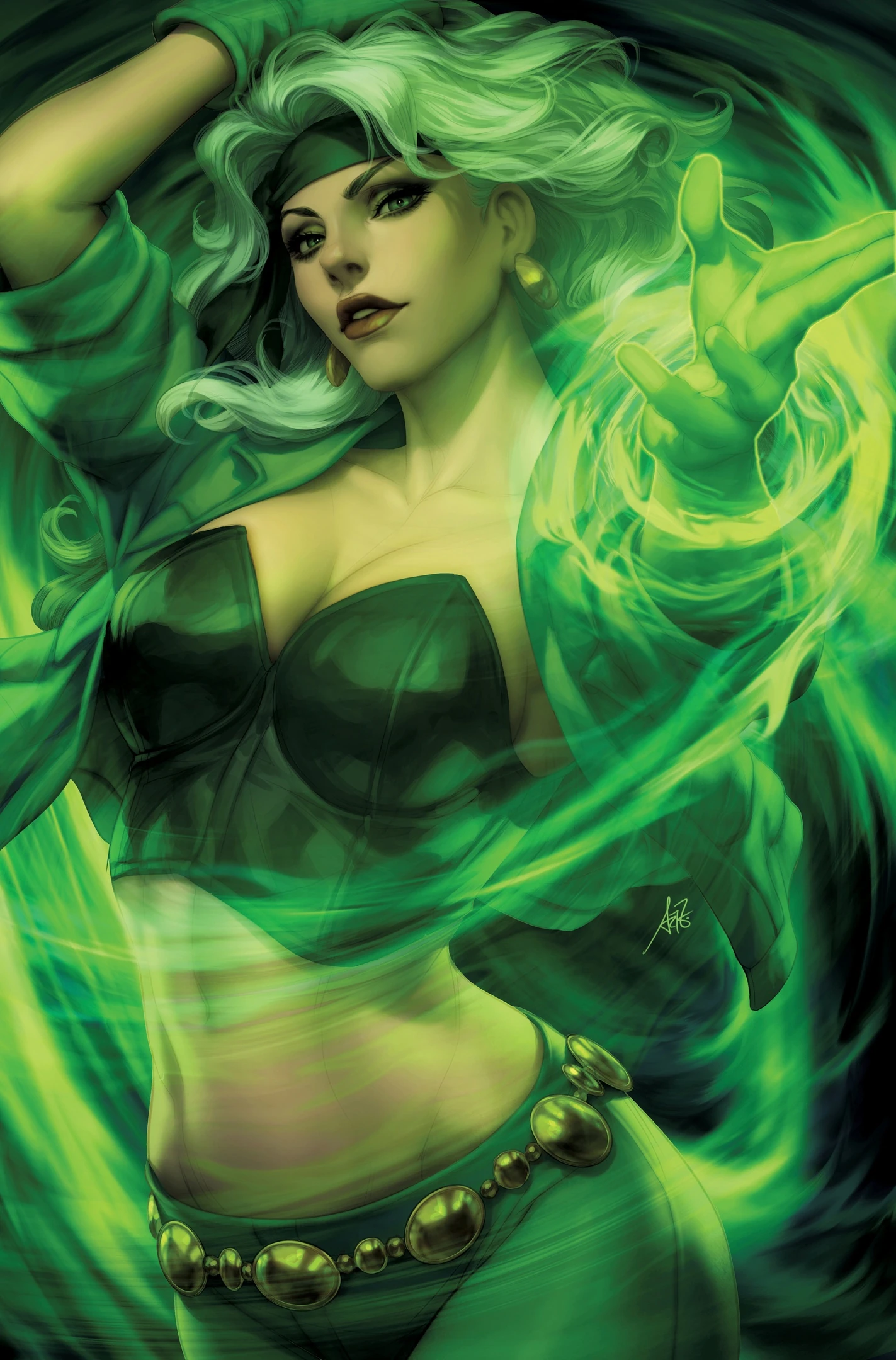
Source: DC Comics
Beatriz Bonilla da Costa, known as Fire (formerly Green Flame), represents one of DC Comics’ most internationally minded fire-wielders and a crucial member of the Global Guardians and Justice League International. Her unique green flames and her role as a Brazilian superhero bring both visual distinction and cultural diversity to the world of fire-powered heroes, while her partnership with Ice creates one of comics’ most enduring superhero friendships.
Fire’s origin story reflects DC’s commitment to creating international heroes who represent different cultures and perspectives within the superhero community. As a Brazilian model and performer who gained her powers through mystical means, Beatriz brings a unique background that combines glamour industry experience with supernatural abilities. Her transformation from Green Flame to Fire represents both character growth and the evolution of her powers and identity.
The distinctive green color of Fire’s flames immediately sets her apart from other fire-wielders and creates a unique visual signature that makes her instantly recognizable. This unusual flame coloration suggests mystical or supernatural origins rather than conventional combustion, adding an element of mystery to her abilities while creating spectacular visual effects that artists can exploit for maximum impact.
Her membership in Justice League International during the late 1980s and early 1990s showcased her abilities in a team context that emphasized international cooperation and cultural diversity. Her interactions with heroes from different countries and backgrounds demonstrated how her Brazilian perspective and fire powers could contribute to global superhero efforts while maintaining her individual identity and cultural authenticity.
The partnership between Fire and Ice represents one of comics’ most successful contrasting power combinations. Their opposing abilities—fire and ice—create natural tactical opportunities while their friendship demonstrates that heroes with opposing powers can work together effectively. This partnership has become iconic within DC continuity and provides ongoing opportunities for stories that explore their complementary abilities.
Fire’s background in the entertainment industry adds glamour and sophistication to her character that many heroes lack. Her experience as a model and performer gives her confidence, stage presence, and an understanding of public relations that proves valuable in her superhero career. This background also creates interesting contrasts between her glamorous civilian identity and her heroic responsibilities.
The mystical origins of Fire’s powers connect her to DC’s supernatural community while maintaining her role as a more conventional superhero. Her green flames suggest connections to magical forces or supernatural entities, creating opportunities for stories that explore the mystical side of the DC Universe while keeping her grounded in more traditional superhero narratives.
Her role as a representative of Brazilian culture in DC Comics provides important diversity and international perspective within the superhero community. Her character helps demonstrate that heroism is a global phenomenon and that different cultures can contribute unique perspectives and abilities to the fight against evil.
Fire’s flame projection abilities include both offensive and defensive applications that demonstrate tactical versatility. She can create flame barriers for protection, project focused fire blasts for offense, and use her flames for illumination or signaling. Her control over the intensity and shape of her flames allows for precise applications tailored to specific situations.
The character’s design effectively communicates both her Brazilian heritage and her fire-based abilities. Her costume incorporates elements that suggest both cultural identity and flame powers, while her confident bearing reflects her entertainment industry background and her comfort with public attention.
Her flight capabilities, achieved through flame propulsion, provide mobility that enhances her tactical value and creates opportunities for spectacular aerial combat sequences. Her ability to fly using her fire powers demonstrates advanced control over her abilities while providing practical advantages in various mission profiles.
Fire’s role in the Global Guardians before joining Justice League International established her as a hero with international experience and perspective. This background gives her insights into global threats and international cooperation that prove valuable in team situations requiring cultural sensitivity or international coordination.
Her relationship with other Brazilian heroes and her connections to her home country create opportunities for stories that explore South American culture and issues. Her character can serve as a bridge between DC’s American-centered narratives and the broader international community.
The environmental applications of Fire’s powers create interesting storytelling possibilities. Her ability to control flames could be used in firefighting situations, while her heat generation might be valuable in rescue operations or environmental emergencies. These civilian applications of her powers demonstrate their utility beyond combat situations.
Her experience working with diverse international teams gives Fire valuable leadership and cooperation skills that enhance her effectiveness in group situations. Her ability to work with heroes from different cultural backgrounds makes her valuable in teams that require international coordination or cultural understanding.
The character’s longevity within DC continuity demonstrates the enduring appeal of her concept and abilities. Her consistent presence in various team lineups and storylines proves that her combination of fire powers, international perspective, and distinctive personality continues to be valuable to DC’s superhero community.
Fire’s green flames create unique tactical opportunities that set her apart from heroes with conventional fire colors. The unusual appearance of her flames can create psychological effects on enemies while providing distinctive visual cues that help allies identify her attacks in complex battle situations.
Her role as a mentor to younger heroes, particularly through her Justice League connections, demonstrates her growth from individual hero to experienced team member capable of guiding others. This development shows how her character has evolved beyond her original conception to become a more complex and valuable hero.
The mystical nature of Fire’s abilities creates connections to DC’s magical community while maintaining her accessibility as a more conventional superhero. This balance allows her to participate in both supernatural storylines and more traditional superhero adventures without seeming out of place in either context.
Her international modeling career provides her with resources, connections, and public recognition that enhance her effectiveness as a superhero. Her civilian identity’s success creates opportunities for stories that explore the intersection of celebrity culture and superhero responsibilities.
Fire claims position number 11 through her unique combination of distinctive green flames, international perspective, and proven team leadership abilities. Her fire powers represent one of comics’ most visually distinctive approaches to flame manipulation, while her role as a Brazilian hero and longtime Justice League member demonstrates her value as both a powerful individual and an effective team player. Her character proves that the most valuable fire-wielders are often those who combine unique abilities with cultural authenticity and the ability to work effectively with diverse groups of heroes.
10. Ghost Rider – The Spirit of Vengeance’s Hellfire Justice

Source: Reddit
The Ghost Rider represents one of Marvel’s most iconic and terrifying supernatural heroes, combining the raw power of hellfire with an uncompromising mission of vengeance against evil. Whether inhabited by Johnny Blaze, Danny Ketch, or other hosts throughout Marvel’s history, the Spirit of Vengeance brings a unique combination of motorcycle-riding coolness and biblical-level supernatural power that has made Ghost Rider one of comics’ most enduring and popular characters.
The concept of Ghost Rider taps into primal fears and fascinations with death, judgment, and supernatural justice. The image of a flaming skull riding a supernatural motorcycle while wielding chains of hellfire creates an immediately iconic visual that has transcended comics to become a cultural symbol. This design perfectly captures the character’s role as an agent of divine vengeance operating in a modern world.
Ghost Rider’s hellfire abilities operate on a level that few other fire-wielders can match, as his flames are literally infernal in origin and carry supernatural properties that affect both physical and spiritual targets. His hellfire can burn souls as well as bodies, making it effective against supernatural entities, demons, and evil beings that might be immune to conventional attacks. This spiritual component to his fire powers makes him uniquely valuable in battles against mystical threats.
The character’s signature weapon—his chain—becomes a supernatural instrument of justice when wielded by the Spirit of Vengeance. The chain can extend to incredible lengths, strike with supernatural force, and burn with hellfire that judges the moral worth of its targets. This combination of practical weapon and mystical judgment tool creates unique combat opportunities while reinforcing the character’s role as an agent of divine justice.
Johnny Blaze’s version of Ghost Rider established many of the character’s core concepts and demonstrated how the curse of the Spirit of Vengeance affects its human host. Blaze’s struggle to control the demon within him while using its power for good creates ongoing internal conflict that adds depth to the character beyond his spectacular abilities. His motorcycle stunt performer background adds an element of daredevil excitement to his adventures.
The Penance Stare represents one of Ghost Rider’s most unique and terrifying abilities, allowing him to force evil beings to experience all the pain and suffering they have caused others. This power operates on a spiritual level that transcends physical defenses, making it effective against even the most powerful villains. The Penance Stare serves as both weapon and judgment, reinforcing Ghost Rider’s role as an agent of cosmic justice.
Danny Ketch’s interpretation of Ghost Rider brought new elements to the character while maintaining the core concepts that make the Spirit of Vengeance compelling. Ketch’s more mystical approach to the role and his connections to supernatural storylines expanded the character’s mythological background while demonstrating that different hosts can bring unique perspectives to the same supernatural power.
The visual spectacle of Ghost Rider’s transformation from human to Spirit of Vengeance creates one of comics’ most dramatic and memorable sequences. The process of his head becoming a flaming skull while his motorcycle transforms into a supernatural vehicle provides artists with opportunities to create stunning imagery that captures both horror and excitement.
Ghost Rider’s role in Marvel’s supernatural community places him alongside characters like Doctor Strange and Blade, where his unique combination of street-level accessibility and cosmic-level power makes him valuable in various types of supernatural threats. His willingness to use lethal force and his immunity to conventional moral constraints make him effective against enemies that other heroes might struggle to defeat.
The character’s motorcycle, whether it’s Johnny Blaze’s customized bike or Danny Ketch’s mystical machine, becomes an extension of his supernatural abilities. The bike can ride on any surface, including water and walls, travel at supernatural speeds, and even fly when necessary. This mobility enhances Ghost Rider’s effectiveness while creating opportunities for spectacular chase sequences and aerial combat.
His immunity to conventional weapons and most forms of attack makes Ghost Rider nearly invulnerable in physical combat, while his supernatural strength allows him to engage powerful enemies in direct confrontation. This combination of offensive hellfire abilities and defensive invulnerability makes him one of Marvel’s most formidable combatants.
The moral complexity of Ghost Rider’s mission creates interesting storytelling opportunities. While he fights against evil, his methods are often extreme and his judgment absolute. This uncompromising approach to justice can put him at odds with other heroes while making him effective against threats that require permanent solutions.
His connections to various supernatural entities, including Mephisto and other demonic powers, create ongoing storylines about the price of power and the nature of deals with evil forces. These relationships add depth to Ghost Rider’s mythology while exploring themes of temptation, corruption, and redemption.
The character’s influence on popular culture extends far beyond comics, with successful films, video games, and merchandise proving his appeal to mainstream audiences. His iconic appearance and concept have made him one of Marvel’s most recognizable characters and a symbol of supernatural justice in popular culture.
Ghost Rider’s hellfire abilities serve both practical and symbolic functions in storytelling. His flames can represent judgment, purification, vengeance, or divine wrath depending on the context, allowing writers to use his powers to explore various themes while maintaining spectacular visual impact.
The character’s role as a bridge between street-level crime fighting and cosmic supernatural threats makes him valuable in stories that span multiple levels of Marvel’s universe. He can operate effectively against both human criminals and demonic entities, making him versatile in various narrative contexts.
His various hosts throughout Marvel history demonstrate that the Spirit of Vengeance is larger than any individual character, while each host brings unique perspectives and abilities to the role. This flexibility allows for character development and evolution while maintaining the core concepts that make Ghost Rider compelling.
The environmental effects of Ghost Rider’s presence—his hellfire leaving supernatural burns, his motorcycle’s tire tracks burning with mystical flame—create lasting visual evidence of his passage and add atmospheric elements to his stories.
Ghost Rider claims position number 10 through his unique combination of hellfire powers, iconic visual design, and uncompromising mission of supernatural justice. His infernal flames represent one of comics’ most literally supernatural power sets, while his role as the Spirit of Vengeance creates compelling moral complexity that sets him apart from traditional heroes. His character proves that the most memorable fire-wielders are often those who combine spectacular abilities with clear moral purpose and iconic visual presentation that transcends their original medium.
9. Firestar – The Microwave Mutant’s Radiant Power
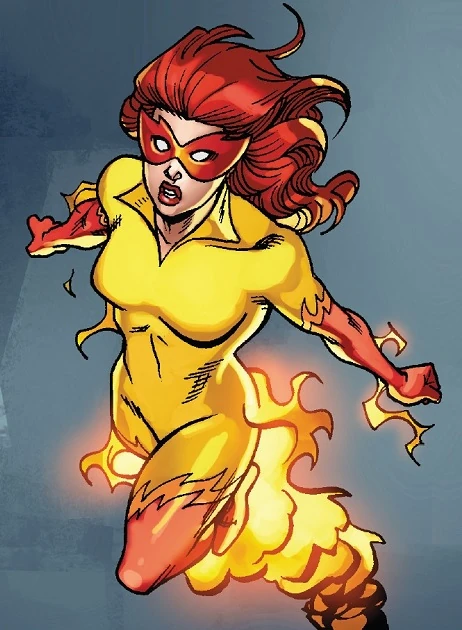
Source: Super Powers and Characters Wiki – Fandom
Angelica Jones, known as Firestar, represents one of Marvel’s most scientifically grounded and emotionally compelling fire-powered heroes. Her unique ability to generate and manipulate microwave radiation, which manifests as heat and flame effects, combined with her journey from manipulated student to confident Avenger, makes her one of the most well-developed and relatable fire-wielders in comics.
Firestar’s origin story explores themes of manipulation, education, and self-discovery that resonate with readers who have experienced similar challenges in their own lives. Initially recruited by Emma Frost and the Massachusetts Academy under false pretenses, Angelica was trained to be an assassin while believing she was learning to control her dangerous powers for the good of society. This deception adds layers of trauma and trust issues to her character that inform her relationships and decision-making throughout her heroic career.
The scientific basis of Firestar’s abilities sets her apart from more mystical or mutation-based fire heroes. Her power to generate and manipulate microwave radiation provides a realistic foundation for her heat and flame effects while creating unique tactical applications that other fire-wielders cannot replicate. Her ability to affect electromagnetic fields, disrupt electronic devices, and generate precise heat effects demonstrates the versatility of her scientifically grounded powers.
Her membership in the New Warriors during the team’s early years showcased her abilities alongside other young heroes while allowing her to develop leadership skills and personal relationships. Her time with the team proved that despite her traumatic background and dangerous powers, she could work effectively with others and contribute meaningfully to team objectives. Her relationships with teammates like Nova and Speedball added personal dimensions to her character.
The visual presentation of Firestar’s powers creates distinctive imagery that sets her apart from conventional fire-wielders. Her microwave radiation manifests as golden-orange energy that can appear as flames, energy blasts, or radiant auras depending on her specific application. This unique visual signature makes her attacks instantly recognizable while creating spectacular action sequences that emphasize both beauty and power.
Her romantic relationship with Iceman creates one of comics’ most interesting power-based partnerships. The contrast between her heat-based abilities and his ice powers creates natural dramatic tension while their emotional connection demonstrates that opposing forces can complement each other. Their relationship explores themes of balance, compromise, and how differences can strengthen rather than divide couples.
Firestar’s role as an Avenger elevated her from team player to major league hero while demonstrating that her powers and character were worthy of Earth’s Mightiest Heroes. Her membership in the team proved her tactical value and heroic credentials while providing opportunities for stories that showcased her abilities against cosmic-level threats and alongside Marvel’s most established heroes.
The health implications of Firestar’s powers add realistic consequences to her abilities that create ongoing character development opportunities. Her microwave generation affects her own cellular structure, creating potential health risks that she must constantly monitor and manage. This biological cost to her powers adds weight to her decisions about when and how to use her abilities.
Her flight capabilities, achieved through microwave-powered propulsion, provide mobility that enhances her tactical effectiveness while creating opportunities for aerial combat and reconnaissance. Her ability to fly using her own powers demonstrates advanced control over her abilities while providing practical advantages in various mission profiles.
The precision of Firestar’s microwave manipulation allows for surgical applications that other fire-wielders cannot achieve. She can target specific electronic systems, create localized heat effects, or generate electromagnetic pulses with pinpoint accuracy. This precision makes her valuable in situations requiring finesse rather than raw power.
Her background with the Massachusetts Academy and her complex relationship with Emma Frost create ongoing storylines about forgiveness, growth, and overcoming manipulation. These personal conflicts add depth to her character while exploring themes of education, trust, and the long-term effects of psychological manipulation.
Firestar’s role as a mentor to younger heroes demonstrates her growth from manipulated student to confident leader. Her experiences with deception and control make her particularly effective at helping other young heroes navigate the challenges of developing their abilities while maintaining their moral compass.
The environmental applications of Firestar’s powers create opportunities for civilian heroics beyond traditional combat situations. Her ability to generate controlled heat could be valuable in rescue operations, while her electromagnetic manipulation might be useful in technological emergencies or natural disasters.
Her costume design effectively communicates her fire-based abilities while maintaining a distinctive visual identity. The red and yellow color scheme suggests both flame and energy, while her confident posture reflects her growth from uncertain student to accomplished hero.
The character’s evolution from animated series creation to comic book mainstay demonstrates the potential for characters to transcend their original medium and find new life in different formats. Her successful transition from “Spider-Man and His Amazing Friends” to Marvel Comics proper proves the strength of her core concept and character design.
Her microwave powers create unique defensive capabilities that complement her offensive abilities. She can create heat barriers, disrupt incoming energy attacks, or generate electromagnetic fields that interfere with enemy equipment. This versatility makes her effective in various combat situations.
Firestar’s role in major Marvel events, including her participation in Civil War and other crossover storylines, demonstrates her importance to Marvel’s broader continuity. Her powers and character make her valuable in stories that require both combat effectiveness and emotional depth.
The psychological impact of her powers on Angelica herself creates ongoing character development opportunities. Living with abilities that could potentially harm her own health while being responsible for protecting others creates internal conflicts that add depth to her heroic journey.
Her relationship with her father and her efforts to maintain connections to her civilian life demonstrate the challenges of balancing superhero responsibilities with personal relationships. These civilian connections ground her character and provide stakes beyond her heroic activities.
The technical aspects of Firestar’s microwave manipulation allow for creative problem-solving applications that go beyond simple combat. Her ability to affect electromagnetic fields and electronic systems makes her valuable in technological scenarios where conventional fire powers might be ineffective.
Her role as a bridge between different generations of Marvel heroes—having worked with both established Avengers and younger New Warriors—gives her unique perspectives on heroism and team dynamics that enhance her value as a character and team member.
Firestar claims position number 9 through her unique combination of scientifically grounded powers, compelling character development, and proven effectiveness across multiple teams and contexts. Her microwave-based abilities represent one of comics’ most realistic and versatile approaches to heat and flame generation, while her journey from manipulated student to confident Avenger demonstrates remarkable personal growth. Her character proves that the most memorable fire-wielders are often those who combine unique abilities with genuine human struggles and the determination to overcome past trauma while helping others.
8. Sunfire – The Nuclear Flame of the Rising Sun
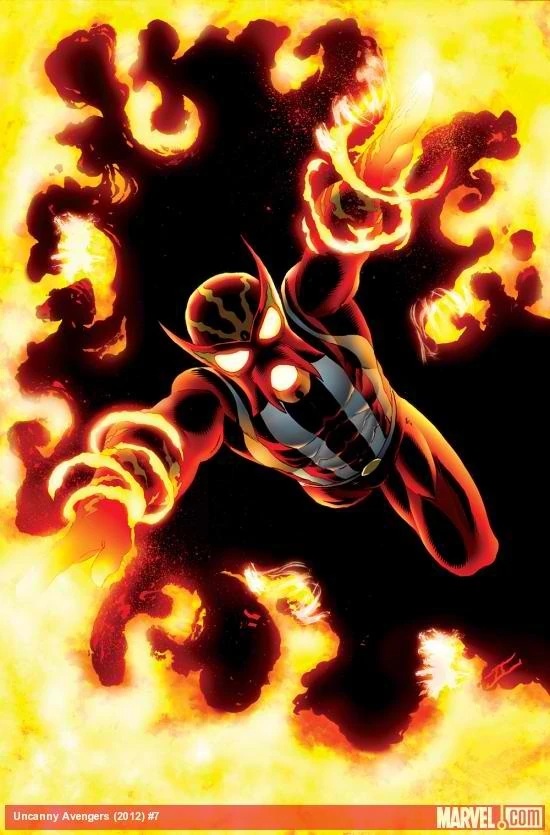
Source: Avengers and X-Men Wiki – Fandom
Shiro Yoshida, known as Sunfire, stands as one of Marvel’s most powerful and culturally significant fire-wielders, representing both the destructive potential of nuclear energy and the complex relationship between Japan and the atomic age. His ability to absorb and project solar radiation in the form of nuclear fire makes him one of the most scientifically formidable heroes in the Marvel Universe, while his role as Japan’s premier superhero adds important international perspective to the X-Men and broader Marvel continuity.
Sunfire’s origin story is deeply rooted in the historical trauma of nuclear warfare and Japan’s unique relationship with atomic energy. As a mutant whose powers manifested in response to radiation exposure, Shiro represents both the destructive legacy of nuclear weapons and the potential for that same energy to be channeled toward protection and heroism. This background gives his character profound historical weight and cultural significance that extends far beyond typical superhero origins.
The scope of Sunfire’s abilities encompasses both solar energy absorption and nuclear fire projection, creating a power set that operates on a scale few other heroes can match. His ability to absorb solar radiation allows him to continuously recharge his powers while his nuclear fire projection can reach temperatures exceeding those of conventional flames by orders of magnitude. This combination of renewable energy source and devastating output makes him incredibly formidable in extended conflicts.
His membership in the X-Men, though often reluctant and temporary, demonstrates his importance to Marvel’s mutant community while showcasing his abilities alongside other powerful heroes. His participation in major X-Men storylines, including his role in the team that rescued the original X-Men from Krakoa, proves his tactical value and heroic credentials despite his often abrasive personality and nationalist tendencies.
The visual spectacle of Sunfire’s nuclear flames creates some of Marvel’s most impressive fire-based imagery. His ability to generate plasma-level temperatures and create nuclear fire effects provides artists with opportunities to illustrate truly spectacular displays of power that emphasize both beauty and terror. His flames often incorporate solar imagery and atomic symbols that reinforce the scientific basis of his abilities.
Sunfire’s flight capabilities, achieved through nuclear-powered propulsion, allow him to reach incredible speeds while creating distinctive contrails of nuclear fire. His aerial mobility makes him effective in various tactical situations while creating opportunities for dynamic action sequences that showcase both his power and his grace in the air.
His role as Japan’s national superhero adds political and cultural dimensions to his character that most heroes lack. His actions reflect not just on himself but on his entire nation, creating stakes that extend beyond personal heroics to international relations and cultural representation. This responsibility adds weight to his decisions and creates opportunities for stories that explore nationalism, cultural identity, and international cooperation.
The atomic nature of Sunfire’s powers creates unique tactical applications that set him apart from conventional fire-wielders. His nuclear fire can affect targets on a molecular level, disrupt electronic systems through electromagnetic pulse effects, and generate radiation that can be harmful to enemies while remaining under his control. These applications demonstrate the sophisticated nature of his abilities.
His complex relationship with his father and his family’s history with atomic energy adds personal stakes to his character that connect to larger historical themes. His struggle to honor his family while forging his own path as a hero creates internal conflicts that enhance his character development while exploring themes of legacy, responsibility, and cultural identity.
Sunfire’s interactions with other international heroes demonstrate his value as a representative of Japanese culture and perspective within the global superhero community. His participation in international teams and his relationships with heroes from other countries showcase how cultural differences can be overcome through shared commitment to protecting humanity.
The environmental implications of Sunfire’s nuclear powers create interesting storytelling opportunities. His ability to generate clean nuclear energy could be valuable in addressing energy crises, while his understanding of radiation and atomic processes makes him uniquely qualified to deal with nuclear accidents or atomic-powered threats.
His costume design effectively communicates both his Japanese heritage and his nuclear-based abilities. The rising sun motif on his costume reinforces his connection to Japan while the red and yellow color scheme suggests both flame and atomic energy. This visual presentation immediately establishes his cultural identity and power source.
The character’s role in major Marvel events, including his participation in various X-Men missions and international crises, demonstrates his importance to Marvel’s global continuity. His powers make him valuable against cosmic-level threats while his perspective as a Japanese hero adds diversity to predominantly American superhero teams.
Sunfire’s ability to absorb various forms of radiation beyond just solar energy gives him tactical flexibility and defensive capabilities. He can potentially neutralize radioactive threats, absorb energy attacks, or draw power from various sources depending on the situation. This adaptability makes him effective in various environments and against different types of enemies.
His knowledge of atomic science and nuclear physics, whether innate or learned through his powers, gives him insights that make him valuable beyond his combat abilities. He can understand and potentially counter nuclear threats, advise on atomic energy applications, or serve as an expert consultant on radiation-related issues.
The psychological impact of wielding nuclear-level power adds depth to Sunfire’s character. Living with the knowledge that his abilities could cause incredible destruction if misused creates internal pressure that informs his personality and decision-making. This responsibility adds weight to his character beyond simple power fantasy.
His role as a bridge between Eastern and Western superhero traditions provides opportunities for stories that explore different cultural approaches to heroism and power. His Japanese perspective on duty, honor, and responsibility creates interesting contrasts with Western superhero ideals.
The scientific accuracy of Sunfire’s nuclear-based powers adds credibility to his abilities while creating educational opportunities for readers interested in atomic science. His powers reflect actual nuclear processes and atomic theory, making him one of comics’ most scientifically grounded characters.
His participation in space-based adventures and cosmic-level threats demonstrates that his powers are effective beyond Earth’s atmosphere. His ability to absorb solar radiation directly from the sun in space makes him potentially more powerful in extraterrestrial environments.
Sunfire claims position number 8 through his unique combination of nuclear-powered abilities, cultural significance, and scientific grounding that sets him apart from all other fire-wielders. His nuclear flames represent one of comics’ most powerful and scientifically accurate approaches to fire-based abilities, while his role as Japan’s premier superhero adds important international perspective to Marvel’s continuity. His character proves that the most impactful fire-wielders are often those whose abilities connect to real-world science and historical events while representing important cultural perspectives within the global superhero community.
7. Firestorm – The Nuclear Man’s Atomic Fusion
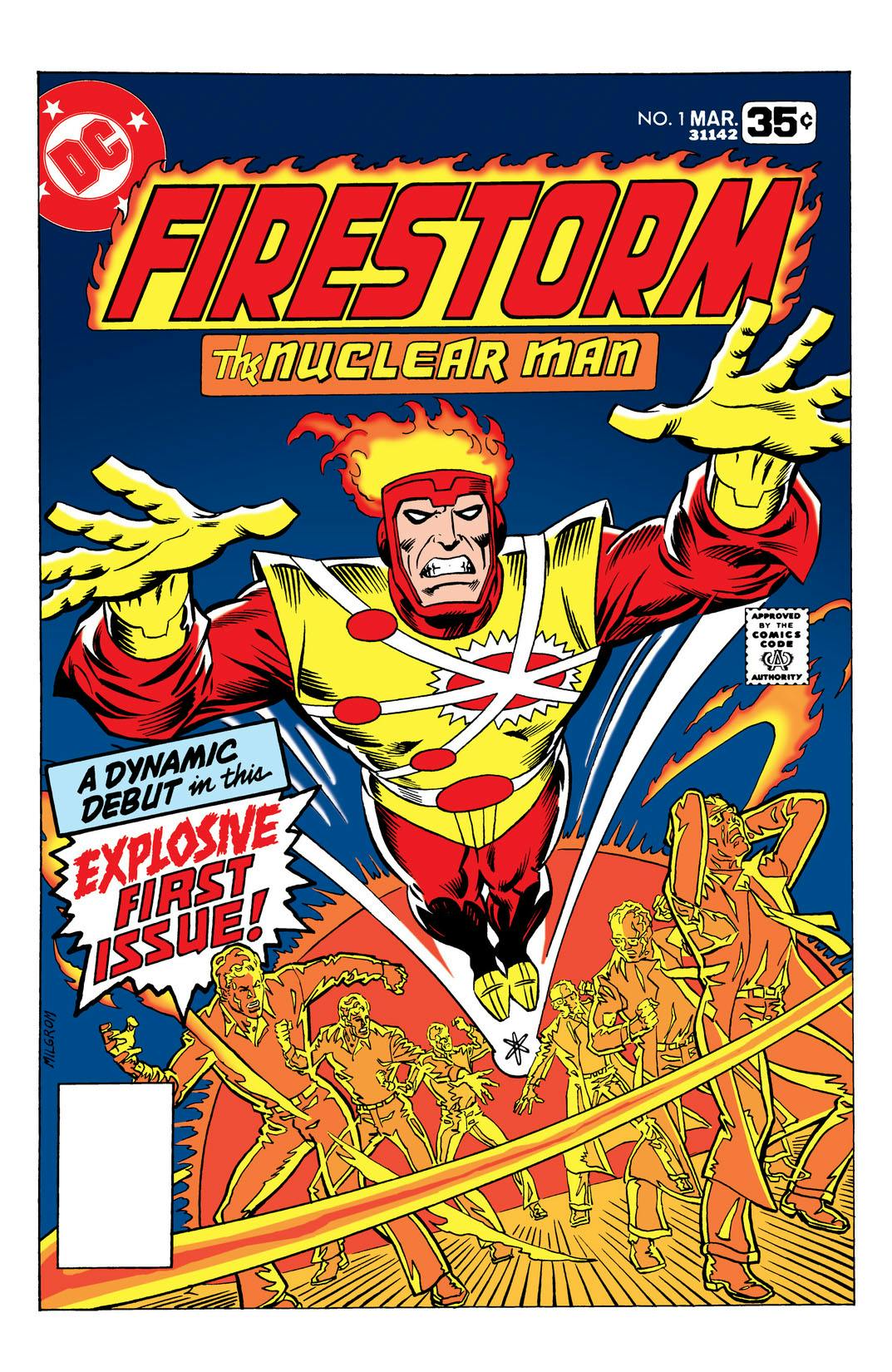
Source: DC Universe Infinite
Firestorm, the Nuclear Man, represents one of DC Comics’ most scientifically sophisticated and visually spectacular fire-powered heroes. The unique fusion of two individuals—typically Ronnie Raymond and Professor Martin Stein—into a single nuclear-powered being creates not only incredible atomic abilities but also fascinating character dynamics that explore themes of cooperation, identity, and the responsible use of ultimate power.
The concept of Firestorm as a fusion of two distinct personalities creates unprecedented storytelling opportunities in superhero comics. The combination of Ronnie Raymond’s youthful enthusiasm and physical control with Professor Stein’s scientific knowledge and wisdom creates a character that is literally greater than the sum of its parts. This dual consciousness allows for internal dialogue, moral debates, and character development that would be impossible with a single individual.
Firestorm’s nuclear powers operate on a fundamental level that few other heroes can match. His ability to manipulate atomic structure allows him to transmute elements, create nuclear fusion reactions, and generate energy on a scale that approaches cosmic levels. His signature nuclear blasts can level city blocks while his transmutation abilities can solve problems that would be impossible for conventional heroes to address.
The visual design of Firestorm creates one of comics’ most iconic and immediately recognizable appearances. His flaming hair, nuclear symbol chest emblem, and energy-wreathed form communicate both power and scientific sophistication. The “nuclear man” aesthetic perfectly captures the character’s atomic theme while creating spectacular visual effects that make every appearance memorable.
His flight capabilities, powered by nuclear energy, allow him to achieve incredible speeds while leaving distinctive energy contrails that mark his passage. His aerial mobility is enhanced by his ability to generate nuclear propulsion, making him one of the fastest flying heroes in the DC Universe while creating opportunities for spectacular chase sequences and aerial combat.
The transmutation aspect of Firestorm’s abilities sets him apart from all other fire-wielders and most other heroes in general. His power to rearrange atomic structure means he can transform any inorganic matter into any other inorganic substance, limited only by his knowledge of chemistry and physics. This ability makes him incredibly versatile in problem-solving situations and provides unique tactical applications.
Firestorm’s role in the DC Universe as both street-level hero and cosmic-level powerhouse demonstrates his versatility and importance to the company’s continuity. His nuclear abilities make him effective against both human criminals and cosmic threats, while his scientific knowledge provides valuable expertise in technological or scientific crises.
The educational potential of Firestorm’s character cannot be overstated. His adventures often incorporate real scientific principles, atomic theory, and chemistry lessons that can educate readers while entertaining them. Professor Stein’s scientific expertise, channeled through the character, makes Firestorm one of comics’ most scientifically accurate heroes.
His membership in various teams, including the Justice League and the Legends, showcases his abilities in group contexts while demonstrating his value as both a powerhouse and a problem-solver. His unique combination of raw power and scientific knowledge makes him valuable in teams that face diverse threats requiring different approaches.
The character’s evolution through different host combinations—from Ronnie and Stein to Jason Rusch and others—demonstrates the flexibility of the Firestorm concept while exploring how different personalities affect the character’s abilities and decision-making. Each combination brings unique perspectives and capabilities to the role.
Firestorm’s nuclear matrix serves as both power source and limitation, creating interesting storytelling constraints that prevent him from being overpowered while adding scientific authenticity to his abilities. The matrix’s requirements and limitations add strategic elements to his adventures while maintaining scientific credibility.
The environmental implications of Firestorm’s powers create opportunities for stories that address ecological themes and scientific responsibility. His ability to transmute pollutants, neutralize radioactive materials, or create beneficial chemical compounds makes him valuable in environmental protection scenarios.
His role in major DC events, including Crisis on Infinite Earths and other crossover storylines, demonstrates his importance to DC’s cosmic continuity. His nuclear powers make him effective against reality-threatening crises while his scientific knowledge provides crucial expertise in understanding and countering cosmic-level threats.
The character’s design allows for spectacular special effects in various media adaptations. His nuclear flames, transmutation abilities, and energy projections create opportunities for impressive visual displays that showcase the full potential of his atomic powers while maintaining scientific authenticity.
Firestorm’s ability to detect and analyze atomic structures gives him investigative capabilities that complement his combat abilities. He can identify unknown substances, detect nuclear materials, or analyze chemical compositions in ways that other heroes cannot, making him valuable in scientific mysteries and technological threats.
The psychological dynamics between Firestorm’s component personalities create ongoing character development opportunities. The need for cooperation between different individuals with different priorities and perspectives adds complexity to decision-making while exploring themes of compromise, communication, and mutual respect.
His nuclear knowledge makes him uniquely qualified to deal with atomic-powered villains, nuclear accidents, or radiation-based threats. His understanding of atomic processes and his immunity to radiation effects make him the ideal hero for scenarios involving nuclear dangers.
The character’s role as a bridge between street-level heroics and cosmic-level adventures demonstrates his versatility and broad appeal. He can operate effectively against both conventional criminals and reality-threatening cosmic entities, making him valuable in various narrative contexts.
Firestorm’s transmutation abilities create unique problem-solving opportunities that go beyond conventional superhero solutions. His power to change the fundamental nature of matter allows for creative approaches to obstacles that would stymie other heroes, making him particularly valuable in scenarios requiring innovative thinking.
His nuclear flames serve both practical and symbolic functions in storytelling. They can represent the power of atomic energy, the potential for both creation and destruction, or the importance of scientific knowledge in addressing modern challenges.
Firestorm claims position number 7 through his unique combination of nuclear-powered abilities, dual consciousness, and scientific sophistication that sets him apart from all other heroes. His atomic manipulation represents one of comics’ most powerful and scientifically grounded power sets, while his fusion of multiple personalities creates unprecedented character dynamics. His character proves that the most compelling fire-wielders are often those who combine incredible power with scientific knowledge and the complexity that comes from multiple perspectives working toward common goals.
6. Sunspot – The Solar-Powered Mutant’s Dark Fire
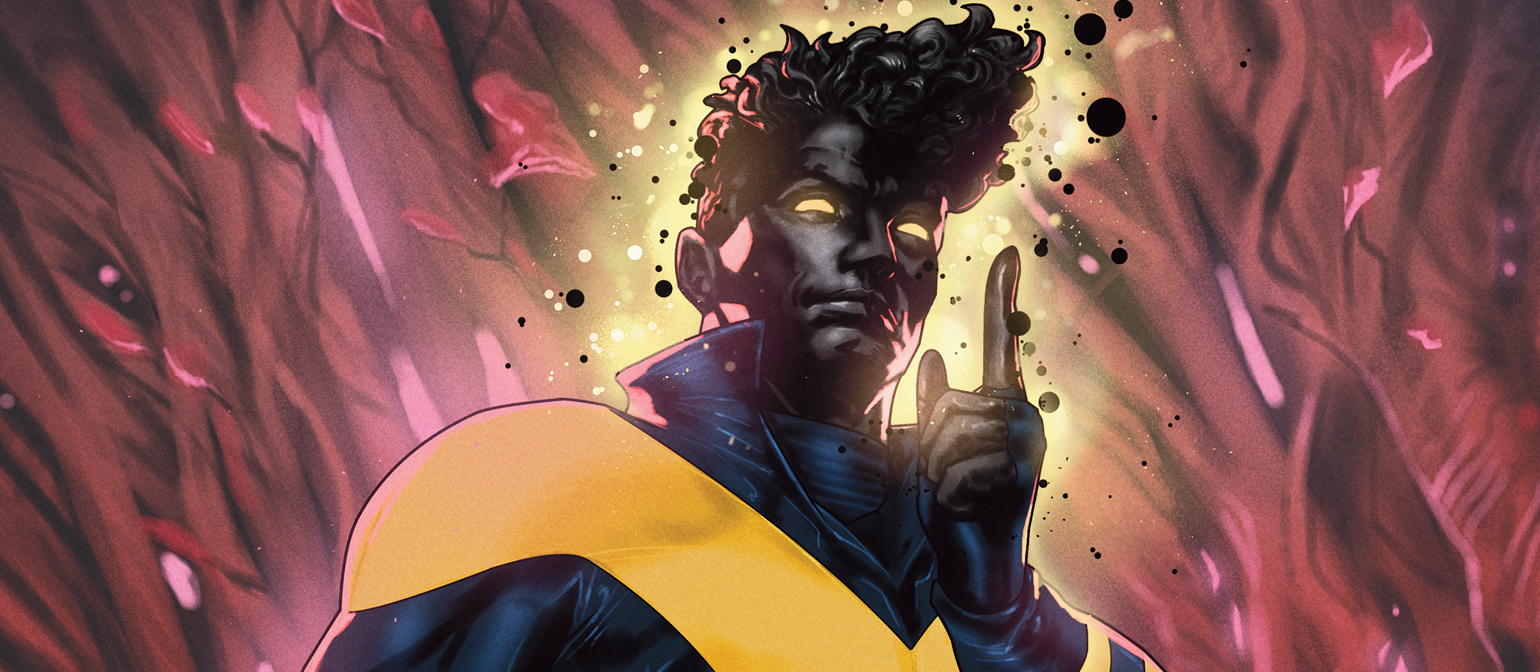
Source: Marvel Comics
Roberto da Costa, known as Sunspot, represents one of Marvel’s most unique approaches to solar-powered abilities, combining the absorption of solar energy with its conversion into superhuman strength and heat projection. His distinctive black solar form and his evolution from wealthy Brazilian teenager to cosmic-level powerhouse make him one of the most visually striking and progressively powerful fire-based heroes in the Marvel Universe.
Sunspot’s origin story perfectly captures the international scope of Marvel’s mutant community while addressing themes of privilege, responsibility, and cultural identity. As the son of a wealthy Brazilian businessman, Roberto’s initial concerns centered around typical teenage issues until his mutant powers manifested during a racially motivated attack. This origin connects his abilities to real-world social issues while establishing his character as someone who must learn to use his privilege and power responsibly.
The unique nature of Sunspot’s solar absorption creates a power set that operates differently from conventional fire-wielders. Rather than generating flames directly, he absorbs solar radiation and converts it into superhuman physical abilities and heat projection. His distinctive black appearance when powered up—the result of his body absorbing light across the spectrum—creates a visually striking contrast to typical fire-based heroes who glow or burn with visible flames.
His membership in the New Mutants provided him with a team context that allowed for character development while showcasing his abilities alongside other young heroes. His relationships with teammates like Cannonball, Wolfsbane, and Mirage added personal dimensions to his character while his leadership potential became apparent through various adventures and crises.
The progressive nature of Sunspot’s power development demonstrates one of comics’ most impressive examples of power evolution. From his initial ability to absorb solar energy for enhanced strength, he has grown to cosmic-level capabilities including matter manipulation, energy projection on a planetary scale, and even the ability to create and control solar flares. This growth reflects both his increasing mastery of his abilities and the expanding scope of threats he faces.
His role as a member of X-Force showcased his abilities in more mature and complex storylines while demonstrating his evolution from teenager to adult hero. His participation in the team’s time-traveling adventures and cosmic-level missions proved his tactical value and heroic credentials while allowing for character growth and development.
The visual presentation of Sunspot’s powers creates distinctive imagery that sets him apart from other solar-powered heroes. His transformation into a being of living shadow that radiates heat and energy creates striking visual contrasts while his ability to project solar flares and energy blasts provides spectacular action sequences that emphasize both power and precision.
His wealthy background and business acumen add dimensions to his character that most heroes lack. His ability to use financial resources and corporate connections to support his heroic activities demonstrates how wealth can be channeled toward positive ends while his understanding of economics and business provides unique perspectives on global threats.
Sunspot’s Brazilian heritage brings important cultural diversity to Marvel’s superhero community while providing opportunities for stories that explore South American culture, politics, and social issues. His character helps demonstrate that heroism is a global phenomenon and that different cultures can contribute unique perspectives to the fight against evil.
His role in the Avengers, particularly during his time with the team, elevated him from team player to major league hero while demonstrating that his powers and character were worthy of Earth’s Mightiest Heroes. His membership proved his tactical value and leadership potential while providing opportunities for cosmic-level adventures.
The scientific basis of Sunspot’s abilities adds credibility to his powers while creating educational opportunities for readers interested in solar energy and physics. His power to absorb and convert solar radiation reflects actual scientific principles while his heat projection demonstrates practical applications of solar energy conversion.
His leadership roles in various teams, including his time leading the New Mutants and X-Force, demonstrate his growth from impulsive teenager to mature leader. His ability to inspire and coordinate other heroes while maintaining his individual effectiveness makes him valuable in team situations requiring both power and strategic thinking.
The environmental implications of Sunspot’s solar-based powers create opportunities for stories that address renewable energy themes and environmental protection. His ability to harness clean solar energy and his understanding of energy systems make him uniquely qualified to address energy-related crises or environmental threats.
His costume design effectively communicates his solar-based abilities while maintaining a distinctive visual identity. The contrast between his normal appearance and his powered-up black solar form creates dramatic visual impact while his confident bearing reflects his wealthy background and heroic experience.
Sunspot’s ability to operate at various power levels depending on available solar energy creates interesting strategic elements in his adventures. His need to manage his energy reserves and his increased effectiveness in direct sunlight add tactical considerations that enhance storytelling while maintaining scientific authenticity.
His role in major Marvel events, including his participation in various crossover storylines and cosmic-level threats, demonstrates his importance to Marvel’s broader continuity. His powers make him effective against both terrestrial and extraterrestrial threats while his leadership experience provides valuable strategic expertise.
The character’s evolution from New Mutant to cosmic-level hero demonstrates impressive character growth and power development. His journey from wealthy teenager learning to use his abilities responsibly to leader capable of facing universal threats shows remarkable personal and heroic development.
His heat projection abilities complement his enhanced physical capabilities to create a well-rounded power set effective in various combat situations. His ability to generate intense heat while maintaining superhuman strength makes him formidable in both close combat and ranged engagements.
Sunspot’s role as a bridge between different generations of Marvel heroes—having worked with both established teams and younger heroes—gives him unique perspectives on heroism and team dynamics that enhance his value as a character and leader.
The technical aspects of his solar energy manipulation allow for creative applications beyond simple strength enhancement and heat projection. His growing ability to manipulate solar radiation at fundamental levels opens possibilities for increasingly sophisticated uses of his powers.
Sunspot claims position number 6 through his unique combination of solar energy absorption, progressive power development, and proven leadership capabilities across multiple teams and contexts. His solar-based abilities represent one of comics’ most scientifically grounded and visually distinctive approaches to energy manipulation, while his evolution from privileged teenager to cosmic-level hero demonstrates remarkable character growth. His character proves that the most compelling fire-wielders are often those who combine unique power sources with genuine personal development and the ability to grow into greater responsibilities while maintaining their core identity and values.
5. Firelord – The Herald’s Cosmic Inferno

Source: Marvel Comics
Pyreus Kril, known as Firelord, represents the ultimate fusion of cosmic power and fire-based abilities in the Marvel Universe. As a former Herald of Galactus, Firelord wields the Power Cosmic channeled through flame-based applications, making him one of the most powerful fire-wielders in all of comics. His journey from Xandarian starship captain to cosmic-level hero demonstrates how ordinary individuals can rise to face universal responsibilities while wielding power that operates on a planetary scale.
Firelord’s origin story connects him to Marvel’s cosmic hierarchy while providing a compelling narrative of sacrifice, transformation, and redemption. When his friend Gabriel Lan (Air-Walker) was killed while serving as Galactus’s herald, Pyreus Kril volunteered to take his place to prevent Galactus from creating a robotic replacement. This selfless act established his heroic character while providing him with cosmic-level abilities that he would later use to protect rather than serve the World-Devourer.
The scope of Firelord’s abilities encompasses both the fundamental forces of fire and the limitless potential of the Power Cosmic. His flames can reach temperatures that exceed those of stellar cores, while his cosmic awareness allows him to perceive threats and opportunities across vast distances. His combination of fire-based attacks and cosmic-level durability makes him capable of engaging threats that would destroy entire planets.
His distinctive appearance, with his flaming staff and fire-wreathed form, creates one of Marvel’s most visually impressive cosmic characters. The contrast between his humanoid appearance and his cosmic-level abilities emphasizes the transformation that cosmic power can bring while his flame-based visual effects create spectacular imagery that communicates both beauty and terrible power.
Firelord’s cosmic staff serves as both weapon and symbol of his cosmic status. The staff can project flames across interstellar distances, channel the Power Cosmic into devastating attacks, and serve as a focus for his cosmic awareness. This weapon represents the marriage of his fire-based nature with his cosmic responsibilities, creating a unique visual and conceptual element that sets him apart from other cosmic beings.
His role as a former Herald of Galactus provides him with unique insights into cosmic-level threats and the responsibilities that come with ultimate power. His experience serving the World-Devourer taught him about the balance between individual desires and universal necessities, while his eventual rebellion against Galactus demonstrated his commitment to protecting life rather than consuming it.
The interstellar scope of Firelord’s adventures demonstrates the cosmic scale of his abilities and responsibilities. His flames can survive in the vacuum of space, his cosmic awareness spans galaxies, and his power level allows him to engage threats that endanger entire star systems. This cosmic perspective sets him apart from Earth-based heroes while connecting him to Marvel’s larger universal continuity.
His interactions with Earth’s heroes, particularly the Fantastic Four and the Avengers, showcase his abilities in contexts that readers can relate to while demonstrating the vast difference between cosmic and terrestrial power levels. His willingness to aid Earth’s heroes despite his cosmic responsibilities proves his heroic character and his commitment to protecting all life.
Firelord’s flames possess properties that transcend normal combustion, incorporating cosmic energies that can affect matter and energy on fundamental levels. His fire can burn in airless space, affect intangible targets, and generate temperatures that approach absolute limits. These cosmic-enhanced flames make him effective against threats that would be immune to conventional fire attacks.
His flight capabilities, powered by cosmic energy, allow him to travel at faster-than-light speeds while navigating through space, hyperspace, and various dimensions. This mobility makes him one of the most capable cosmic travelers in the Marvel Universe while providing tactical advantages in cosmic-level conflicts.
The character’s role in major cosmic events, including his participation in various galactic crises and universal threats, demonstrates his importance to Marvel’s cosmic continuity. His power level and cosmic awareness make him valuable in situations that threaten entire galaxies while his heroic character ensures his commitment to protecting life.
His relationship with other cosmic beings, including his former master Galactus and fellow Heralds, creates ongoing storylines about power, responsibility, and the nature of cosmic duty. These relationships explore themes of redemption, rebellion, and the possibility of using ultimate power for protective rather than destructive purposes.
Firelord’s cosmic awareness provides him with knowledge and perception that extends far beyond his fire-based abilities. He can detect threats across vast distances, understand cosmic-level phenomena, and perceive the interconnections between seemingly unrelated events. This awareness makes him valuable as both combatant and advisor in cosmic-level crises.
The environmental effects of Firelord’s presence demonstrate the scale of his power. His flames can ignite atmospheres, his cosmic energy can affect planetary magnetic fields, and his mere presence can influence local space-time. These effects emphasize the vast difference between cosmic and terrestrial power levels.
His moral complexity as a former servant of Galactus adds depth to his character beyond simple heroism. His past participation in planetary destruction creates internal conflicts about redemption and responsibility while his current heroic activities demonstrate the possibility of using cosmic power for protection rather than consumption.
The character’s design effectively communicates both his cosmic status and his fire-based nature. His flaming appearance and cosmic staff immediately establish his power level while his humanoid form maintains relatability and emotional connection with readers.
Firelord’s role as a bridge between cosmic and terrestrial storylines makes him valuable in narratives that span multiple scales of conflict. He can operate effectively in both cosmic adventures and Earth-based stories, providing connections between different levels of Marvel’s universe.
His flames serve both practical and symbolic functions in cosmic-level storytelling. They can represent the power of stars, the energy of creation and destruction, or the passion required to face universal responsibilities while maintaining individual identity and moral purpose.
The technical aspects of Firelord’s cosmic fire manipulation create opportunities for spectacular displays of power that operate on scales difficult to comprehend. His ability to generate stellar-level temperatures and cosmic-scale flame effects provides artists with opportunities to create truly awe-inspiring imagery.
His experience as both destroyer and protector gives him unique perspectives on the use of ultimate power and the responsibilities that come with cosmic-level abilities. This experience makes him valuable as a mentor and advisor to other heroes facing similar moral challenges.
Firelord claims position number 5 through his unique combination of cosmic-level power, fire-based abilities, and compelling character arc from Herald to hero. His cosmic flames represent one of comics’ most powerful and literally stellar approaches to fire manipulation, while his journey from servant of destruction to protector of life demonstrates the possibility of redemption even at cosmic scales. His character proves that the most impressive fire-wielders are often those who combine ultimate power with the wisdom to use it responsibly and the courage to rebel against destructive purposes in favor of protective ones.
4. Nova (Frankie Raye) – The Herald’s Stellar Sacrifice
Source: Marvel Comics
Frankie Raye, known as Nova during her time as Herald of Galactus, represents one of Marvel’s most tragic and powerful fire-wielders. Her transformation from Johnny Storm’s girlfriend to cosmic-level Herald demonstrates the ultimate expression of fire-based abilities while exploring themes of sacrifice, cosmic responsibility, and the price of ultimate power. Her story serves as both inspiration and cautionary tale about the seductive nature of cosmic power and the responsibilities that come with abilities that operate on a universal scale.
Nova’s origin story begins with tragedy and manipulation, as she was exposed to the same chemicals that gave the original Human Torch his powers, but with the added psychological conditioning that made her fear and hate fire. This cruel irony—being granted fire powers while being conditioned to fear them—created internal conflicts that defined her character and made her eventual embrace of her abilities all the more meaningful and powerful.
Her relationship with Johnny Storm and the Fantastic Four provided her with the support and understanding necessary to overcome her psychological conditioning and embrace her fire-based abilities. This period of her life demonstrated how the right environment and relationships can help individuals overcome even the most severe psychological barriers while showcasing her potential as a fire-wielder who could match or exceed the Human Torch’s abilities.
The scope of Nova’s abilities, even before her cosmic enhancement, rivaled those of the most powerful fire-wielders on Earth. Her flames could reach incredible temperatures, her flight capabilities exceeded those of most heroes, and her heat generation could affect large areas. These Earth-level abilities established her as a formidable hero while foreshadowing her potential for even greater power.
Her decision to become Galactus’s Herald represents one of comics’ most complex moral choices, as she voluntarily accepted cosmic power and the responsibility to help the World-Devourer find uninhabited worlds to consume. This choice demonstrated her willingness to sacrifice her personal desires for what she perceived as the greater good while showcasing the seductive nature of ultimate power.
As Herald of Galactus, Nova’s abilities were enhanced to cosmic levels that placed her among the most powerful beings in the Marvel Universe. Her flames could now burn in the vacuum of space, reach temperatures that rivaled stellar cores, and affect matter on fundamental levels. Her cosmic awareness allowed her to perceive threats and opportunities across galactic distances while her enhanced durability made her nearly invulnerable to conventional attacks.
The visual presentation of Nova’s cosmic form created some of Marvel’s most spectacular imagery. Her transformation from human appearance to a being of living stellar fire provided artists with opportunities to create stunning visual effects that communicated both beauty and terrible power. Her cosmic flames and energy aura established her as one of the most visually impressive characters in Marvel’s cosmic hierarchy.
Her role in major cosmic events, including her participation in various galactic crises and her interactions with other cosmic beings, demonstrated her importance to Marvel’s universal continuity. Her power level made her effective against threats that could destroy entire star systems while her human origins provided emotional connections that pure cosmic entities often lack.
The tragedy of Nova’s eventual death while serving as Galactus’s Herald adds emotional weight to her story while exploring themes of sacrifice and the cost of cosmic responsibility. Her willingness to die protecting others, even while serving the World-Devourer, demonstrated that her heroic nature remained intact despite her cosmic transformation and morally ambiguous position.
Her relationship with other Heralds of Galactus, including the Silver Surfer and Firelord, created opportunities for stories that explored the psychological and moral challenges of serving a being whose actions result in planetary destruction. These relationships demonstrated how individuals with similar cosmic responsibilities can support each other while maintaining their individual moral compasses.
Nova’s cosmic staff, like those of other Heralds, served as both weapon and symbol of her cosmic status. Her staff could channel the Power Cosmic into devastating attacks, project flames across interstellar distances, and serve as a focus for her cosmic awareness. This weapon represented the marriage of her fire-based nature with her cosmic responsibilities.
The environmental effects of Nova’s cosmic presence demonstrated the scale of her power. Her flames could ignite planetary atmospheres, her cosmic energy could affect stellar phenomena, and her mere presence could influence local space-time. These effects emphasized the vast difference between terrestrial and cosmic power levels.
Her moral complexity as a Herald who retained her heroic nature created unique storytelling opportunities. Unlike some Heralds who became detached from mortal concerns, Nova maintained her emotional connections and moral principles, creating internal conflicts about her role in planetary destruction while demonstrating the possibility of maintaining individual identity even when wielding cosmic power.
The character’s design effectively communicated both her cosmic status and her fire-based origins. Her stellar appearance and cosmic flames immediately established her power level while her humanoid form maintained emotional connection with readers and other characters.
Nova’s role as a bridge between Earth-based and cosmic storylines made her valuable in narratives that required connections between different scales of conflict. Her human origins and cosmic power allowed her to operate effectively in both terrestrial and universal contexts while providing emotional stakes that pure cosmic beings often lack.
Her flames served both practical and symbolic functions in cosmic-level storytelling. They represented the power of stars, the energy of creation and destruction, and the passion required to face universal responsibilities while maintaining individual moral purpose and emotional connections.
The technical aspects of Nova’s cosmic fire manipulation created opportunities for spectacular displays of power that operated on scales difficult to comprehend. Her ability to generate stellar-level temperatures and cosmic-scale flame effects provided artists with opportunities to create truly awe-inspiring imagery that communicated the vast scope of cosmic power.
Her experience as both human hero and cosmic Herald gave her unique perspectives on the use of ultimate power and the responsibilities that come with abilities that can affect entire civilizations. This dual experience made her valuable as both combatant and advisor in cosmic-level crises.
Nova claims position number 4 through her unique combination of human origins, cosmic-level power, and tragic heroic sacrifice. Her stellar flames represent one of comics’ most powerful expressions of fire-based abilities enhanced to cosmic scales, while her story demonstrates both the seductive nature of ultimate power and the possibility of maintaining heroic principles even when serving morally ambiguous cosmic purposes. Her character proves that the most memorable fire-wielders are often those who face the ultimate test of maintaining their humanity and moral compass while wielding power that operates on universal scales.
3. Johnny Storm (Human Torch) – The Fantastic Four’s Flaming Heart
Source: Fantastic Four: World’s Greatest Heroes Wiki – Fandom
Johnny Storm, the Human Torch of the Fantastic Four, stands as Marvel’s most iconic and influential fire-powered superhero. His combination of spectacular flame-based abilities, infectious enthusiasm, and role as the heart of Marvel’s First Family has made him not just one of the greatest fire-wielders of all time, but one of the most beloved and enduring characters in all of comics. His famous battle cry “Flame on!” has become synonymous with fire-based heroics and represents the pure joy and excitement that superhero comics can provide.
Johnny’s origin as part of the Fantastic Four’s cosmic ray exposure establishes him as a foundational character in the Marvel Universe while providing him with abilities that have defined fire-based heroics for over six decades. His transformation from hot-shot test pilot to superhero occurred alongside his sister Sue, her boyfriend Reed Richards, and pilot Ben Grimm, creating family dynamics that have provided emotional depth and interpersonal conflict that enhances every adventure.
The scope of Johnny’s fire-based abilities encompasses virtually every application of flame and heat that readers can imagine. His power to generate and control fire, achieve flight through flame propulsion, create complex fire constructs, and reach temperatures that can melt through virtually any substance makes him one of the most versatile and powerful fire-wielders in comics. His “nova flame” represents the ultimate expression of his abilities, generating heat that approaches stellar levels.
His role as the youngest member of the Fantastic Four has allowed him to grow and mature over decades of publication while maintaining the enthusiasm and impulsiveness that make him relatable to readers of all ages. His character development from reckless teenager to responsible adult hero demonstrates how superhero comics can explore themes of growth, responsibility, and family relationships while maintaining spectacular action and adventure.
The visual impact of Johnny’s transformation sequence—his famous “Flame on!” moment—has become one of comics’ most iconic and recognizable images. The dramatic change from normal human appearance to a being of living flame creates instant visual excitement while his flight capabilities and flame effects provide artists with endless opportunities for spectacular action sequences and dynamic page layouts.
His membership in the Fantastic Four places him at the center of Marvel’s cosmic adventures while grounding him in family relationships that provide emotional stakes beyond simple heroics. His interactions with Reed’s scientific genius, Sue’s protective instincts, and Ben’s gruff loyalty create character dynamics that have sustained reader interest for decades while providing opportunities for both humor and drama.
Johnny’s rivalry and friendship with Ben Grimm (The Thing) represents one of comics’ most enduring and entertaining relationships. Their constant banter, practical jokes, and underlying mutual respect create humor and heart that balances the team’s more serious scientific and cosmic adventures while demonstrating how different personalities can complement each other in family and team situations.
His romantic relationships, from his early infatuation with various girlfriends to his more serious relationships with characters like Crystal of the Inhumans, have provided opportunities for character development while exploring how superhero responsibilities affect personal relationships. These romantic storylines have humanized Johnny while creating emotional stakes that extend beyond his heroic activities.
The technical versatility of Johnny’s flame powers has been demonstrated through decades of creative applications. He can create flame duplicates of himself, generate precise heat for welding or cutting, use his flames for communication through sky-writing, and even create complex flame constructs that serve various tactical purposes. This versatility keeps his abilities fresh and interesting while providing solutions to diverse challenges.
His role in major Marvel events, from the Galactus trilogy to Secret Wars to Civil War, demonstrates his importance to Marvel’s broader continuity while showcasing his abilities against cosmic-level threats. His participation in these universe-spanning adventures proves that his powers and character are worthy of the biggest stages while maintaining his essential role as the Fantastic Four’s emotional center.
Johnny’s influence on subsequent fire-powered characters cannot be overstated. His visual design, power applications, and personality traits have influenced virtually every fire-wielder who came after him, while his “Flame on!” battle cry has been adopted or referenced by numerous other characters. He established the template that most fire-based heroes still follow today.
His scientific knowledge, gained through years of association with Reed Richards and exposure to advanced technology, adds intellectual depth to his character beyond his fire powers. His understanding of physics, chemistry, and advanced science makes him more than just a powerhouse—he’s a valuable team member who can contribute to problem-solving and strategic planning.
The character’s design, with his blue costume and flame effects, creates one of comics’ most visually striking and immediately recognizable appearances. The contrast between his human form and his flaming appearance emphasizes the dramatic nature of his transformation while his confident posture and expression communicate both power and approachability.
His role as a celebrity and public figure within the Marvel Universe adds dimensions to his character that many heroes lack. His comfort with media attention and public appearances makes him valuable as a spokesperson for superhero activities while his natural charisma helps maintain positive public relations for the superhero community.
Johnny’s flame immunity and heat resistance provide defensive capabilities that complement his offensive fire powers. His ability to survive in extreme heat environments, resist fire-based attacks, and maintain his powers even in challenging conditions makes him effective in various tactical situations while providing logical consistency to his abilities.
His flight speed, achieved through flame propulsion, rivals that of many of Marvel’s fastest heroes while his maneuverability in the air makes him effective in aerial combat and reconnaissance. His three-dimensional mobility provides tactical advantages that ground-based heroes cannot match while creating opportunities for spectacular aerial action sequences.
The environmental applications of Johnny’s powers extend beyond combat to include rescue operations, disaster relief, and civilian assistance. His ability to provide heat, light, and controlled destruction makes him valuable in various emergency situations while demonstrating the positive applications of his abilities.
His role as a bridge between different generations of Marvel heroes—having worked with both established veterans and younger heroes—gives him unique perspectives on heroism and team dynamics. His experience and enthusiasm make him valuable as both team member and mentor to newer heroes.
The psychological aspects of Johnny’s powers, including his need to maintain emotional control to prevent dangerous overheating, add depth to his character while creating internal conflicts that enhance storytelling. His struggle to balance his passionate nature with the need for restraint adds complexity to his seemingly straightforward abilities.
His participation in space-based adventures and cosmic-level threats demonstrates that his powers are effective beyond Earth’s atmosphere. His flames can burn in the vacuum of space while his heat generation remains effective in various alien environments, making him valuable in the Fantastic Four’s cosmic adventures.
Johnny Storm claims position number 3 through his unique combination of iconic status, versatile fire powers, and foundational importance to Marvel Comics and superhero fiction in general. His flame-based abilities represent the gold standard for fire-powered heroes, while his role as the heart of the Fantastic Four demonstrates how spectacular powers can be grounded in genuine human relationships and family dynamics. His character proves that the greatest fire-wielders are often those who combine incredible abilities with infectious enthusiasm, genuine growth, and the ability to inspire both fellow heroes and readers with the pure joy of superheroic adventure.
2. Phoenix Force – The Cosmic Entity of Infinite Fire

Source: Amazon
The Phoenix Force stands as the ultimate expression of fire-based power in the Marvel Universe—a cosmic entity of such incredible scope and ability that it transcends individual heroism to become a fundamental force of nature itself. As the nexus of all psionic energy across time and space, the Phoenix Force represents not just fire and destruction, but the eternal cycle of death and rebirth that governs all existence. Its power operates on scales that dwarf planetary concerns and extend to the very fabric of reality itself.
The Phoenix Force’s nature as a cosmic entity places it beyond conventional superhero categorization while establishing it as one of the most powerful forces in the Marvel Universe. Unlike heroes who gained their abilities through accident or mutation, the Phoenix Force is power itself—a fundamental aspect of cosmic reality that has existed since the beginning of time and will continue until the end of all things. This cosmic scope makes it unique among fire-wielders and establishes it as the ultimate expression of flame-based abilities.
The scope of the Phoenix Force’s abilities encompasses not just fire and energy manipulation, but reality alteration on a universal scale. It can manipulate matter and energy at the atomic level, travel through time and space instantaneously, resurrect the dead, and even recreate entire galaxies. Its flames are not merely hot—they are the fires of creation and destruction that can unmake and remake reality according to its will.
The visual presentation of the Phoenix Force creates some of comics’ most spectacular and awe-inspiring imagery. Its manifestation as a giant firebird composed of cosmic flames immediately communicates both beauty and terrible power, while its ability to encompass entire star systems demonstrates the vast scale of its abilities. The Phoenix raptor form has become one of the most recognizable and iconic images in all of comics.
Its relationship with Jean Grey and other hosts demonstrates how cosmic power can be channeled through individual personalities while exploring themes of corruption, responsibility, and the price of ultimate power. The Phoenix Force’s various manifestations through different hosts have created some of Marvel’s most compelling storylines while examining how infinite power affects finite beings.
The Phoenix Force’s role in major cosmic events, including its consumption of a star system and the resulting genocide of billions of D’Bari, establishes it as a force that operates beyond conventional morality. Its actions demonstrate that cosmic-level power comes with cosmic-level consequences, while its eventual redemption through various storylines explores themes of forgiveness and the possibility of change even for cosmic entities.
Its connection to the M’Kraan Crystal and other cosmic artifacts places it at the center of Marvel’s cosmic hierarchy while establishing its importance to the fundamental structure of reality. The Phoenix Force’s role as guardian of the crystal that contains the nexus of all realities demonstrates its cosmic significance and its responsibility for maintaining universal stability.
The entity’s ability to exist across multiple timelines and dimensions simultaneously makes it one of the most complex and far-reaching forces in Marvel continuity. Its actions in one timeline can affect events across multiple realities, while its cosmic awareness allows it to perceive threats and opportunities that exist beyond normal space-time.
The Phoenix Force’s flames possess properties that transcend normal combustion or even cosmic fire. Its flames can burn across dimensional barriers, affect abstract concepts like time and space, and even consume other cosmic entities. These flames represent the ultimate expression of fire-based power, operating on levels that approach the fundamental forces that govern reality itself.
Its role as both destroyer and creator reflects the dual nature of fire itself—the power to both consume and purify, to end old cycles and begin new ones. The Phoenix Force embodies this duality on a cosmic scale, serving as both the ultimate threat to existing reality and the ultimate source of renewal and rebirth.
The entity’s various manifestations through different hosts have created diverse interpretations of its power while maintaining its core identity as a force of cosmic fire and rebirth. From Jean Grey to Rachel Summers to Hope Summers, each host has brought unique perspectives to the Phoenix Force while demonstrating different aspects of its incredible abilities.
Its influence on Marvel’s cosmic continuity cannot be overstated. The Phoenix Force has been involved in reality-altering events, universal crises, and cosmic-level threats that have shaped the entire Marvel Universe. Its actions have consequences that extend across multiple comic book series and affect countless characters and storylines.
The Phoenix Force’s connection to psionic energy and telepathic abilities adds mental and spiritual dimensions to its fire-based powers. Its ability to manipulate minds, emotions, and souls demonstrates that its flames can burn more than just physical matter—they can affect the very essence of consciousness and identity.
Its role in the cycle of death and rebirth gives the Phoenix Force philosophical and spiritual significance that extends beyond simple power fantasy. The entity represents fundamental concepts about the nature of existence, the necessity of change, and the eternal cycle of destruction and renewal that governs all life.
The technical aspects of the Phoenix Force’s reality manipulation create opportunities for storylines that operate on scales difficult to comprehend. Its ability to alter fundamental forces, rewrite natural laws, and recreate entire universes provides writers with ultimate creative freedom while challenging them to create meaningful stories about ultimate power.
Its moral ambiguity as a force that operates beyond conventional good and evil creates complex storytelling opportunities. The Phoenix Force’s actions are guided by cosmic necessity rather than human morality, making it both savior and destroyer depending on the circumstances and perspective.
The entity’s design and visual presentation effectively communicate its cosmic status and fire-based nature. The Phoenix raptor form immediately establishes its power level while its cosmic flames and energy effects create imagery that operates on truly universal scales.
Its role as a test of worthiness for potential hosts creates ongoing storylines about power, responsibility, and the corruption that can come with ultimate abilities. The Phoenix Force’s selection of hosts and its interactions with them explore themes about who is worthy of cosmic power and what that power does to those who wield it.
The Phoenix Force’s connection to concepts of evolution and transcendence makes it relevant to stories about human potential and the future of consciousness. Its role in advancing evolution and creating new forms of life demonstrates how cosmic power can serve creative as well as destructive purposes.
The Phoenix Force claims position number 2 through its unique status as the ultimate expression of cosmic fire power and its fundamental importance to the structure of reality itself. Its flames represent not just the pinnacle of fire-based abilities but the very forces of creation and destruction that govern existence. The Phoenix Force proves that the most powerful fire-wielders are not individuals at all, but cosmic forces that embody the fundamental principles of change, renewal, and the eternal cycle of death and rebirth that defines all existence.
1. Phoenix (Jean Grey) – The Ultimate Fire-Wielder’s Perfect Union
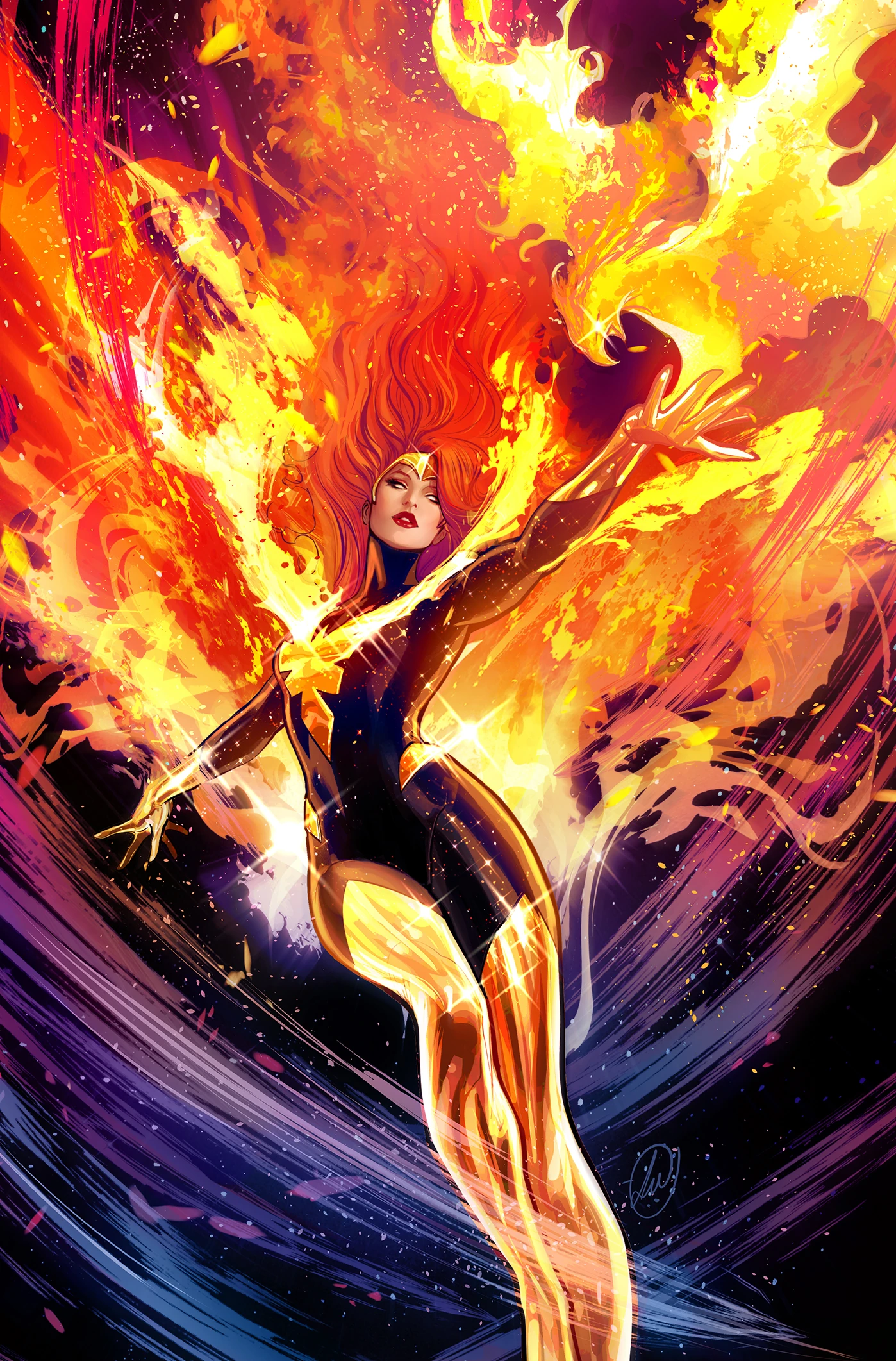
Source: Marvel Comics
Jean Grey as Phoenix represents the perfect synthesis of human heroism and cosmic power, creating the ultimate fire-wielding character in all of comics, television, movies, and anime. Her transformation from telepathic mutant to cosmic entity demonstrates the highest possible evolution of fire-based abilities while maintaining the human heart and moral compass that make her relatable and inspiring. As Phoenix, Jean Grey doesn’t just wield fire—she becomes fire itself, embodying the creative and destructive potential of the universe while never losing sight of her commitment to protecting life and fighting for justice.
Jean’s origin story as one of the original X-Men establishes her heroic credentials and moral foundation before her cosmic transformation, creating a character whose ultimate power is grounded in genuine heroism and selfless dedication to others. Her early manifestation of telepathic abilities and her training under Professor Xavier provided her with the mental discipline and ethical framework necessary to eventually handle cosmic-level power without losing her essential humanity.
The scope of Jean Grey’s abilities as Phoenix encompasses not just the Phoenix Force’s cosmic power but her own formidable telepathic and telekinetic abilities, creating a combination that is literally unmatched in comics. Her telepathy allows her to understand and connect with all life, while her telekinesis provides precise control over matter and energy. When combined with the Phoenix Force’s reality-altering flames, these abilities create a power set that operates on every conceivable level from molecular to universal.
Her relationship with Scott Summers (Cyclops) provides emotional grounding that prevents her cosmic power from overwhelming her human identity. Their love story, spanning decades of comics and multiple resurrections, demonstrates how genuine human connections can anchor even cosmic-level beings to their moral principles and emotional core. This relationship proves that the greatest power is meaningless without love and human connection.
The visual presentation of Jean Grey as Phoenix creates the most iconic and recognizable fire-based imagery in all of popular culture. Her transformation sequence, surrounded by cosmic flames that form the shape of a giant firebird, has been recreated and referenced countless times across various media. The Phoenix costume design, with its distinctive red and gold color scheme and cosmic flame effects, immediately communicates both power and heroism.
Her role in the X-Men’s most significant storylines, from the Dark Phoenix Saga to her various resurrections and returns, demonstrates her central importance to Marvel’s mutant mythology while showcasing her abilities against the greatest threats the universe can offer. Her sacrifice to save the universe during the Dark Phoenix Saga remains one of comics’ most powerful and emotionally resonant moments.
The duality of Jean’s nature as both nurturing healer and cosmic destroyer reflects the fundamental nature of fire itself—the power to both create and consume, to heal and harm, to end old cycles and begin new ones. Her struggle to balance these opposing aspects of her nature creates internal conflicts that add depth and complexity to her character while exploring themes about power, responsibility, and the price of ultimate abilities.
Her telepathic abilities, enhanced by the Phoenix Force, allow her to connect with and understand all forms of life across the universe. This cosmic empathy makes her uniquely qualified to wield ultimate power responsibly, as she can literally feel the pain and joy of every living being affected by her actions. This connection to universal consciousness sets her apart from other cosmic entities who might become detached from individual concerns.
Jean’s telekinetic powers, amplified to cosmic levels by the Phoenix Force, provide her with precise control over matter and energy that complements her fire-based abilities. She can manipulate objects on atomic levels, create force fields that can withstand cosmic-level attacks, and reshape matter according to her will. This combination of mental powers and cosmic flames creates tactical opportunities that no other character can match.
Her role as a teacher and mentor at Xavier’s School demonstrates how her cosmic experiences have enhanced rather than diminished her commitment to nurturing the next generation of heroes. Her ability to understand and guide young mutants through their power development shows that ultimate power can be used to serve others rather than dominate them.
The Phoenix flames that Jean wields possess all the properties of the cosmic Phoenix Force while being channeled through her human compassion and heroic nature. Her fires can resurrect the dead, heal the wounded, purify corruption, and create new life, demonstrating the creative potential of her abilities. When she chooses destruction, it is always in service of protecting life and preventing greater harm.
Her various deaths and resurrections explore themes of sacrifice, redemption, and the cyclical nature of existence that the Phoenix Force represents. Each return brings new understanding of her cosmic role while reinforcing her essential humanity and heroic nature. These cycles demonstrate that true heroism involves the willingness to sacrifice oneself for others, even when one possesses ultimate power.
Jean’s influence on other characters, particularly her fellow X-Men, demonstrates how cosmic power can inspire and elevate others rather than intimidate or isolate them. Her relationships with characters like Storm, Wolverine, and Professor Xavier show how her cosmic experiences have deepened her understanding of heroism and her commitment to the X-Men’s dream of peaceful coexistence.
The environmental effects of Jean’s Phoenix powers demonstrate their cosmic scope while showing her restraint and control. When she chooses to display her full power, she can affect entire star systems, but her typical manifestations are carefully controlled to achieve specific objectives without causing unnecessary destruction. This restraint proves her worthiness to wield such incredible abilities.
Her role in major Marvel events demonstrates her importance to the company’s cosmic continuity while proving that her power level is sufficient to face any threat the universe can produce. From cosmic entities to reality-altering crises, Jean as Phoenix has consistently proven herself capable of protecting not just Earth but all existence itself.
The character’s design evolution, from her original Marvel Girl costume to her various Phoenix manifestations, reflects her growth from promising young hero to cosmic-level protector. Each costume change represents a new phase in her development while maintaining visual elements that make her instantly recognizable across decades of publication.
Her connection to the concept of evolution and human potential makes her relevant to the X-Men’s core themes while demonstrating how individuals can transcend their limitations through growth, sacrifice, and dedication to others. Jean represents the ultimate expression of what mutants—and humans—can become when they embrace their potential for good.
The technical aspects of Jean’s reality manipulation as Phoenix create opportunities for storylines that operate on every conceivable scale. Her ability to affect fundamental forces, manipulate time and space, and alter reality itself provides unlimited creative possibilities while her human nature ensures that these abilities serve meaningful purposes.
Her moral complexity as someone who has experienced both ultimate power and ultimate responsibility creates rich storytelling opportunities. Jean’s understanding of what it means to hold the power of life and death over entire civilizations gives her perspectives on heroism and sacrifice that no other character can match.
The Phoenix flames serve both literal and metaphorical functions in Jean’s stories. They represent transformation, purification, renewal, and the eternal cycle of death and rebirth while also serving as incredibly powerful weapons and tools for creation. This dual symbolism makes her fires meaningful on multiple levels.
Her role as a bridge between human and cosmic concerns makes her valuable in stories that require both emotional resonance and spectacular scope. Jean can operate effectively in intimate character studies and universe-spanning epics, providing connections between different scales of storytelling.
Jean Grey as Phoenix claims the number 1 position through her unique combination of ultimate cosmic power, unwavering heroic nature, and perfect synthesis of human emotion with universal responsibility. Her Phoenix flames represent not just the pinnacle of fire-based abilities but the ultimate expression of how incredible power can be wielded with wisdom, compassion, and selfless dedication to protecting all life. Her character proves that the greatest fire-wielders are those who combine unlimited power with unlimited love, using cosmic abilities not for personal gain but for the protection and nurturing of all existence. Jean Grey as Phoenix stands alone as the ultimate fire-based superhero—a cosmic force of nature who never forgot her human heart.
Conclusion: The Eternal Flame of Heroism
From the pyromaniacal obsessions of Heat Wave to the cosmic transcendence of Phoenix, our journey through the top 30 fire-based superheroes reveals the incredible diversity and enduring appeal of flame-wielding characters across all media. These heroes represent more than just spectacular powers—they embody humanity’s complex relationship with one of nature’s most fundamental and dangerous forces.
Fire has always held a special place in human consciousness. It represents creation and destruction, passion and purification, life and death. The heroes on this list demonstrate how different creators have explored these themes through characters who wield flame as both weapon and tool, curse and blessing. From the scientific precision of Firestar’s microwave manipulation to the mystical hellfire of Ghost Rider, from the nuclear power of Sunfire to the cosmic flames of the Phoenix Force, each character brings a unique perspective to the fundamental power of fire.
What makes these characters truly great isn’t just their ability to generate spectacular flame effects or melt through steel barriers. The best fire-wielders combine their incredible abilities with compelling personal stories, meaningful character development, and the wisdom to understand that true power comes not from what you can destroy, but from what you choose to protect. Whether it’s Johnny Storm’s infectious enthusiasm inspiring his teammates, Roy Mustang’s tactical brilliance serving his ambitions for reform, or Jean Grey’s cosmic compassion guiding her reality-altering abilities, the greatest fire heroes are those who use their flames to light the way for others.
The evolution of fire-based characters across different media—from Golden Age comics to modern anime, from Saturday morning cartoons to blockbuster films—demonstrates the universal appeal of these flame-wielding heroes. They’ve adapted to changing times and audiences while maintaining the core elements that make them compelling: the visual spectacle of their powers, the symbolic weight of fire itself, and the human stories that give meaning to their incredible abilities.
As we look toward the future of superhero storytelling, fire-based characters will undoubtedly continue to evolve and inspire new generations of fans. Whether they’re wielding hellfire from demonic realms, channeling solar energy from distant stars, or manipulating the very forces of creation and destruction, these heroes remind us that the greatest flames are those that burn not with hatred or destruction, but with hope, determination, and the unwavering commitment to protect those who cannot protect themselves.
The fire burns eternal in the hearts of heroes, and these 30 characters represent the brightest flames in the vast constellation of superhero fiction. They prove that sometimes, to light the darkness, you must be willing to become the flame itself.
What do you think of our ranking? Did your favorite fire-wielding hero make the list? Share your thoughts and let us know which flame-powered character ignites your imagination in the comments below!
Tags: #Superheroes #Comics #FirePowers #Marvel #DC #Anime #XMen #FantasticFour #Phoenix #HumanTorch #ComicBooks #Manga #MyHeroAcademia #OnePiece #FairyTail #FullmetalAlchemist
Sources and References
- Marvel Comics Database – marvel.com
- DC Comics Database – dccomics.com
- CBR (Comic Book Resources) – cbr.com
- ComicBook.com – comicbook.com
- Marvel Database – Fandom – marvel.fandom.com
- DC Database – Fandom – dc.fandom.com
- My Hero Academia Wiki – myheroacademia.fandom.com
- One Piece Wiki – onepiece.fandom.com
- Fairy Tail Wiki – fairytail.fandom.com
- Fullmetal Alchemist Wiki – fma.fandom.com