From the spinner rack at the corner store to the biggest blockbusters in Hollywood, comic books have evolved from a niche hobby into a global entertainment powerhouse. But behind the capes, cowls, and cosmic battles lies a complex, multi-billion dollar industry. Ever wonder how a comic book goes from a creator’s idea to a worldwide phenomenon? It’s a story of creative passion, shrewd business models, and two distinct, powerful economies that shape everything from what you read to what you watch.
The global comic book market was valued at a staggering $17.62 billion in 2024 and is projected to surge to over $37 billion by 2033, according to Grand View Research. This isn’t just about colorful pamphlets anymore; it’s a vast ecosystem of intellectual property (IP) that fuels movies, TV shows, video games, and merchandise. Understanding the business of comics reveals not just how publishers and creators make a living, but why certain stories and characters dominate our culture.
The Modern Comic Book Gold Rush: A Market Overview
The comic book industry today is a far cry from its mid-20th century peak, when, in 1952, a billion comics were sold in a single year. While print numbers for individual issues are lower, the industry’s overall financial footprint is larger than ever, thanks in large part to the Hollywood effect. The more than $18 billion generated by superhero films at the global box office in 2024 alone creates a powerful feedback loop, driving new and old readers alike to seek out the source material. This synergy has transformed comic books into the engine room of modern pop culture.
This boom is not monolithic. It’s driven by several key segments, including the explosive growth of digital comics and the incredible popularity of Japanese manga in the bookstore market. As one academic analysis notes, the idea of a single “comic book industry” is misleading. Instead, it’s a collection of interconnected industries—publishing, distribution, retail, and licensing—each with its own economic logic.
The Two Comic Book Economies: Direct Market vs. Bookstores
To truly understand how comics make money, you have to recognize that they operate in two parallel, and surprisingly separate, retail universes: the Direct Market and the Bookstore Market.
The Direct Market: Where the Hardcore Fans Shop
The Direct Market is the traditional heart of the comic book industry, a network of approximately 3,000 specialty comic shops primarily supplied by Diamond Comics Distributors. This system, established in the 1980s, saved the industry from the decline of newsstand sales. Its business model is built on non-returnable orders, meaning retailers buy comics from publishers outright. This creates a stable, predictable revenue stream for publishers but places all the financial risk on the store owners.
This market is dominated by the monthly, serialized comic book format and caters to a dedicated, subcultural audience of fans and collectors. As data from 2016 shows, this is where publishers like Marvel and DC have historically made the majority of their print revenue. For example, in that year, Marvel derived 76% of its revenue from the direct market. This is the world of the “pull list,” where dedicated readers subscribe to their favorite titles month after month.
The Bookstore Boom: Graphic Novels and the Mainstream Audience
While the Direct Market serves the faithful, the Bookstore Market has become the industry’s gateway to a massive mainstream audience. Chains like Barnes & Noble, independent bookstores, and online giants like Amazon have embraced graphic novels, which are collected editions of comic book story arcs. This market operates on a returnable model, which is more favorable to retailers but less predictable for publishers.
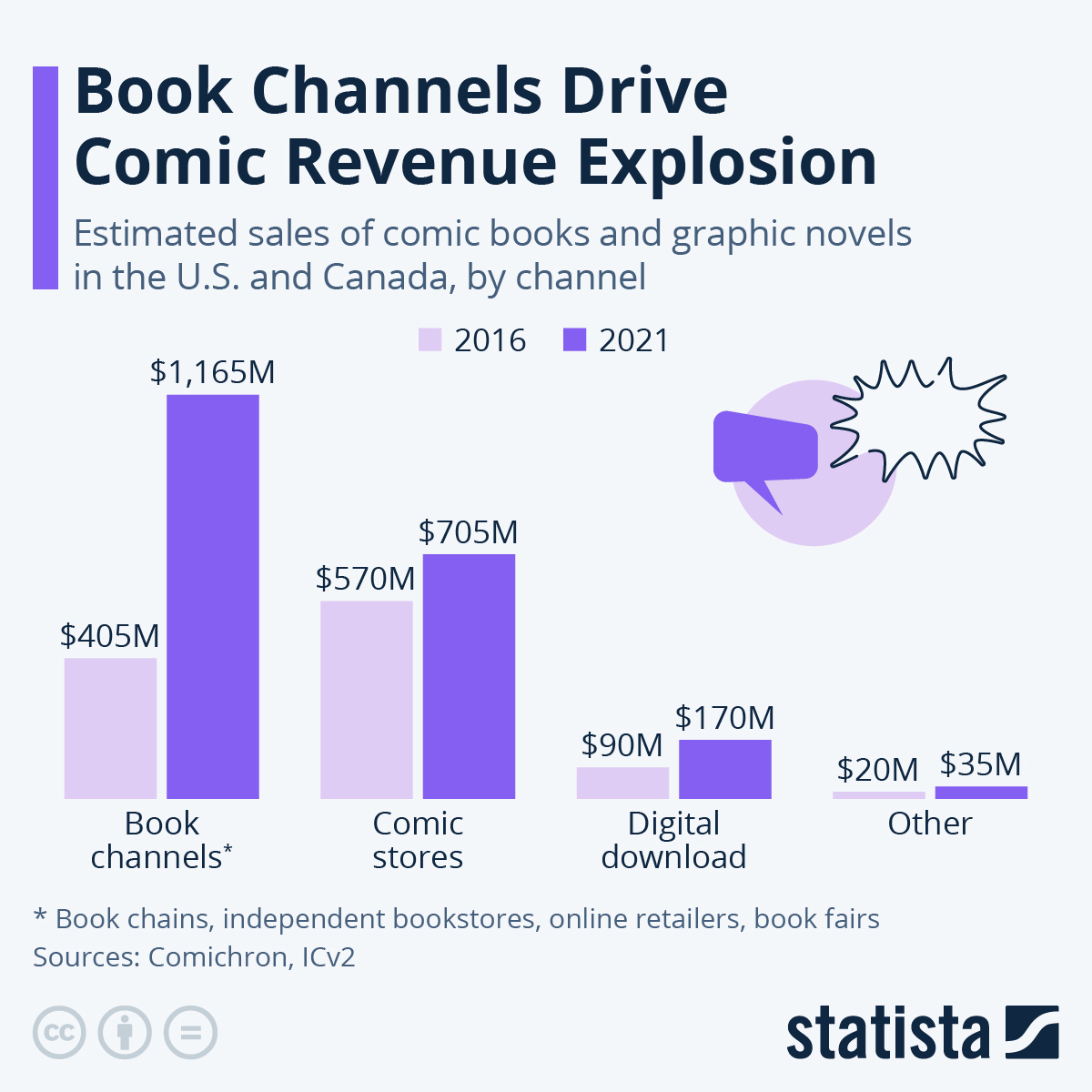 Caption: Book channels have become a dominant force in comic book revenue, far surpassing the traditional comic store market.
Credit: Statista
Source:https://www.statista.com/chart/27893/estimated-sales-of-comic-books-and-graphic-novels-by-channel/
The numbers tell a dramatic story. In 2016, bookstores sold nearly 12 million graphic novels, compared to the 4.5 million sold in the direct market. This channel is dominated by perennial bestsellers, young adult (YA) graphic novels, and manga. In fact, an academic study by Benjamin Woo revealed that many of the top-selling graphic novels in bookstores, like Raina Telgemeier’s Smile, are virtually absent from direct market sales charts, highlighting the “two solitudes” of the industry.
How Comic Book Publishers Make Money: The Big Two and Beyond
Different publishers have developed distinct business models to navigate these two economies, but they generally fall into two camps: the IP-driven model of the
“Big Two” (Marvel and DC) and the creator-centric model of publishers like Image Comics.
The Big Two: Intellectual Property Machines
For Marvel (owned by Disney) and DC (owned by Warner Bros. Discovery), the comic books themselves are not the primary profit center. They are, in essence, the research and development (R&D) department for their parent companies’ multi-billion dollar film, television, and merchandise empires. The primary goal of their publishing divisions is to create and maintain a steady stream of stories and characters that can be licensed and adapted for other media.
This is why you see characters like the evolution of Captain America constantly reinterpreted. These companies own the characters, and the freelance creators who write and draw their adventures are typically paid on a work-for-hire basis. They receive a page rate for their work but do not own the characters or stories they create and generally do not receive royalties from the massive profits generated by a blockbuster movie.
The Creator-Owned Model: High Risk, High Reward
Publishers like Image Comics, on the other hand, operate on a completely different model. Founded by high-profile artists who left Marvel in the early ‘90s, Image was built on the principle of creator ownership. Under this model, creators retain full ownership of their intellectual property.
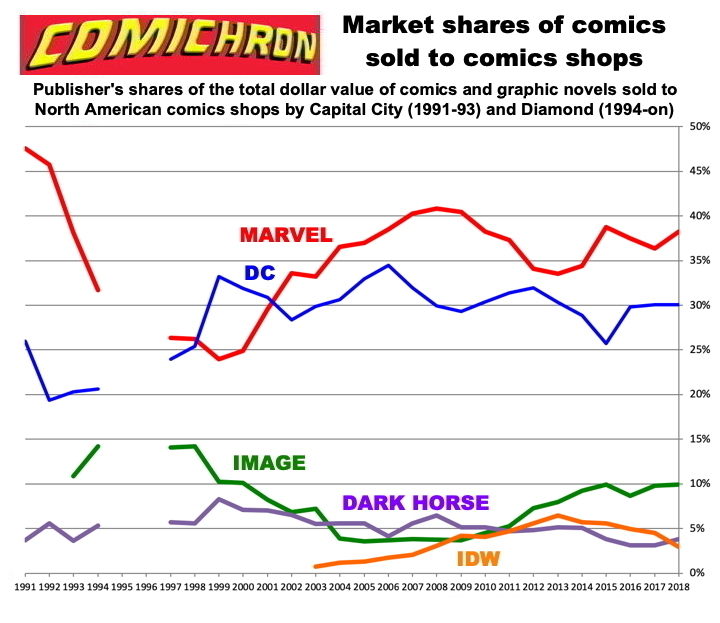 Caption: Publisher market shares have shifted over the years, with Image Comics carving out a significant space against the Big Two.
Credit: Comichron
Source:https://www.comichron.com/markets.html
As explained by creator Jim Zub, Image charges a flat administrative fee to cover its costs for solicitation, printing, and distribution. After that fee and the costs of printing and distribution are covered, all remaining profits go directly to the creative team. This is a high-risk, high-reward system. A low-selling comic might not even cover its costs, leaving the creators in the red. But a breakout hit like Saga or The Walking Dead can make its creators incredibly wealthy and lead to lucrative adaptation deals that they control.
This model has revolutionized the industry, creating a vibrant space for new, original stories outside the superhero mainstream and proving that creators can achieve massive success on their own terms.
The Economics of a Comic Book Creator: A Tough Gig
So, how does an individual writer or artist actually make a living? The reality is that for most, it’s a challenging freelance career.
“The vast majority of modern comics book characters and stories are created, designed, or produced by freelance creators. Publishers often own the legal rights to the comics. Cartoonists can generate work without outside creative input. But very few comics being made today in North America that don’t have one or more hired guns working behind the scenes.” – Gamal Hennessy, The Business of Freelance Comic Book Publishing
Creators are typically paid a page rate, which can vary dramatically based on the publisher and the creator’s experience. For a writer, this might be $50-$120 per page. For an artist, it could be $100-$300 per page for pencils and inks. Colorists and letterers are also paid page rates, though typically lower. While these rates might sound decent, a single comic book page can take a full day or more to draw, and the relentless monthly schedule leaves little room for error.
In the creator-owned world, there are often no upfront page rates. The entire creative team works on the promise of future profits, splitting the revenue after the publisher’s fees and other costs are paid. It’s a gamble, but one that has paid off handsomely for some and has led to some of the most acclaimed comics of the modern era, like the story of how mythology shaped modern superheroes.
The Final Boss: Distribution and Retail
No matter how a comic is published, it has to get into the hands of readers. This is where the final pieces of the economic puzzle—distribution and retail—come into play.
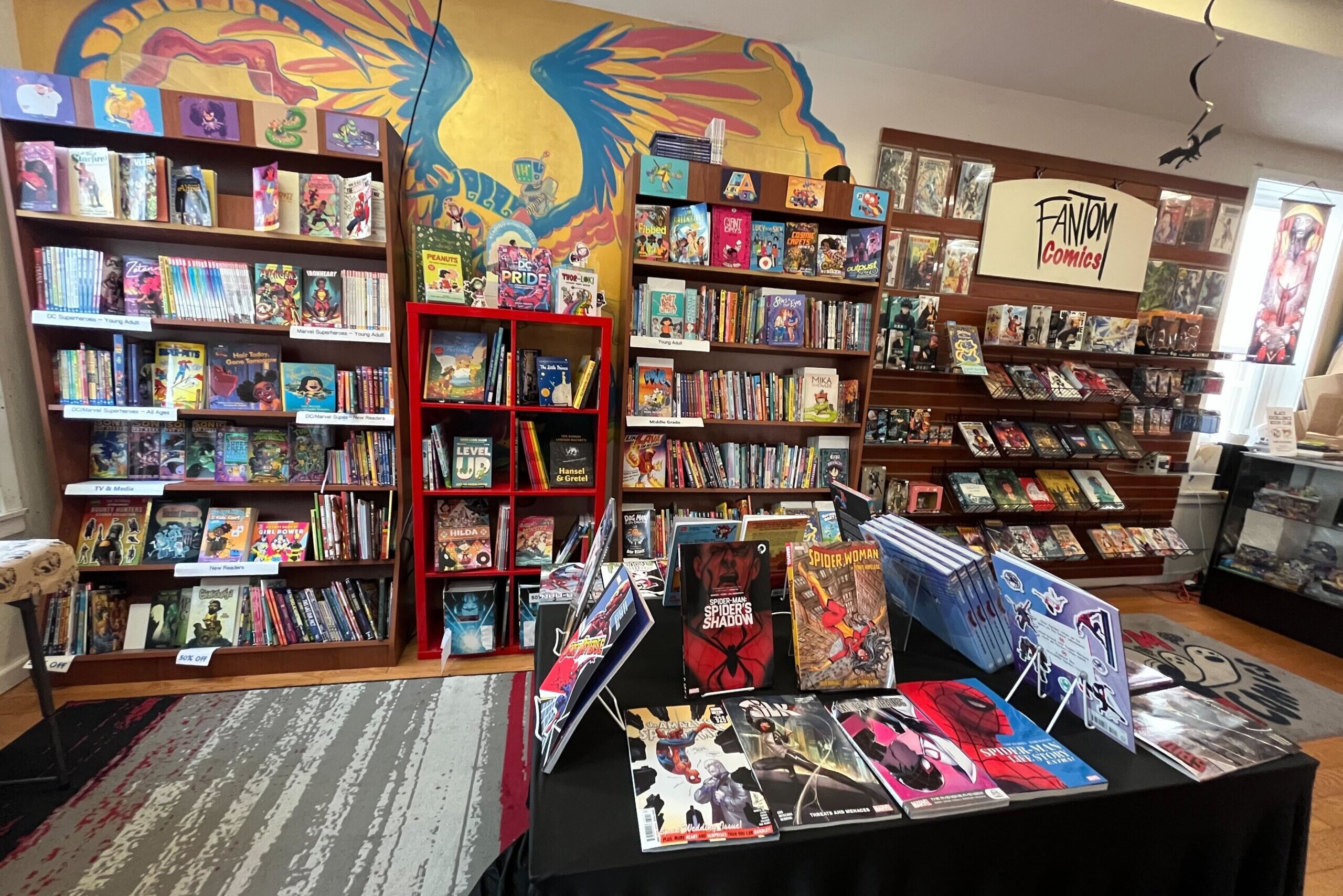 Caption: Specialty comic book stores are the backbone of the Direct Market, providing a dedicated space for fans to discover new titles.
Credit: WTOP / Megan Cloherty
Source:https://wtop.com/business-finance/2018/07/dc-comic-book-shop-brings-world-of-superheroes-to-life/
As mentioned, Diamond Comics Distributors holds a near-monopoly on the Direct Market. They are the crucial middleman between publishers and the thousands of independent comic shops. Retailers typically purchase comics from Diamond at a discount of 50-60% off the cover price. This means that for a $3.99 comic, the retailer is paying about $1.60-$2.00. Out of that remaining margin, they have to pay for rent, employees, utilities, and all the other costs of running a small business.
This complex, often precarious financial chain—from the freelance creator to the corporate publisher, through the distributor to the local comic shop—is what keeps the industry running. It’s a business model forged in the 20th century that is rapidly adapting to the new realities of digital distribution and the insatiable demand for new content from Hollywood. The next time you pick up a comic or watch a superhero movie, you’ll have a better understanding of the incredible economic journey it took to get there.
References
- Grand View Research. “Comic Book Market Size And Share | Industry Report, 2033.” https://www.grandviewresearch.com/industry-analysis/comic-books-market-report
- Woo, Benjamin. “Is There a Comic Book Industry?” Media Industries Journal 5, no. 1 (2018). https://quod.lib.umich.edu/m/mij/15031809.0005.102/–is-there-a-comic-book-industry?rgn=main;view=fulltext
- Zub, Jim. “Creator-Owned Economics: The Changing Market.” Zub Tales, February 23, 2015. https://www.jimzub.com/creator-owned-economics-the-changing-market/
- Hennessy, Gamal. “An Introduction to The Business of Freelance Comic Book Publishing.” Creative Contract Consulting, January 11, 2021. https://www.creativecontractconsulting.com/c3blog/2021/1/11/an-introduction-to-the-business-of-freelance-comic-book-publishing