Emma Frost is a Marvel Comics mutant telepath known as the White Queen. Created by Chris Claremont and John Byrne, she debuted in Uncanny X-Men #129 (1980) as a villain in the Hellfire Club’s Inner Circle, later becoming an X-Men member, headmistress and one of mutantkind’s most powerful telepaths. She can also transform into organic diamond.
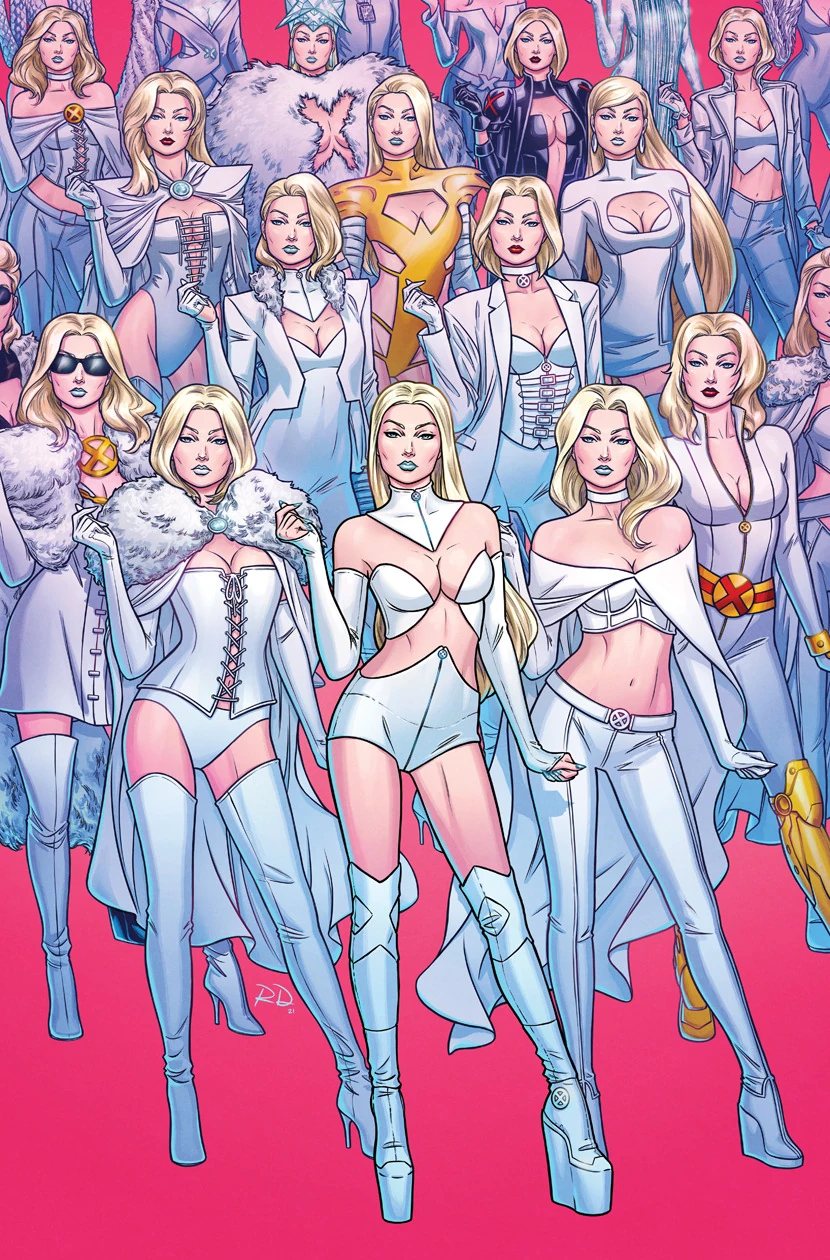
Emma Frost’s powers explained
Emma has two distinct power sets, and the relationship between them is the most interesting thing about her.
Telepathy. She is consistently written as one of the strongest telepaths on Earth, in the conversation with Charles Xavier and Jean Grey. She reads minds, projects illusions, wipes and rewrites memories, communicates across continents, and can shut a human brain down. Her precision is her signature — where Xavier is powerful and Jean is cosmic, Emma is surgical.
Organic diamond form. A secondary mutation lets her convert her body into a diamond-like substance, granting superhuman durability and strength, and removing her need to eat, breathe or sleep.
The catch is the good part: while she’s in diamond form, her telepathy switches off entirely. She cannot read a mind, and no telepath can read hers.

Why the diamond form is the best character detail in the X-Men
Comics are full of powers that look cool. Very few of them argue something about the person who has them. Emma’s does.
Consider what the diamond actually does. It makes her invulnerable and it makes her unable to feel anyone else. Total protection purchased with total isolation. She becomes hard, beautiful, cold and completely cut off, all in the same instant.
That is a precise mechanical restatement of the character’s psychology. Emma Frost’s entire personality is armour — the cutting remarks, the impossible poise, the refusal to be seen needing anything. The diamond is that defence mechanism given a physical form and a literal cost.
And writers use it as such. Emma reaches for diamond when she is about to be hurt, and the moments where she refuses to shift — choosing to stay soft and stay connected — carry weight precisely because we know what she’s giving up. A power that doubles as a character flaw is rare. A power that doubles as a character’s defining flaw is close to unique.
From villain to X-Man
| Era | Role |
|---|---|
| 1980 debut | White Queen of the Hellfire Club’s Inner Circle — antagonist |
| 1980s | Headmistress of the Massachusetts Academy, mentor to the Hellions |
| 1990s | Co-leads Generation X with Banshee after the Hellions’ deaths |
| 2001 onward | Joins the X-Men following the destruction of Genosha |
| 2000s | Co-headmaster of the Xavier Institute; partner to Cyclops |
| 2012 | One of the Phoenix Five in Avengers vs. X-Men |
| Krakoa era | Quiet Council member; White Queen of the Hellfire Trading Company |
Her turn began in tragedy. As headmistress of the Massachusetts Academy she trained the Hellions, a team meant to rival Xavier’s students. When they were killed, the loss did what decades of X-Men lecturing had not, and she eventually took up teaching on the other side alongside Banshee in Generation X.
The destruction of Genosha completed the move. She joined the X-Men proper, took a leadership role at the Institute, and became a fixture of the franchise’s core cast.
The redemption arc that didn’t sand her down
Here’s what makes Emma unusual among reformed comic book villains, and it’s worth stating plainly because the industry gets this wrong constantly.
The standard redemption arc removes the traits that made a villain compelling. The character apologises, softens, becomes agreeable, and turns into someone you’d never have written a story about in the first place. The reform is real and the character is ruined.
Emma’s writers refused that trade. She joined the X-Men and stayed exactly as unpleasant as before. Still snobbish, still cutting, still contemptuous of people she considers her inferiors — which is most people. Still entirely willing to manipulate a mind, lie to a teammate or make a monstrous call if she’s decided it’s correct.
What changed was not her methods or her manner. It was her allegiance. The X-Men didn’t reform Emma Frost; they aimed her.
That’s why she works. She is permanently uncomfortable to have around, permanently not quite trusted, and permanently the person you want in the room when things go wrong. Most reformed villains become safe. Emma stayed dangerous and just happened to be on your side, and the tension that creates has powered twenty-five years of stories.
Emma Frost and Cyclops
Her most-discussed relationship began badly on purpose. It started as a psychic affair while Scott Summers was married to Jean Grey — not a physical betrayal, which is exactly what made it such an effective piece of writing, since it forced the question of what infidelity actually consists of.
After Jean’s death the two became a couple and co-led the X-Men together. Our explainer on who Cyclops is and why he matters covers his side of that partnership, and our guide to the Phoenix Force covers the entity that shaped all three of them.
Emma Frost in movies and TV
On screen, Emma has been played by Tahyna Tozzi in X-Men Origins: Wolverine (2009) and January Jones in X-Men: First Class (2011), where she appeared as a Hellfire Club member alongside Sebastian Shaw.
Samara Weaving has been reported as cast in the role for Marvel Studios’ X-Men reboot. That casting sits alongside Sadie Sink’s Jean Grey and reports of Kit Connor in talks for Cyclops — we’ve laid out the full confirmed-versus-rumored casting picture ahead of D23.
For more on where she sits in the wider hierarchy, see our ranking of the strongest X-Men of all time. Marvel’s official character profile covers her publication history.
Frequently asked questions
What are Emma Frost’s powers?
Emma Frost is an exceptionally powerful telepath who can read, control and alter minds. She also has a secondary mutation allowing her to transform into organic diamond, granting durability and strength — but this form disables her telepathy.
Is Emma Frost a hero or a villain?
Both, across her history. She debuted in 1980 as a Hellfire Club villain and later joined the X-Men, but she retained her ruthlessness and remains one of the franchise’s most morally ambiguous figures.
Who created Emma Frost?
Chris Claremont and John Byrne created her. She first appeared in Uncanny X-Men #129, published in 1980.
Who plays Emma Frost in the MCU?
Samara Weaving has been reported as cast in the role for Marvel Studios’ X-Men film. Marvel has not published a full official cast list.