DC Comics struck gold in 2024 with its Absolute Universe, a fresh, creator-driven line that has revitalized its most iconic characters. While Absolute Batman and Absolute Superman grabbed initial headlines, the breakout star and critical darling of this new imprint is undeniably Absolute Wonder Woman. Helmed by a stellar creative team, this radical reinvention of Diana of Themyscira has not only dominated sales charts but also snagged multiple Eisner Awards, proving that even a hero forged in hell can shine brighter than ever.
This isn’t your mother’s Wonder Woman. This is a darker, more mythologically dense take that strips away the familiar paradise of Themyscira to ask a fundamental question: who is Diana without her Amazon sisters? The answer, it turns out, is one of the most compelling comic book reads in the last decade.
What is the DC Absolute Universe?
Launched in late 2024 as part of the publisher’s “All-In” initiative, the Absolute Universe is a new, alternate continuity set on Earth-Alpha. This world was shaped by the influence of Darkseid, resulting in a darker, more melancholy reality for its heroes [1]. Think of it as a modern-day Ultimate Marvel, giving top-tier creators the freedom to reimagine characters without the baggage of decades of continuity. The goal was to create accessible, high-stakes stories, and the results have been a resounding success, reigniting fan interest and consistently topping sales charts [2].
Unlike a temporary Elseworlds story, the Absolute Universe is an ongoing, parallel reality. As writer Scott Snyder has described it, “If the main Universe is predicated on Superman energy, then The Absolute Universe is founded on Darkseid” [3]. This foundational difference has led to fascinating and often brutal new origins for DC’s Trinity, with Absolute Wonder Woman standing out as the line’s crown jewel.
The Absolute line has proven that readers are hungry for bold reinventions that respect the core of beloved characters while exploring new territory. Both DC’s Absolute titles and Marvel’s concurrent Ultimate line have dominated monthly sales charts, showing that the industry’s future may lie in these creator-driven alternate universes rather than endless continuity reboots.
A Wonder Woman Forged in Hell
The most radical departure for Absolute Wonder Woman is its complete demolition of Diana’s traditional origin. In this universe, there is no Paradise Island. A baby Diana is taken from Themyscira and, by the decree of a wrathful Zeus, given to the sorceress Circe to be raised in the literal pits of Hell. The very word “Amazon” is forbidden, and Diana grows up without the love of her mother, Hippolyta, or the nurturing sisterhood that defined her.
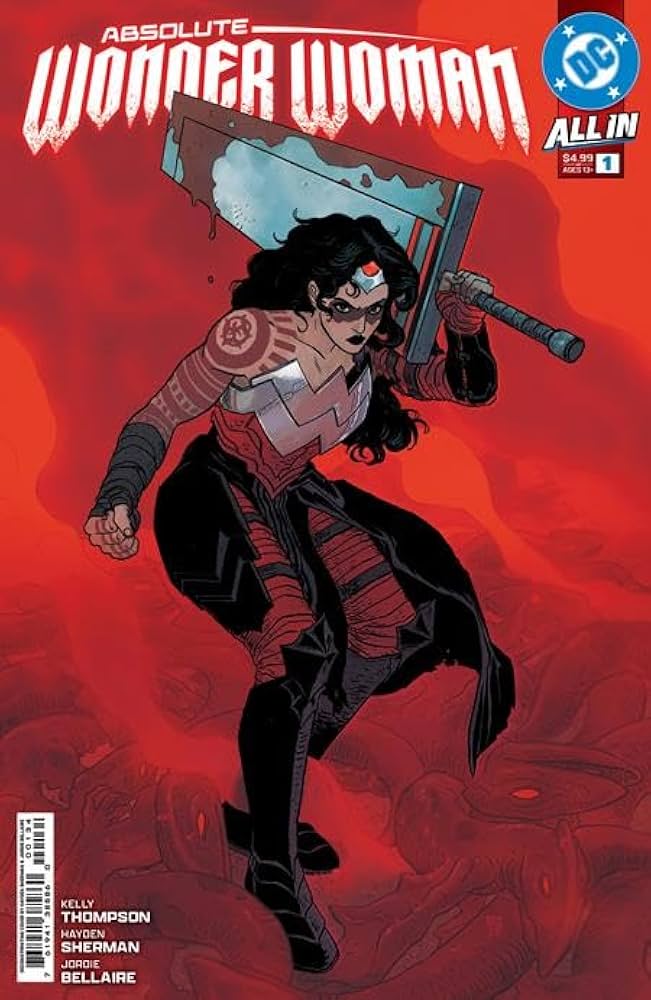 Caption: The official cover for Absolute Wonder Woman #1, showcasing Diana’s new, more aggressive design. Credit: Hayden Sherman / DC Comics Source: DC Comics
This Diana is a warrior from birth, trained by a villain and surrounded by demons. Yet, in a brilliant stroke of characterization by writer Kelly Thompson, Diana’s inherent goodness remains. She is a light in the darkness, a figure of compassion whose core identity is so strong that not even a hellish upbringing can extinguish it. As one reviewer noted, she’s like a “Disney Princess in a hellscape,” befriending salamanders and radiating a hope that slowly transforms the damned souls around her [4]. This take gets to the very heart of why superheroes never stay dead—their ideals are immortal, even when their circumstances change.
The series structure brilliantly alternates between Diana’s childhood in Hell and her emergence into the modern world as Gateway City faces a catastrophic threat. This dual timeline allows readers to see how her upbringing shaped her while also delivering the high-octane superhero action fans crave. It’s a narrative approach that keeps the pacing tight and the emotional stakes high.
The Story Arcs That Define a New Legend
Absolute Wonder Woman has been divided into several distinct story arcs, each building on the last to create a cohesive mythology. The first arc, “The Last Amazon” (issues #1-5), introduces Diana’s origin and her first major battle against a kaiju-like creature called the Tetracide. This opening salvo establishes the tone and stakes while showcasing the creative team’s visual and narrative ambitions [5].
The second arc, “The Lady or the Tiger” (issues #6-7), delves deeper into Diana’s relationship with Circe and the moral complexities of being raised by a traditional villain. It’s a character study that asks whether nature or nurture defines a hero, and the answer Thompson provides is both nuanced and deeply satisfying.
The third arc, “As My Mothers Made Me” (issues #8-12), expands the mythology further, introducing more characters from Wonder Woman’s rogues gallery and supporting cast, but reimagined for this darker universe. Characters like Barbara Minerva (Cheetah), Artemis, and even Zatanna appear, each with their own twisted takes that fit the Absolute Universe’s tone. This arc won particular praise for its exploration of Diana’s identity and her struggle to reconcile her hellish upbringing with her heroic calling.
The ongoing fourth arc, “The Price” (issues #13-14 and beyond), promises to raise the stakes even higher as Diana faces the consequences of her actions and the gods themselves take notice of this upstart Amazon who refuses to be defined by her circumstances.
Why Absolute Wonder Woman is a Critical Darling
The reception to Absolute Wonder Woman has been nothing short of ecstatic. The series holds a stunning 9.1 out of 10 average critic rating on Comic Book Roundup across its first twelve issues [5]. This critical acclaim culminated at the 2025 Eisner Awards, where the series took home the coveted award for Best New Series. Colorist Jordie Bellaire also won for Best Coloring, and the book received nominations for Best Writer (Kelly Thompson), Best Cover Artist (Hayden Sherman), and Best Lettering (Becca Carey) [5].
This success isn’t just critical; it’s commercial. The first issue launched with over 150,000 orders, and subsequent issues have remained fixtures in the monthly top 20, a rare feat for any title not featuring Batman or Spider-Man [6]. It proves that fans are hungry for bold, innovative storytelling that respects the core of a character while pushing them in new directions.
The series has also become a talking point on social media and in comic shops, with readers praising its accessibility for newcomers while still delivering depth for longtime Wonder Woman fans. It’s the kind of book that can serve as a perfect entry point for someone who’s never read a Wonder Woman comic before, while also offering fresh perspectives for readers who’ve been following Diana’s adventures for decades.
The Dream Team Creative Lineup
A huge part of this success is the powerhouse creative team. Kelly Thompson (Captain Marvel, Black Widow) brings her signature blend of wit, heart, and high-octane action. She masterfully deconstructs Diana’s mythology while ensuring the character’s emotional core remains intact. Her Diana is hardened but not broken, a warrior with a poet’s soul. Thompson has proven herself to be one of the most reliable writers in comics today, and this series showcases her at the peak of her powers.
Hayden Sherman‘s art is a revelation. His style is kinetic, raw, and utterly captivating. The character designs are phenomenal, and the page layouts are breathtakingly inventive. In one standout sequence, Sherman uses the design of a Greek urn to narrate an ancient myth, a perfect fusion of classic and modern storytelling. His work is a masterclass in the evolution of comic book art, feeling both timeless and completely fresh. Sherman has leveled up from his already impressive previous work, and this series has cemented him as one of the most exciting visual storytellers in the industry.
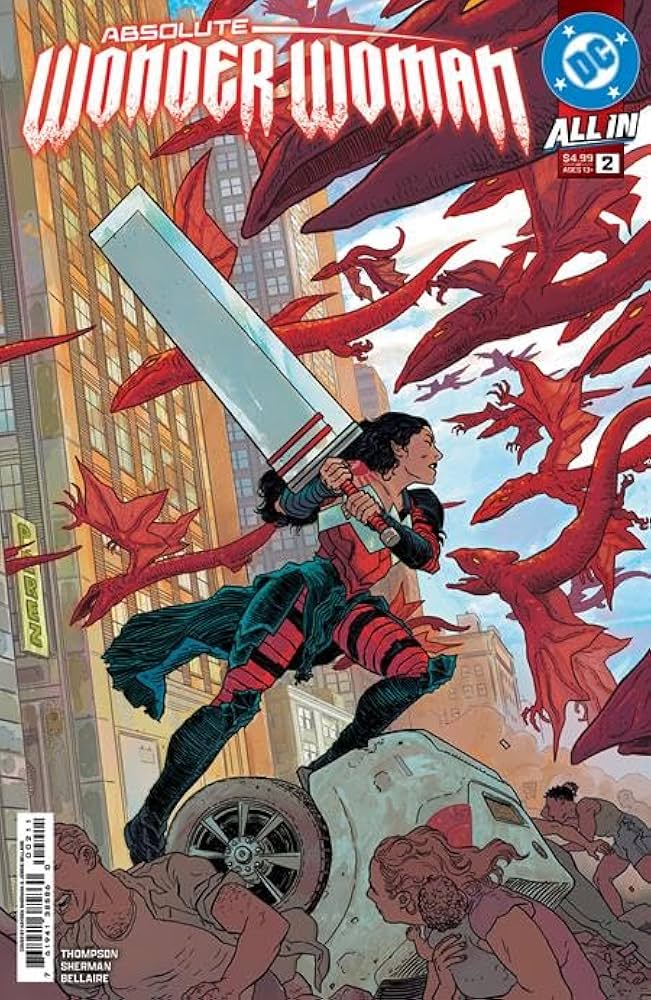 Caption: The cover for Absolute Wonder Woman #2, featuring Diana and her skeletal Pegasus. Credit: Hayden Sherman / DC Comics Source: DC Comics
Rounding out the team is Eisner-winning colorist Jordie Bellaire. Her palette defines the book’s mood, using muted, grey tones for the hellish landscapes, which makes the vibrant colors of Diana’s magic and costume pop. The glowing red of Diana’s eyes in moments of rage or power is a particularly effective touch, visually representing the constant battle between her nurturing and her nature. Bellaire’s work on this series is all the more impressive considering she was simultaneously coloring eight other major titles, showcasing her incredible versatility and work ethic [4].
Letterer Becca Carey deserves special mention as well. Her work on the series, particularly with Circe’s narration boxes and Diana’s magical invocations, adds another layer of visual storytelling that elevates the entire package. The lettering feels like an organic part of the art rather than an afterthought, which is the hallmark of truly great comic book lettering.
How Absolute Wonder Woman Differs from the Main DCU
For longtime Wonder Woman fans, the differences between Absolute Diana and her main DCU counterpart are stark, yet the core of the character remains recognizable. In the main DC Universe, Diana was sculpted from clay by her mother Hippolyta and blessed by the gods. She was raised on Themyscira, an island paradise inhabited solely by warrior women, and her mission is one of peace and compassion. She’s an ambassador to Man’s World, bringing the Amazonian philosophy of love and understanding.
Absolute Wonder Woman flips this entirely. Diana is still blessed by the gods, but she’s raised in Hell by Circe, a traditional enemy. She has no sisterhood, no paradise, and no mission of peace handed to her. Instead, she must forge her own path, discovering her heroism through trial and suffering. The Amazons exist in this universe, but Diana is separated from them, making her literally “the Last Amazon” in terms of her isolation.
What’s remarkable is that despite these massive changes, Diana’s essential character shines through. She’s still compassionate, still driven by a sense of justice, and still willing to sacrifice herself for others. The series argues that these traits aren’t products of her upbringing, but fundamental aspects of who Diana is. It’s a powerful statement about the nature of heroism and one that resonates deeply with readers.
The visual differences are equally striking. Absolute Diana’s costume is darker, more armored, and features heavy use of black and red. She rides a skeletal Pegasus instead of a living one, and her weapons have a more brutal, hellish aesthetic. Yet the iconic elements—the tiara, the bracelets, the lasso—are all present, just reimagined for this darker universe. It’s a design that respects the character’s history while boldly pushing into new territory.
More Than Just a Gritty Reboot
It would be easy to dismiss Absolute Wonder Woman as just another dark and gritty reboot, but that would miss the point entirely. The series is not about making Diana an anti-hero; it’s about proving why she is a hero, no matter the circumstances. By stripping away her paradise, the creators show that her compassion, her drive for justice, and her capacity for love are not products of her environment, but inherent to who she is.
The story leans heavily into mythology, featuring gods, monsters, and magic in a way that feels both epic and deeply personal. Diana rides a skeletal Pegasus, invokes the names of ancient gods for power, and faces off against kaiju-sized threats. It’s a story about the transformative power of love and a testament to the enduring strength of one of comics’ greatest icons.
The series also isn’t afraid to embrace its mythological roots in ways that modern superhero comics sometimes shy away from. Diana’s magic is visceral and powerful, her invocations of the gods feel weighty and consequential, and the monsters she faces are genuinely terrifying. It’s a book that understands that Wonder Woman is, at her core, a mythological figure, and it leans into that aspect with gusto.
What Makes This Series Essential Reading
Beyond the critical acclaim and sales success, Absolute Wonder Woman is essential reading because it represents what superhero comics can be when talented creators are given the freedom to take risks. It’s a book that respects its source material while fearlessly reinventing it. It’s accessible to new readers while offering depth for longtime fans. And it’s a visual feast that showcases some of the best art being produced in mainstream comics today.
The series also benefits from being part of a larger, cohesive universe. While Absolute Wonder Woman works perfectly as a standalone story, readers who are also following Absolute Batman and Absolute Superman will find intriguing connections and a sense that this universe is being carefully constructed with long-term storytelling in mind. It’s the kind of world-building that makes readers excited to see where things are going, similar to the early days of the Marvel Cinematic Universe.
For readers who appreciate strong female characters, Absolute Wonder Woman delivers in spades. Diana is powerful, complex, and utterly compelling. She’s not defined by her relationships with men, and her story is fundamentally about her own journey of self-discovery and heroism. In an industry that still struggles with representation, this series stands as a shining example of how to write a female superhero with depth, agency, and respect.
The Future of the Absolute Universe
With the runaway success of Absolute Wonder Woman and its sister titles, the Absolute Universe is poised to be a major pillar for DC Comics for years to come. It has successfully captured a new audience while thrilling longtime fans, proving that the key to the future of superhero comics may lie in giving talented creators the freedom to break the rules.
The first collected edition, Absolute Wonder Woman Vol. 1: The Last Amazon, is set to hit shelves on August 12, 2025, collecting issues #1-7 [5]. For readers who’ve been waiting to jump in, this is the perfect opportunity. For those already following the series monthly, it’s a chance to revisit the opening arc and appreciate the craftsmanship on display.
Absolute Wonder Woman is not just a great comic; it’s a modern myth in the making and a must-read for any fan of the medium. It’s proof that even the most iconic characters can be reimagined in bold, exciting ways when the right creative team is at the helm. Whether you’re a longtime Wonder Woman fan or someone who’s never picked up a comic before, this series deserves a spot on your reading list.
Resources
[1] CBR.com, “DC’s Absolute Comics, Explained”
[2] ICv2, “Top 50 Comics – August 2025”
[3] Facebook, “What is the Absolute Universe in DC Comics?”
[4] Comics Beat, “Classic Comic Compendium: ABSOLUTE WONDER WOMAN – ‘THE LAST AMAZON’ deserves its Eisner”
[5] Wikipedia, “Absolute Wonder Woman”
[6] Reddit, “Absolute Wonder Woman #1 Gets 150,000 Orders”