Strange New Worlds season 4 episode 5, “Level-Five Transporter Accident,” turns the Enterprise crew into Jim Henson’s Creature Shop puppets and commits to that joke with real craft. It is the most ambitious hour of the season and the most divisive — published reviews have landed anywhere from 4.5 out of 5 to a D+.
Everything below the next heading discusses how the episode ends. If you have not watched “Level-Five Transporter Accident,” stop here and come back.
One section below (“The prequel trap”) discusses where Spock’s story goes in Star Trek: The Original Series, first broadcast in 1966. If you are watching Strange New Worlds as your entry point into Trek and want its future left unspoiled, skip that section — the rest of the review does not depend on it.
The short version
This is the best-made hour of the season, and it ends by announcing that it never happened. The puppetry is superb, the performances around it are game, and then the last few minutes reveal the whole thing as a dream Spock had while unconscious. My argument is not simply that the reset is a cheap escape hatch, though it is one. It is that the reset is the clearest symptom yet of the problem Strange New Worlds has been living with since 2022: it is a prequel, and its lead has to arrive at The Original Series more or less unchanged.
What happens
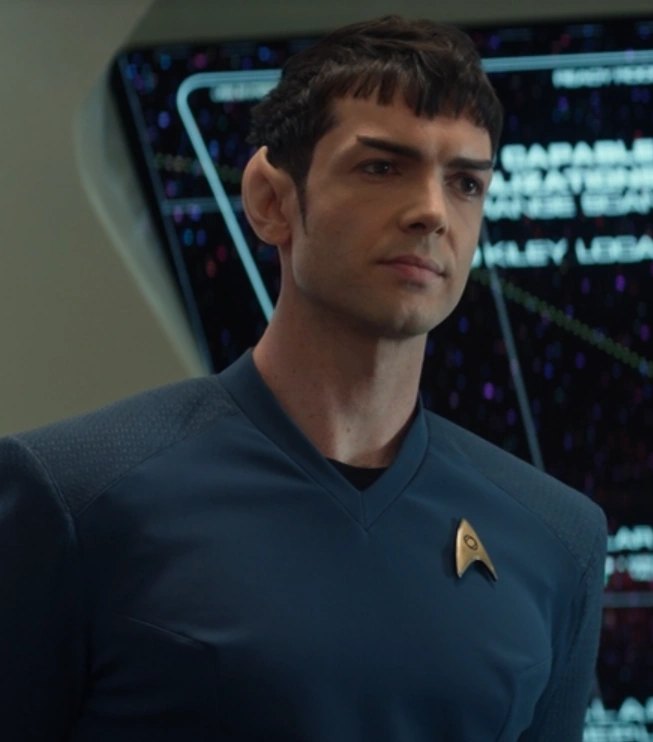
Scotty tries to extend the transporter’s range, using as a test object a ventriloquist doll called Little Ricky that his brothers once used to frighten him. The experiment misfires into a level-five transporter accident and the entire senior staff comes out the other side as puppets. Spock, alone, is unaffected.
An Orion interceptor captained by Ch’Rol (Rachael Harris) opens a channel at the worst possible moment, sees what has happened to the crew, and boards to take the ship. Pike is ejected through an airlock in a straight lift of the Wrath of Khan hand-to-the-glass farewell — then retrieved intact, because a puppet does not need to breathe. The crew retakes the Enterprise. Spock wakes in his quarters with T’Pring beside him and Little Ricky on the desk. There was no accident of that kind; he was knocked unconscious, and the whole adventure was his.
Jordan Canning directs, from a script by Henry Alonso Myers and Dana Horgan. Joe Lo Truglio plays Ch’Rol’s second, and Adrian Holmes appears as Admiral Robert April. It runs roughly 54 minutes.
The puppets are the best craft work the season has produced
Take the ending away and this is a genuinely accomplished piece of television. Jim Henson’s Creature Shop built the puppets, and the episode is not embarrassed by them: it lights them properly, blocks them into the real bridge set, and lets them carry long stretches of dialogue rather than cutting away every few seconds to protect the illusion.
The performances hold up their end. Carol Kane’s Pelia — who spends part of the episode bisected — is the funniest thing in it, because Kane plays the situation as a mild inconvenience rather than a catastrophe. Rachael Harris makes Ch’Rol genuinely menacing while sharing scenes with felt, which is harder than it looks. And the physical comedy is thought through: puppet hands cannot work a touchscreen, and the episode mines that properly instead of stating it once and moving on.
The gags do run long. That is the fairest of the criticisms in the negative reviews, and it is true — several bits land, then keep going past the point where they have paid off. But an overlong joke is a pacing problem. It is not what breaks the episode.
Then the episode takes it all back
The dream reveal is a choice with consequences, and they are all bad ones.
It costs the hour its stakes retroactively. Pike being blown out of an airlock was never danger; Ch’Rol was never a threat; the Enterprise was never taken. Worse, it costs the episode its own best material. If Pelia’s composure while cut in half is a product of Spock’s subconscious rather than Pelia, then it is not characterisation at all — it is set dressing in someone else’s head.
And it is unnecessary. Nothing in the premise required a reset. Star Trek has been doing reality-warping bottle episodes since “Shore Leave” in 1966 and has almost never needed to disown them afterwards. The transporter is already the franchise’s all-purpose excuse machine; an accident that turned the crew into puppets and was then reversed by engineering would have been no more absurd than what we got, and it would have counted.
Compare it to the last time the show did something this silly
Here is the comparison that makes the case, and it is one the show has already given us.
Strange New Worlds takes one enormous swing per season, and until now it has committed to every single one.
| Episode | The swing | Did it count? |
|---|---|---|
| “Those Old Scientists” (S2, ep. 7) | A crossover with the animated Lower Decks, in live action | Yes. Canon, and referenced afterwards. |
| “Subspace Rhapsody” (S2, ep. 9) | A full musical episode — the crew cannot stop singing | Yes. Spock and Chapel’s relationship ends in it, permanently. |
| “Level-Five Transporter Accident” (S4, ep. 5) | The senior staff become Henson puppets | No. Revealed as Spock’s dream. |
“Subspace Rhapsody” is the damning one. A musical is a sillier premise than a puppet, and that episode used it to do permanent damage to its characters — Chapel takes a fellowship, she and Spock end, and the show has lived with it ever since. The sillier episode was the braver one. Whatever else is true of the puppet hour, it is the first time this series has reached for a big idea and then refused to let it leave a mark.

The prequel trap
So why reset it at all? The generous reading is that the dream frame is not laziness but necessity, and that is the more interesting answer.
Strange New Worlds is a prequel. Spock has a destination: the composed, self-contained officer of The Original Series, and the show cannot deliver him there having been fundamentally rearranged by an encounter with Orion pirates and a ventriloquist doll. A dream is the one container in which a prequel can put its lead through something genuinely destabilising and then hand him back unmarked. Read that way, the episode is not avoiding consequence out of cowardice. It is avoiding consequence because the destination will not permit any.
That is a real constraint and it deserves acknowledging. But it is also an argument against the premise of the whole exercise. If the show can only take its biggest swings inside a container marked “none of this is real,” then the swings are decoration. And it sits badly next to the fact that this same show has repeatedly proved otherwise — it broke up Spock and Chapel, it gave Pike foreknowledge of his own maiming and made him live with it, and none of that violated The Original Series. The constraint is real. This episode simply took the easiest possible route around it.
Why the reviews are so far apart
Something worth noticing, because the spread on this episode is unusually wide: Den of Geek gave it 4.5 out of 5, the A.V. Club gave it a D+, and Gizmodo called it a great episode and then said the dream twist ruined it.
Read them together and the disagreement is narrower than the scores suggest. Almost nobody dislikes the puppets. The reviews split on one question — whether the dream frame is a flaw at the end of a good episode or a fact that reaches backwards and changes what the episode was. Den of Geek treats it as a blemish on an otherwise joyful hour. The A.V. Club treats the whole construction as a gimmick stretched past its natural length. Gizmodo says both things in the same paragraph.
That is not three critics disagreeing about quality. It is three critics agreeing about the craft and disagreeing about how much the last five minutes are allowed to cost the previous fifty. Which is a real question, and the honest answer is that it depends entirely on whether you think an episode of television is a thing that happened or a thing you watched.
Where this leaves the final stretch
Five episodes remain in season four, and season five — already greenlit — will be the last. That is the context that turns a pacing complaint into a real cost. A show with eight years ahead of it can spend an hour on a consequence-free lark. A show closing its accounts has a shrinking number of hours in which to land what it has been building, and it just spent one of the best-executed ones on an episode it then declared void.
Verdict
Watch it. It is funny, it is beautifully made, and Carol Kane cut in half is worth the admission on its own. Then notice that you have been given a very good hour of television which the show itself has told you not to count — and that Strange New Worlds, which has spent four seasons proving it is braver than this, has started protecting its characters from its own best ideas at exactly the point when it can least afford to.
We are not putting a number on it. We do not run a scored review scale, and inventing one for a single episode would tell you less than the paragraph above.
More from our TV desk: the full Strange New Worlds season 4 episode schedule, our review of the Lanterns premiere, and our review of Bleach: Thousand-Year Blood War episode 44, another adaptation that earned its swing by making it stick.
Frequently Asked Questions
What is Strange New Worlds season 4 episode 5 called?
“Level-Five Transporter Accident.” It is the fifth episode of season four and was released on Paramount+ on Thursday, 20 August 2026.
Is the puppet episode canon?
No. The episode reveals that the entire puppet sequence was a dream Spock had while unconscious after a transporter accident, so none of its events occurred in the series’ continuity.
Who made the puppets?
Jim Henson’s Creature Shop. The senior staff all appear as puppets except Spock, who is unaffected and spends the episode running the ship.
Who directed and wrote the episode?
Jordan Canning directed. The script is by Henry Alonso Myers and Dana Horgan. Guest cast includes Rachael Harris as the Orion captain Ch’Rol, Joe Lo Truglio, and Adrian Holmes as Admiral Robert April.
How many episodes are left in Strange New Worlds?
Five more episodes of season four, running weekly to the finale “Tomorrow’s Enterprise” on 24 September 2026. Season five has been greenlit and will be the show’s last.
Sources and further reading: the season 4 episode list and credits, Den of Geek’s 4.5-star review, and the A.V. Club’s D+ review.