The best Batman comics aren’t just great superhero stories—they’re the books that redefined what mainstream comics could be, and our #1 pick, Frank Miller’s The Dark Knight Returns, is the single most influential of them all. Whether you’re a newcomer hunting for the perfect entry point or a longtime collector filling gaps in your shelf, this guide ranks the 15 essential Batman graphic novels and story arcs by lasting impact, craft, and re-readability. We’ve weighted genuine influence over hype, so you’ll find century-defining classics like Year One and The Killing Joke alongside modern masterpieces like The Black Mirror and The Court of Owls. Each entry notes the creative team, the original issues, and where it fits in a sensible reading order—because the Dark Knight’s 85-year history can be overwhelming. Start at the top, or jump to whatever era calls to you.
| Rank | Comic | Writer / Artist | Year | Best For |
|---|---|---|---|---|
| 1 | The Dark Knight Returns | Frank Miller / Frank Miller | 1986 | The definitive Batman epic |
| 2 | Batman: Year One | Frank Miller / David Mazzucchelli | 1987 | The best starting point |
| 3 | The Long Halloween | Jeph Loeb / Tim Sale | 1996–97 | Noir detective mystery |
| 4 | The Killing Joke | Alan Moore / Brian Bolland | 1988 | The definitive Joker |
| 5 | Arkham Asylum | Grant Morrison / Dave McKean | 1989 | Psychological horror |
| 6 | The Black Mirror | Scott Snyder / Jock & Francavilla | 2011 | Modern crime noir |
| 7 | The Court of Owls | Scott Snyder / Greg Capullo | 2011–12 | Best modern entry point |
| 8 | Hush | Jeph Loeb / Jim Lee | 2002–03 | Blockbuster rogues tour |
| 9 | A Death in the Family | Jim Starlin / Jim Aparo | 1988 | Landmark tragedy |
| 10 | Knightfall | Dixon, Moench, O’Neil / Various | 1993–94 | Epic saga |
| 11 | Under the Red Hood | Judd Winick / Doug Mahnke | 2005 | Emotional payoff |
| 12 | Whatever Happened to the Caped Crusader? | Neil Gaiman / Andy Kubert | 2009 | Poetic tribute |
| 13 | Gotham by Gaslight | Augustyn / Mike Mignola | 1989 | Best Elseworlds |
| 14 | Mad Love | Paul Dini / Bruce Timm | 1994 | Harley Quinn’s origin |
| 15 | Batman R.I.P. / Batman & Son | Grant Morrison / Various | 2006–08 | Ambitious mythology |
15. Batman R.I.P. / Batman & Son (Grant Morrison Era)
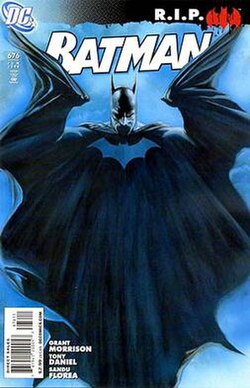
Grant Morrison’s seven-year run on Batman is the most divisive entry on this list—and that’s precisely why it earns a spot. Beginning with 2006’s Batman & Son, which introduced Damian Wayne (Bruce’s son with Talia al Ghul), the run culminates in Batman R.I.P. (Batman #676–681, 2008), where the shadowy Black Glove conspiracy attempts to shatter Bruce Wayne’s mind. Morrison treats every Batman story ever published—campy 1950s sci-fi tales included—as canon, a dizzying thesis that Batman has survived everything and prepared for everything.
It rewards patience rather than casual reading, which is why it lands at 15 rather than higher. Newcomers may feel lost, but readers who commit find one of the richest examinations of the character’s psyche ever attempted. Tony Daniel’s art anchors the surreal narrative, and the run’s ideas—Damian, the “Batman of Zur-En-Arrh,” the Black Glove—still ripple through DC today. Read it after you’ve absorbed the classics.
14. Mad Love (Paul Dini & Bruce Timm)
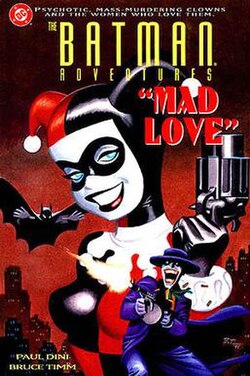
Spinning out of Batman: The Animated Series, 1994’s Mad Love is the rare tie-in comic that surpasses most in-continuity books. Paul Dini and Bruce Timm reveal the origin of Harley Quinn—how promising psychiatrist Dr. Harleen Quinzel fell for the Joker at Arkham Asylum and became his devoted, abused accomplice. It’s funny, stylish, and quietly devastating.
The book’s clean, iconic art belies a genuinely dark story about obsession and emotional manipulation. Mad Love proved Harley—a character created for a cartoon—deserved a permanent place in Batman’s mythology, and she has been a DC mainstay ever since. It won the Eisner Award for Best Single Issue and remains the definitive Harley Quinn story. For anyone who loves the animated series or wants to understand comics’ most famous antihero, this is essential and completely accessible.
13. Gotham by Gaslight (Brian Augustyn & Mike Mignola)
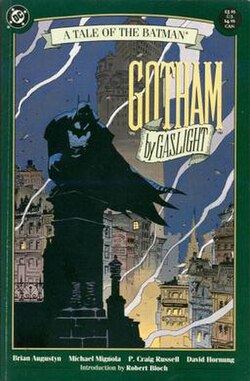
The comic that launched DC’s Elseworlds imprint, 1989’s Gotham by Gaslight transplants Batman to Victorian-era 1889 Gotham, where the Dark Knight hunts Jack the Ripper. Written by Brian Augustyn and illustrated by a young Mike Mignola (years before Hellboy), it’s a moody, atmospheric one-shot that proved Batman’s iconography could survive—even thrive—outside standard continuity.
Mignola’s shadowy, architectural style is a perfect match for gaslit Victorian streets, and the “what if” premise opened the floodgates for decades of alternate-universe Batman stories. It’s short, self-contained, and requires zero prior knowledge, making it an ideal palate cleanser between heavier reads. The concept proved so durable it was adapted into an animated film in 2018. If you only read one Elseworlds title, make it this one.
12. Whatever Happened to the Caped Crusader? (Neil Gaiman & Andy Kubert)
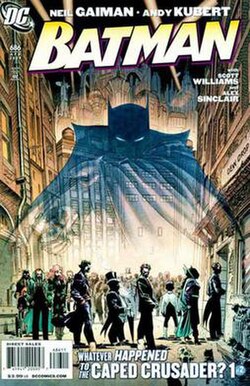
Neil Gaiman—fresh off The Sandman—delivered this two-part elegy in 2009 (Batman #686 and Detective Comics #853). Framed as Batman’s funeral, where every friend and foe tells a contradictory story of how he died, it’s less a plot than a meditation on what Batman means. The answer Gaiman lands on is quietly moving: Batman is the man who never gives up, who always gets back up, in every version of the story.
Andy Kubert’s art shape-shifts to honor decades of Batman styles, from Golden Age camp to modern grit. Deliberately echoing Alan Moore’s Superman farewell “Whatever Happened to the Man of Tomorrow?”, it functions as a love letter to the entire character. It’s a book best appreciated once you know the mythology—the more Batman you’ve read, the more it resonates. A perfect, poetic capstone.
11. Under the Red Hood (Judd Winick & Doug Mahnke)
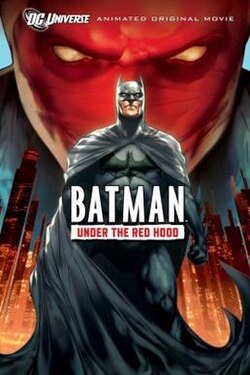
Running through Batman #635–650 (2005), Under the Red Hood answers a question fans thought was settled: what if Jason Todd, the Robin murdered in A Death in the Family, came back? Judd Winick resurrects Jason as the Red Hood, a violent vigilante who forces Batman to confront his greatest failure and his unbending refusal to kill the Joker.
The emotional core is airtight—this is a story about grief, guilt, and the limits of Batman’s code. Doug Mahnke’s kinetic art sells both the brutal action and the quiet devastation. The 2010 animated adaptation is widely considered one of DC’s best films, but the comic hits even harder. Read A Death in the Family first for maximum impact; together they form one of Batman’s most powerful two-part sagas.
10. Knightfall (Dixon, Moench, O’Neil & Various)
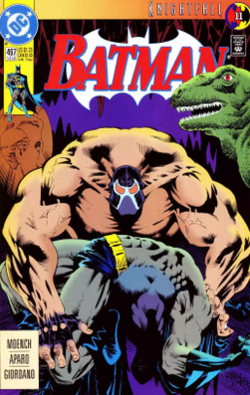
The saga that “broke the Bat,” 1993–94’s sprawling Knightfall introduced Bane, a hulking, super-strong strategist who deduces Batman’s identity, exhausts him by freeing every Arkham inmate, then breaks his spine. What follows—across Knightquest and KnightsEnd—is the story of the unstable Jean-Paul Valley (Azrael) taking up the mantle and Bruce Wayne fighting to reclaim it.
It’s a massive read spanning dozens of issues, but it’s a foundational 90s epic that gave the world one of Batman’s greatest villains. Bane’s dark, calculating menace directly inspired his portrayal in The Dark Knight Rises. The saga also interrogates what makes Bruce Wayne the Batman—proving it’s his restraint and humanity, not just his skills. Best experienced in the collected omnibus editions for the full sweep.
9. A Death in the Family (Jim Starlin & Jim Aparo)
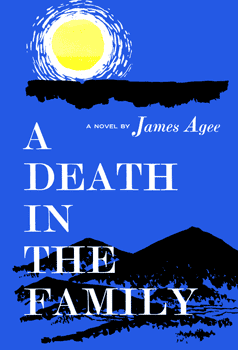
One of the most infamous stories in comics history, 1988’s A Death in the Family (Batman #426–429) let readers vote by 900-number phone line on whether Jason Todd, the second Robin, would live or die. By a margin of 72 votes, they chose death—and the Joker beat Jason with a crowbar before killing him in an explosion.
The stunt made national news, but the story endures for its emotional weight and its consequences. Jason’s death haunted Batman for decades and reshaped the character’s relationship with sidekicks and mortality. Jim Aparo’s classic art keeps the horror grounded and human. It’s a landmark that changed how comics treated permanence and reader participation. Read it before Under the Red Hood, which pays off this tragedy years later in devastating fashion.
8. Hush (Jeph Loeb & Jim Lee)
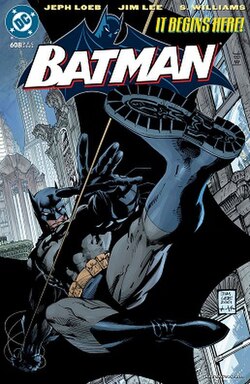
Running through Batman #608–619 (2002–03), Hush is the blockbuster of Batman comics: a twisting mystery in which a bandaged mastermind named Hush pulls the strings of Batman’s entire rogues gallery. Jeph Loeb structures it as a whodunit that parades nearly every major villain—Joker, Riddler, Poison Ivy, Ra’s al Ghul—across its pages.
The real star is Jim Lee, whose sleek, detailed art made this the best-selling Batman book of its era and defined the character’s modern look for a generation. The plot leans more on spectacle than the airtight logic of Loeb’s Long Halloween, which is why it sits a few spots lower—but as a visual feast and a greatest-hits tour of Gotham, it’s unmatched. An ideal book for lapsed readers returning to the character.
7. The Court of Owls (Scott Snyder & Greg Capullo)
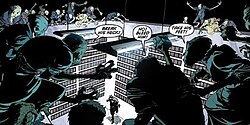
Launching DC’s 2011 “New 52” relaunch, The Court of Owls (Batman #1–7) accomplished the near-impossible: it introduced a genuinely new threat to a character with 70 years of history. Scott Snyder’s Court is a secret cabal of Gotham’s oldest, wealthiest families that has ruled the city from the shadows for centuries—undermining Batman’s core belief that he knows Gotham better than anyone.
Greg Capullo’s art is a modern marvel, especially in the harrowing labyrinth sequence where a trapped, starving Batman is pushed to his psychological breaking point. Because it launched a fresh #1, it’s the single best jumping-on point for modern readers who want current continuity. Snyder and Capullo’s run continues into Death of the Family and Endgame, but it all starts here with one of the best debut arcs in Batman history.
6. The Black Mirror (Scott Snyder, Jock & Francesco Francavilla)
Before the New 52 made him a superstar, Scott Snyder wrote this masterful crime noir in Detective Comics #871–881 (2011). Uniquely, Bruce Wayne is presumed dead—so Dick Grayson wears the cowl, giving the story a lighter, more vulnerable Batman confronting a Gotham that grows darker around him. A serial-killer mystery entwines with the return of Commissioner Gordon’s psychopathic son, James Jr.
Jock and Francesco Francavilla’s art is astonishing, all deep shadows and blood-red palettes that make Gotham feel genuinely diseased. This is one of the most tightly written Batman stories of the modern era—a book that works as pure crime fiction even if you don’t know the wider mythology. It’s frequently cited by critics as the best post-Crisis Batman story, and it announced Snyder as the character’s defining modern voice.
5. Arkham Asylum: A Serious House on Serious Earth (Grant Morrison & Dave McKean)
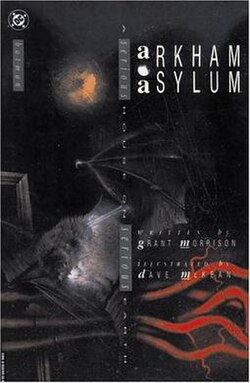
1989’s Arkham Asylum is unlike any other Batman book. When the inmates take over the asylum on April Fools’ Day, the Joker lures Batman inside for a nightmarish walk through his own psyche. Grant Morrison’s script draws on Jungian psychology, Lewis Carroll, and Aleister Crowley to ask whether Batman himself belongs among the madmen.
Dave McKean’s painted, collage-like artwork is genuinely disorienting—this is horror as much as superhero fiction, and the Joker’s dialogue is even hand-lettered in unsettling red script. It became one of the best-selling graphic novels of all time and its title inspired the acclaimed Arkham video game series. It’s a challenging, arthouse read rather than a breezy one, which is the only thing keeping it out of the top three. Essential for understanding Batman as a psychological figure.
4. The Killing Joke (Alan Moore & Brian Bolland)
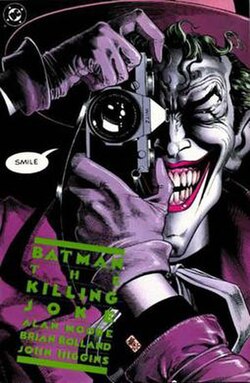
The definitive Joker story, 1988’s The Killing Joke is Alan Moore and Brian Bolland’s brutal one-shot exploring the thesis that anyone can become the Joker after “one bad day.” Through flashbacks to a failed comedian’s descent into madness, Moore gives the Clown Prince of Crime a possible (and deliberately unreliable) origin, while in the present the Joker shoots and paralyzes Barbara Gordon to prove his point.
Bolland’s immaculate art—fully recolored by the artist himself in the 2008 Deluxe Edition—makes every panel a masterclass. The book is not without controversy for its treatment of Barbara, but its influence is undeniable: countless later Joker portrayals, including films, draw directly from it. The final exchange between Batman and the Joker is one of the most analyzed endings in comics. Short, unforgettable, and profoundly dark.
3. The Long Halloween (Jeph Loeb & Tim Sale)
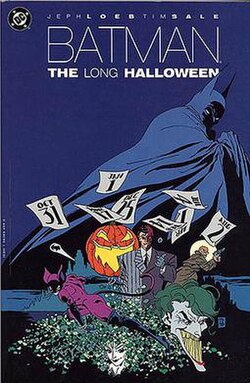
A sweeping 13-issue murder mystery (1996–97), The Long Halloween follows a young Batman, Commissioner Gordon, and District Attorney Harvey Dent as they hunt a serial killer—dubbed Holiday—who strikes only on holidays. Set early in Batman’s career, it chronicles Gotham’s transition from mob-run city to a playground for costumed freaks, and the tragic fall of Harvey Dent into Two-Face.
Jeph Loeb’s noir plotting and Tim Sale’s moody, expressionistic art make this the finest Batman-as-detective story ever told. It heavily influenced Christopher Nolan’s The Dark Knight, particularly Dent’s arc. The sequel, Dark Victory, continues the saga and introduces Robin. As a self-contained epic that captures every facet of the character—detective, tactician, tragic hero—it’s arguably the most complete Batman story on this list, and a perfect follow-up to Year One.
2. Batman: Year One (Frank Miller & David Mazzucchelli)
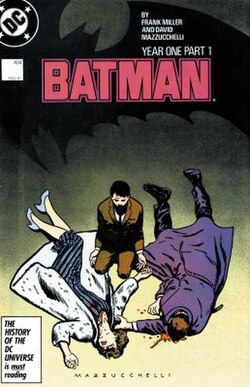
Published in Batman #404–407 (1987), Year One is the definitive origin story and, per DC’s own reading guides, the single best place to start reading Batman. Frank Miller strips the myth back to its bones: a grim, street-level account of Bruce Wayne’s first year fighting crime, told in parallel with a young, honest Lieutenant Jim Gordon arriving in a Gotham rotted through with corruption.
David Mazzucchelli’s spare, powerful art and Richmond Lewis’s muted colors give the book a timeless, hard-boiled elegance. Everything modern Batman rests on—the alliance with Gordon, the flawed early mistakes, the tone of grounded realism—traces back here. It’s short, completely self-contained, and requires no prior knowledge, which makes it the perfect entry point. Its influence on Batman Begins is unmistakable. If you read only one Batman comic, this is the one to start with.
1. The Dark Knight Returns (Frank Miller)
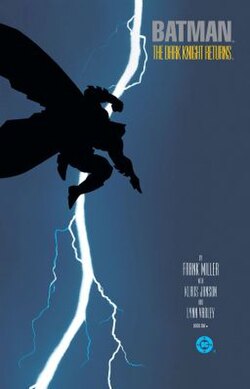
Frank Miller’s 1986 four-issue masterpiece is not just the best Batman comic—it’s one of the most important comics ever published. A 55-year-old Bruce Wayne comes out of retirement to reclaim a Gotham consumed by crime and apathy, in a dystopian future that culminates in a legendary brawl with a government-controlled Superman. Miller reimagines Batman as an aging, obsessive force of will, and the result reshaped the entire medium.
Alongside Watchmen, it ushered in comics’ “dark age” and proved superhero stories could carry genuine literary and political weight. Miller’s jagged art and Lynn Varley’s painterly colors remain striking decades on. Its DNA is everywhere—from Batman v Superman to virtually every “grim, older Batman” story since. It’s the rare book that is both historically monumental and a thrilling read on its own terms. This is the mountaintop of Batman comics, and the definitive statement on the character.
The Ideal Batman Reading Order for Newcomers
Rankings tell you what’s great, but not what to read first—and that trips up most new fans. Here’s the counterintuitive truth: our #1 pick, The Dark Knight Returns, is actually a terrible starting point. It’s an ending—a story about an old Batman—that hits hardest once you already love the character. The smarter path is to read chronologically by Batman’s in-story career, not by rank.
Start with Year One (his first year), then The Long Halloween and its sequel Dark Victory (early career, the birth of the supervillains). From there, read The Killing Joke and A Death in the Family to understand the Joker and the cost of the mission, then Under the Red Hood to see that tragedy pay off. Once you’re invested, tackle Hush for a rogues-gallery tour, then jump to modern DC with The Court of Owls—a fresh #1 that requires no homework. Save The Dark Knight Returns and Whatever Happened to the Caped Crusader? for last; as farewell and elegy, they land far harder when you already know what you’re saying goodbye to. Read this way and the whole mythology clicks into place.
Frequently Asked Questions
What is the best Batman comic for beginners?
Batman: Year One by Frank Miller and David Mazzucchelli is the near-universal recommendation, and it’s endorsed by DC’s own reading guides. It’s short (four issues), completely self-contained, requires zero prior knowledge, and retells Batman’s origin in a grounded, accessible way. The Long Halloween is a strong runner-up for readers who love detective mysteries.
Is The Dark Knight Returns a good first Batman comic?
Not really. While it’s our #1 pick and one of the greatest comics ever made, it depicts an aging Batman coming out of retirement—it’s essentially an epilogue to the character’s career. It hits far harder once you already understand and love Batman. Start with Year One and save this masterpiece for later.
In what order should I read Batman comics?
For newcomers, read by Batman’s in-story timeline rather than publication date: begin with Year One, then The Long Halloween, The Killing Joke, A Death in the Family, Under the Red Hood, and Hush. For current continuity, jump into Scott Snyder’s The Court of Owls, which begins with a fresh issue #1.
Are Batman comics worth collecting or investing in?
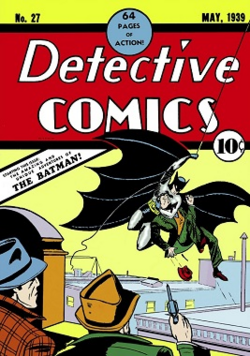
Absolutely. Key issues like Batman #1 (1940), Detective Comics #27 (Batman’s 1939 debut), and Batman #357 (first Jason Todd) command significant sums, and high-grade copies of landmark 80s books like The Dark Knight Returns #1 continue to appreciate. Collected editions of the stories on this list are also excellent, affordable additions to any shelf.
Which Batman comics inspired the movies?
Several. Year One heavily influenced Batman Begins; The Long Halloween shaped The Dark Knight; Knightfall informed Bane in The Dark Knight Rises; and The Dark Knight Returns was a direct visual and thematic template for Batman v Superman. Reading them adds real depth to the films.
Want more? Explore our guides to the most powerful comic book characters ranked, the strongest Marvel villains, the most valuable comic books of all time, and the best comics to invest in for 2026.