What Is a Symbiote in Marvel? Venom, Carnage and the Klyntar Explained
If you have watched Eddie Brock argue with a voice only he can hear, you have already met one. But understanding what is a symbiote in the fuller Marvel sense means going past the black goo and the teeth. Symbiotes are one of the strangest, most tragic ideas in the whole Marvel Universe, and the more you learn about their origin, the less they look like monsters and the more they look like a mirror.
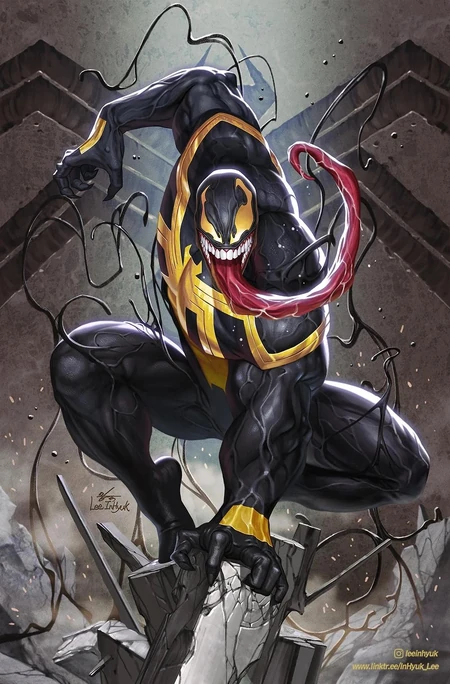
Quick answer: A symbiote is a member of the Klyntar, an alien species of living, shapeshifting ooze that bonds physically and mentally to a host. The bond grants powers like strength, healing and shapeshifting, but the symbiote also rewrites the host’s emotions and desires, feeding on their adrenaline and darker impulses.
What is a symbiote in Marvel Comics?
A symbiote is a non-humanoid alien organism that cannot survive long on its own. It needs a living host to bond with, wrapping around that person like a second skin and merging with their nervous system. In return for a home, the symbiote lends its host a shopping list of abilities: superhuman strength, agility, a healing factor, camouflage and the power to form claws, tendrils and blades out of its own mass.
The catch is that this is never a clean transaction. Symbiotes are, per Marvel canon, capable of altering their host’s personality and memories, amplifying emotional traits and steering the host toward their darkest desires. A symbiote does not just sit on you. It gets a vote in who you become. That two-way influence is the single most important thing to understand about the species, and it is what separates a symbiote from a simple superpower or a magic suit.
Their proper species name is the Klyntar, taken from the artificial planet in the Andromeda Galaxy that the symbiotes built as both a homeworld and a prison. When a symbiote is bonded to a noble, compatible host and kept free of corruption, the Klyntar can be a genuine force for good. When it is starved, abused or bonded to someone cruel, it becomes exactly the nightmare Spider-Man first ran from.
How symbiote bonding works
Bonding is the core mechanic of the entire mythology, so it is worth slowing down on. When a symbiote attaches to a host, the two become a single functional entity, sharing sensation, emotion and often thought. The symbiote can retain a genetic memory from every host it has ever worn, which is why an old symbiote is more dangerous than a fresh one: it carries the fighting instincts and knowledge of everyone it has been.
Symbiotes feed on brain chemistry. In most modern stories they crave phenethylamine, a chemical produced by the human brain during states of fear, anger and excitement, which is also present in chocolate. That biological hunger is why symbiotes push their hosts toward violence and thrill. Aggression is, quite literally, food. It also explains why a symbiote can experience something like starvation and desperation when denied that emotional diet, and why a hungry symbiote will do anything to keep its host.
Crucially, the influence flows both ways. A host with strong willpower can tame a symbiote and even reform it, as Flash Thompson did during his run as Agent Venom. A weak or malicious host, like the serial killer Cletus Kasady, lets the symbiote off the leash entirely. The relationship is a negotiation, and whoever has the stronger will tends to win.
Powers and weaknesses at a glance
Symbiotes are formidable, but they are not invincible. They carry two hard-coded weaknesses that heroes exploit again and again: intense sound and intense heat. According to canon, Knull unintentionally baked these vulnerabilities into the species during their violent forging. A church bell, a sonic emitter or a burst of flame can force a symbiote to recoil from its host. Here is how the pros and cons stack up.
| Trait | Detail | Story impact |
|---|---|---|
| Strength | Hosts can lift 50+ tons | Matches or exceeds Spider-Man |
| Healing | Negates disease and injury | Kept hosts alive from fatal wounds |
| Shapeshifting | Forms claws, blades, tendrils, disguises | Endless offensive options |
| Genetic memory | Retains skills of past hosts | Older symbiotes fight smarter |
| Sound weakness | Sonic frequencies force separation | The classic bell-tower defeat |
| Heat weakness | Fire causes it to recoil and weaken | Flamethrowers as anti-symbiote tools |
If you enjoy ranking raw power like this, our guide to the most powerful comic book characters ranked puts symbiote-empowered heroes in context against the wider Marvel and DC rosters.
Types of symbiotes: the family tree from Venom to Toxin
Symbiotes reproduce asexually, which means the species spreads through a sprawling and slightly disturbing family tree. The whole modern line on Earth traces back to one individual.
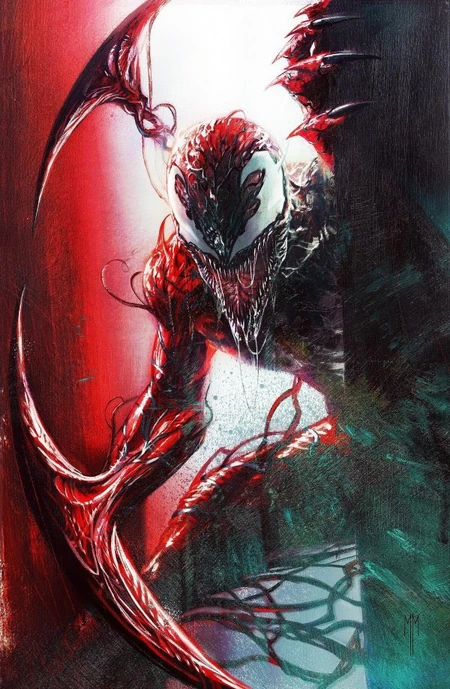
Venom is the progenitor. First appearing in 1984, it bonded briefly with Spider-Man before Peter Parker rejected it, then found a lasting partner in disgraced journalist Eddie Brock. From Eddie, the Venom symbiote spawned multiple offspring. Its most infamous child is Carnage, which bonded to Cletus Kasady and became a red, unchained engine of murder precisely because both symbiote and host were broken.
Below is the shorthand lineage that trips up most new readers.
| Symbiote | Notable host | Lineage |
|---|---|---|
| Venom | Eddie Brock | The Earth progenitor |
| Carnage | Cletus Kasady | Offspring of Venom’s line |
| Toxin | Patrick Mulligan | Offspring of Carnage |
| Riot, Lasher, Phage, Agony | Life Foundation soldiers | Extracted seeds of Venom’s line |
| Scream | Donna Diego | Venom lineage sibling |
| Anti-Venom | Eddie Brock | Accidental hybrid, corrosive to symbiotes |
A few of these deserve a note. Toxin is described in canon as a thousandth-generation descendant and was feared even by Venom and Carnage. Anti-Venom is the odd one out: it formed by accident when Venom’s remnants fused with Eddie Brock’s altered white blood cells, giving it healing powers and making it toxic to other symbiotes rather than a normal offspring. Because so many of the species read as villains, they feature heavily in our roundup of the strongest Marvel villains.
Knull, the God of Symbiotes, and the King in Black
For decades symbiotes were treated as alien parasites with a vague backstory. Then writer Donny Cates rewrote the ceiling of the mythology by introducing Knull, and everything got darker.
Knull is a primordial god of the void who existed before light. When the Celestials began seeding the universe with life, Knull retaliated by decapitating one of them and forging its skull and his own living darkness into All-Black the Necrosword, the first symbiote weapon and the oldest in Marvel cosmology. He then learned he could splinter his living abyss into countless creatures and bond them to hosts across the cosmos, building the Symbiote Hive as an army of god-killers under his hive mind.
The symbiotes eventually rebelled against Knull’s control, imprisoning him at the heart of the artificial planet they named Klyntar, which is why the free, purified members of the species reject their violent instincts. In the 2020 to 2021 crossover event King in Black, Knull finally broke free, invaded Earth with a fleet of symbiote dragons, killed the Sentry and wrapped the entire planet in darkness to blot out the sun. He was ultimately destroyed when Eddie Brock, briefly wielding the Uni-Power, vaporized him, and Eddie inherited the mantle of King in Black.
Knull recontextualizes the entire species. Every symbiote is a shard of a dead-god’s rage that learned, over eons, that it did not have to be what it was made to be. For where a cosmic threat like this ranks among power-scaling heavyweights, compare notes with the strongest anime characters our readers debate endlessly.
Common misconceptions about symbiotes
Because the films simplify things, a few myths have hardened into fake facts. Let us clear them up.
“Venom is the first symbiote.” No. Venom is the first symbiote most readers met, and the Earth progenitor, but the first symbiote ever is All-Black the Necrosword, forged by Knull before the current universe existed.
“Symbiotes are always evil.” Also false. A purified Klyntar bonded to a strong, decent host can be heroic. The species trends dangerous because of hunger and bad hosts, not because evil is hardwired. Given the right partner, a symbiote is closer to a struggling addict than a demon.
“The symbiote is just a super-suit.” This is the most consequential myth. A symbiote is a living being with its own desires, memories and emotional needs. Treating it as a costume is exactly the mistake that gets hosts consumed.
The real reason symbiotes resonate: Marvel’s best metaphor for addiction and codependency
Here is the reading that makes the Venom saga land harder than any power-scaling chart, and it is one most explainers skip entirely. Symbiotes are Marvel’s sharpest metaphor for addiction and codependency, because the bond gives you power while quietly rewriting who you are, and you come to need the thing that is unmaking you.
Look at the mechanics again with this lens. The symbiote arrives during a low point and makes the host feel stronger, bolder, more capable than they have ever been. That is the high. It whispers, it isolates the host from the people who love them, and it demands to be fed with escalating aggression. That is dependency. When the host tries to remove it, the symbiote reacts with grief and desperation, and the host feels a genuine sense of loss, not just relief. Anyone who has watched a loved one try to quit something will recognize that push and pull instantly.
This is precisely why the Eddie Brock arc is the emotional core of the franchise rather than Peter Parker’s brief brush with the suit. Peter used the symbiote and walked away, so his story is a cautionary tale. Eddie stayed. He and the symbiote hurt each other, enabled each other, forgave each other and slowly, over decades of stories, chose to become better together. Their arc is not a hero getting a weapon. It is two damaged parties negotiating a healthier relationship, complete with relapses, boundaries and hard-won trust. Codependency is the whole engine of the drama.
Knull deepens the metaphor at cosmic scale. He represents the origin of the compulsion, the dead-god rage every symbiote was born carrying. When the Klyntar imprison him and choose purity, they are, in narrative terms, a species collectively going into recovery, deciding they will not be defined by the worst impulse they inherited. That is why the mythology keeps working: strip away the teeth and the tendrils, and a symbiote story is about whether you can hold power that changes you without letting it own you. Few metaphors in comics are that honest, and it puts these characters in rare company among the icons on our list of the strongest One Piece characters and beyond, where power always carries a cost.
Frequently asked questions about symbiotes
What is a symbiote made of?
A symbiote is a living, non-humanoid alien composed of a shapeshifting biomass often described as living abyss or darkness. It has no fixed form of its own and survives by bonding to a host, drawing on the host’s body and brain chemistry to sustain itself.
Are symbiotes actually alien parasites?
Technically the relationship spans the full spectrum of symbiosis. Bonded to an unwilling or incompatible host, a symbiote behaves parasitically. Bonded to a compatible, willing partner, the relationship becomes closer to mutualism, with both parties gaining strength and companionship, which is why Marvel treats the species as tragic rather than purely evil.
What is the weakness of a symbiote?
Symbiotes have two signature weaknesses: intense sound and intense heat. Sonic frequencies and fire can force a symbiote to separate from its host or weaken it dramatically. Both flaws were, in canon, accidentally forged into the species by their creator Knull.
Who is the strongest symbiote?
Setting aside Knull himself, who is a god rather than a standard symbiote, All-Black the Necrosword is the oldest and among the deadliest. Among Earth-based symbiotes, Toxin was feared by both Venom and Carnage, while a fully powered Venom wielding cosmic energy has literally destroyed a god.
Is Venom a hero or a villain?
Both, across different eras. Venom debuted as a Spider-Man villain, evolved into a violent antihero known as a “lethal protector,” and has served as an outright hero, notably as Agent Venom. Its alignment depends almost entirely on the host and how healthy the bond is.
For more on the collecting side of these characters, browse our picks for the most valuable comic books and the best comics to invest in 2026. You can also dig into the primary sources on the Marvel symbiote entry at Wikipedia and the character history of Knull, the God of Symbiotes.