Yandere vs tsundere is not a difference of degree. A tsundere hides genuine affection behind hostility and gradually softens; a yandere is openly loving but becomes dangerous — usually to anyone who threatens the relationship. Tsundere describes how affection is expressed. Yandere describes what affection does to the character.
Getting that wrong is the most common mistake in anime terminology, and it comes from treating the two as points on a single “intensity” scale. They are not. Here is what the words actually mean, where they came from, and how the full family of “-dere” types fits together.
What does “dere” mean?
Every term in this family ends in the same word, and understanding it makes the rest fall into place.
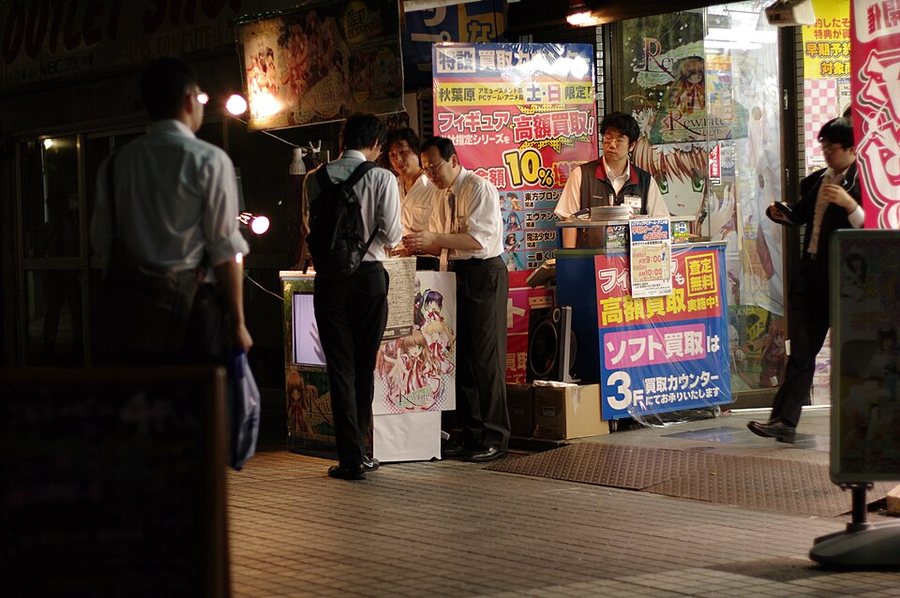
Deredere (デレデレ) is ordinary Japanese — an onomatopoeic expression for someone melting with infatuation, being lovestruck or gushing with affection. It is not anime jargon; it is a normal descriptive word.
The archetype names all work the same way: take a word describing an outward manner, weld it to dere, and you have described a person whose affection is being filtered through that manner.
- tsun — from tsuntsun, to turn away in anger or disgust; prickly and aloof
- yan — from yanderu, to be mentally or emotionally ill
- kuu — from the English loanword “cool”; emotionally flat
- dan — from danmari, silence; shy to the point of muteness
This is why the vocabulary is more precise than it looks from outside. “Yandere” does not mean “crazy girl.” The dere is load-bearing — it specifies that the affection is genuine. A character who is simply violent and obsessive without real attachment is not a yandere at all.
Yandere vs tsundere: the comparison
| Tsundere | Yandere | |
|---|---|---|
| Literal build | tsuntsun (aloof) + dere (affectionate) | yanderu (unwell) + dere (affectionate) |
| Affection shown openly? | No — concealed behind irritation or insults | Yes — often overwhelmingly |
| Who receives the hostility | The love interest | Everyone except the love interest |
| Character arc | The “tsun” recedes over time as trust builds | No softening arc — escalation instead |
| Core tension | Will they admit how they feel? | What will they do to protect this? |
| Genre it drives | Romantic comedy | Psychological thriller and horror |
| Danger to others | None — the hostility is verbal | Central to the archetype |
Yandere vs tsundere: two different axes, not two points on one
Here is the framing that makes yandere vs tsundere stick.
Picture two separate questions you can ask about a character in love. First: is the affection visible or concealed? Second: is the affection stabilising or destabilising?
Tsundere answers the first question and says nothing about the second. A tsundere’s feelings are real, healthy and entirely safe — they are simply hidden behind a defensive manner, and the story is about that defence coming down. The hostility points inward at the person they like, because that person is the source of the vulnerability.
Yandere answers the second question and says nothing about the first. A yandere’s feelings are usually not hidden at all — they are declared, constantly and warmly. What makes them a yandere is that the devotion has stopped being a stabilising force. And critically, the hostility points outward, at rivals, obstacles and anyone perceived as a threat.
That directional flip is the cleanest test available. Ask who the character is being cruel to. If it is the person they love, tsundere. If it is everyone standing near the person they love, yandere.
The scale framing fails because it predicts a tsundere becomes a yandere if you turn the dial up. Nothing of the kind happens. Turn a tsundere’s dial up and you get a character who is more stubborn about admitting their feelings, which is a comedy problem, not a horror one. The two archetypes are not neighbours — they are answers to different questions.
A second structural difference: one has an arc, the other has a reveal
Tsundere and yandere also function differently as storytelling machinery.
The tsundere is a gradient. The entire appeal is watching the ratio shift — heavy on tsun early, increasingly dere as the relationship develops. It is a slow-release mechanism built for long-running romantic comedy, and it can sustain dozens of episodes because the audience is tracking incremental change.
The yandere is a switch. The tension comes from a reveal — the moment the audience understands that the sweetness has something underneath it — and from escalation afterward. It cannot be stretched the same way, because once the reveal lands it cannot be un-landed. This is why yandere characters tend to appear in shorter, tighter stories, and why they are so often used as a mid-story turn rather than a premise stated up front.
Where the terms came from
Both words are genuinely modern slang, born on Japanese message boards in the early 2000s rather than in any official publishing vocabulary — and the tsundere paper trail is unusually precise for internet slang.
The earliest known use dates to August 29, 2002, in a post on an anonymous board called Ayashii World @Zantei. A user praising Ayu Daikuuji, a character from the PC game Kimi ga Nozomu Eien, described her appeal as “tsuntsun deredere.” The compound spread on that board and, by the end of the same year, had been shortened to tsundere on 2channel’s eroge board. Junichi Togashi of Daito Bunka University’s Department of Japanese Literature has documented the same origin academically.
Yandere followed on the same circuit, and is commonly traced to Kotonoha Katsura from the 2005 visual novel School Days.
Here is the part that matters more than the dates: the archetypes long predate the words. Comiket organiser Koichi Ichikawa has pointed to Lum from Urusei Yatsura (1978) as arguably the first tsundere, and manga critic Jason Thompson traced the pattern back to Madoka Ayukawa in Kimagure Orange Road in the 1980s. Fandom did not invent these character types in 2002. It invented a name for something writers had been doing for decades, which is why the vocabulary caught on so fast — it labelled a pattern readers already recognised.
Both terms are now widely understood in Japan, including by people who watch no anime at all, used casually the way an English speaker might say “drama queen.” Kuudere and dandere remain more confined to fandom.
The wider dere family
| Type | The mask | What is underneath |
|---|---|---|
| Tsundere | Irritation and insults | Genuine affection they cannot admit |
| Yandere | Warmth and devotion | Obsession that turns dangerous |
| Kuudere | Cool detachment, flat affect | Real feeling, expressed rarely and quietly |
| Dandere | Silence and social anxiety | Affection that emerges only in private |
| Deredere | None — openly affectionate | Exactly what it looks like |
Fandom has generated a long tail of further variants, most of which are jokes or extremely niche. The four above plus deredere cover the vocabulary you will actually encounter.
A note on using these terms well
Two habits worth avoiding.
First, do not treat the labels as diagnoses. “Yandere” is a fiction archetype describing a narrative function, not a description of any real mental health condition, and the yanderu etymology has led to some genuinely careless usage. The archetype is a horror device.
Second, these categories are descriptive shorthand, not a classification system that every character must fit. Plenty of well-written characters use one register in some scenes and another elsewhere, and forcing a label onto them usually flattens what makes them interesting.
If you are building out your anime vocabulary, our companion explainers cover the terms that most often trip people up: shonen versus seinen untangles the demographic labels, what isekai means covers the genre term, and the best anime villains is a good place to see how obsession works when it is written well.
Frequently asked questions
What is the difference between yandere and tsundere?
A tsundere hides real affection behind hostility aimed at the person they like, and softens over time. A yandere expresses affection openly but becomes dangerous toward anyone perceived as a threat to the relationship. The quickest test is who the character is hostile toward.
Can a character be both yandere and tsundere?
Rarely, and usually not well. The archetypes describe different things, so a character can technically be prickly toward a love interest while dangerous toward rivals, but in practice the two narrative structures pull against each other.
What does dere actually mean?
Dere comes from deredere, an ordinary Japanese onomatopoeic word meaning lovestruck or melting with affection. Every dere archetype attaches a word describing an outward manner to it.
What are kuudere and dandere?
A kuudere is emotionally cool and detached on the surface, from the English word cool, with real feeling expressed rarely. A dandere is silent and socially anxious, from danmari meaning silence, opening up only in private.
Sources: Tofugu’s history of the tsundere archetype, which documents the 2002 Ayashii World post and Junichi Togashi’s research, Japanese with Anime on the dere suffix, and MyAnimeList’s overview of the term.