Comics have evolved from simple newspaper strips to a powerful and respected literary medium. But what is it about the combination of words and pictures that captivates us? The answer lies in the sophisticated art of comic book storytelling, a unique language of sequential art that has been refined over decades. From the groundbreaking work of legends like Will Eisner to the modern analysis of theorists like Scott McCloud, the techniques of visual narrative have been honed to create immersive and emotionally resonant experiences.
This article will delve into the core principles of comic book storytelling, exploring how artists and writers use panels, gutters, pacing, and a rich visual vocabulary to bring their stories to life. Whether you’re a lifelong comic fan or a curious newcomer, understanding these techniques will give you a new appreciation for the artistry and craftsmanship behind your favorite comics and graphic novels.
The Language of Sequential Art: More Than Just Pictures
At its core, comic book storytelling is a form of sequential art, a term famously coined by the legendary Will Eisner. In his seminal book, Comics and Sequential Art, Eisner defines it as the art of arranging images in a specific order to tell a story. This concept is further explored by Scott McCloud in his acclaimed book Understanding Comics: The Invisible Art, where he refines the definition to “juxtaposed pictorial and other images in deliberate sequence, intended to convey information and/or to produce an aesthetic response in the viewer.” [4]

Caption: Will Eisner’s seminal work “Comics and Sequential Art” – the foundational text on comic book storytelling Credit: Amazon.com Source: https://www.amazon.com/
This means that comics are not just a series of illustrations, but a visual language with its own grammar and syntax. The way panels are arranged, the space between them, and the interplay of words and images all contribute to the narrative flow and emotional impact of the story. Understanding this visual language is key to appreciating the artistry of comics.
The Building Blocks: Panels, Gutters, and Flow
The fundamental building blocks of comic book storytelling are the panels—the individual frames that contain a segment of the action. The arrangement of these panels on a page dictates the rhythm and flow of the narrative. As noted by WriteSeen, “Panel designs and layouts in comic books are more than page organizers; they control the rhythm and emotions of your story.” [1]
Here are some key aspects of panels and their role in storytelling:
- Panel Size and Shape: A large, expansive panel can create a sense of awe or emphasize a dramatic moment, while a series of small, rapid-fire panels can increase the pace and create a feeling of urgency or chaos. Overlapping or irregularly shaped panels can also be used to convey a sense of disorientation or intense action.
- The Gutter: The space between the panels, known as the gutter, is just as important as the panels themselves. The gutter represents the passage of time and the reader’s mind actively fills in the gaps, a phenomenon Scott McCloud calls “closure.” A wider gutter can signify a longer pause or a change in location, while a narrow gutter can create a sense of immediacy.
- Page Layout and Flow: The overall arrangement of panels on a page guides the reader’s eye and controls the pacing of the story. A simple grid layout can create a sense of order and stability, while a more dynamic and unconventional layout can create a feeling of excitement or unpredictability.

Caption: Visual example of comic book panel layouts and storytelling techniques Credit: Myth Works Source: https://www.myth.works/
By manipulating these basic elements, comic creators can create a wide range of narrative effects, from slow, contemplative moments to fast-paced action sequences. The careful orchestration of panels and gutters is a key aspect of the visual storytelling in comics.
Mastering the Clock: Pacing and Timing in Comics
Pacing is a critical element in any form of storytelling, and in comics, it is largely controlled by the manipulation of panels and page layout. As discussed in an article on WriteSeen, “Pacing and timing determine how a comic book unfolds. Without the luxury of pages upon pages of text, the speed at which a story progresses lies heavily in the hands of panel transitions and strategic scene arrangements.” [1]
Comic creators use a variety of techniques to control the pacing of their stories:
- Number of Panels: A page with many small panels will slow down the reader, forcing them to process more information and creating a sense of a longer, more drawn-out moment. Conversely, a page with a single, large splash panel will be absorbed quickly, creating a sense of a sudden, impactful event.
- Panel Transitions: The transitions between panels also play a crucial role in pacing. Scott McCloud identifies several types of panel transitions in Understanding Comics, including moment-to-moment, action-to-action, and scene-to-scene. The choice of transition can either speed up or slow down the narrative, depending on the desired effect.
- Visual Rhythm: The repetition of certain visual elements, such as a character’s expression or a particular background, can create a visual rhythm that affects the pacing of the story. This can be used to create a sense of monotony, or to build tension and suspense.
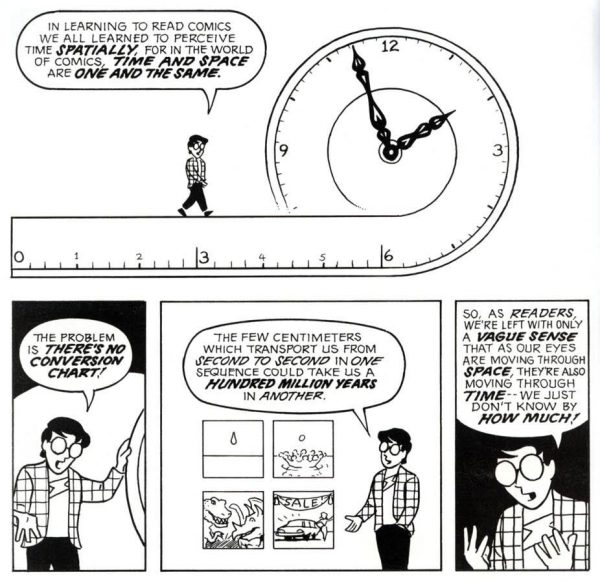
Caption: Scott McCloud’s “Understanding Comics” explores the visual language of sequential art Credit: 99% Invisible Source: https://99percentinvisible.org/
By mastering these techniques, comic creators can create a dynamic and engaging reading experience, taking the reader on a journey of carefully controlled emotional highs and lows. The evolution of comic book art has seen artists become increasingly sophisticated in their use of pacing and timing to create complex and nuanced narratives.
Visual Vocabulary: Beyond Words and Pictures
Beyond the structural elements of panels and gutters, comic book storytelling relies on a rich visual vocabulary to convey meaning and emotion. This vocabulary includes everything from the use of color and line work to the composition of individual panels and the integration of sound effects.
- Color and Mood: Color is a powerful tool for setting the mood and tone of a scene. A warm color palette can create a sense of comfort and nostalgia, while a cool, muted palette can evoke feelings of sadness or alienation. Drastic shifts in color can be used to signal a change in location, a flashback, or a shift in the emotional state of a character.
- Line Work and Texture: The quality of the line work can also have a significant impact on the reader’s experience. Jagged, energetic lines can create a sense of chaos and action, while smooth, flowing lines can create a feeling of calm and serenity. The use of texture can also add depth and realism to the artwork, making the world of the comic feel more tangible.
- Composition and Framing: The way elements are arranged within a panel, known as composition, can be used to guide the reader’s eye and create a sense of balance or tension. The framing of a shot, whether it’s a close-up, a long shot, or a Dutch angle, can also be used to create a specific emotional response.
- Sound Effects and Lettering: Sound effects, or onomatopoeia, are a unique feature of comic book storytelling, allowing the artist to visually represent sounds. The style and placement of the lettering can also contribute to the overall tone and mood of the story. The evolution of comic book lettering has been a key part of the development of the medium.
By mastering this visual vocabulary, comic creators can create a multi-layered and immersive reading experience that goes far beyond what can be achieved with words or pictures alone.
The Enduring Power of Sequential Art
From the pioneering work of Will Eisner to the insightful analysis of Scott McCloud, the art of comic book storytelling has evolved into a sophisticated and powerful medium. By understanding the intricate interplay of panels, gutters, pacing, and visual vocabulary, we can gain a deeper appreciation for the craftsmanship and artistry that goes into creating our favorite comics and graphic novels.
As the medium continues to evolve with the advent of digital comics and new technologies, the fundamental principles of sequential art remain as relevant as ever. The ability to tell a compelling story through a sequence of images is a timeless art form, and one that will continue to captivate and inspire readers for generations to come. So the next time you pick up a comic, take a moment to appreciate the invisible art of storytelling that is unfolding before your eyes.
References
- WriteSeen. (2025, March 11). What Are Comic Book Storytelling Techniques for Success? https://writeseen.com/blog/what-are-comic-book-storytelling-techniques-for-success
- EMP Art. (2024, April 15). The Art of Sequential Storytelling: Comics and Graphic Novels. https://www.emp-art.com/emp-blog/the-art-of-sequential-storytelling-comics-and-graphic-novels
- Pinnacle Pages. (n.d.). Comics as a Visual Language: Understanding the Power of Sequential Art. https://www.pinnaclepages.ca/comics-as-a-visual-language-understanding-the-power-of-sequential-art/
- O’Brien Holmes, S. (2023, October 13). What are comics?: Understanding Comics by Scott McCloud Part 1. Writer and the Wolf Editorial. https://www.writerandthewolf.com/2023/10/13/understanding-comics-by-scott-mccloud-part-1-what-are-comics/