Lex Luthor is Superman’s greatest foe not because he can match the Man of Steel’s strength, but because his best comic book storylines make the case that human ambition, resentment, and genius are just as dangerous as any alien threat. Ranked here are the eight Luthor arcs that best prove it, from his 1940 debut to his recent stint as a reluctant Justice League member.
Last updated: September 10, 2026
Most “best villain stories” lists rank Luthor by body count or scheme complexity. This one ranks him by something else: how honestly each story answers the question of why a man with no powers keeps refusing to lose to a god. That standard is why a quiet five-issue miniseries beats out several louder universe-shaking crossovers below.
1. Lex Luthor: Man of Steel (2005)
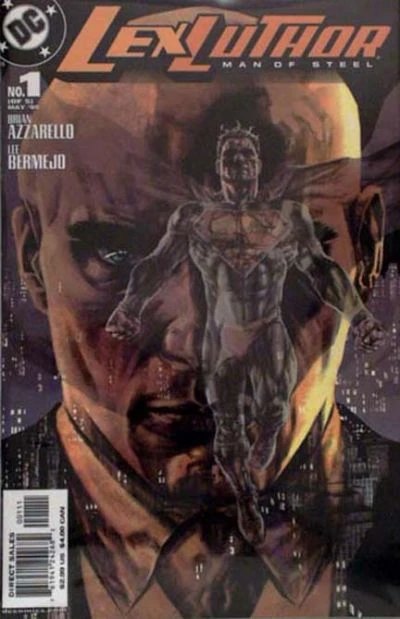
Lex Luthor: Man of Steel is the definitive Luthor story: a five-issue 2005 miniseries by writer Brian Azzarello and artist Lee Bermejo that tells its entire story from Luthor’s point of view, framing him as a committed humanist convinced Superman’s mere presence makes humanity weak and complacent.
Azzarello and Bermejo never let Luthor off the hook, but they also never let the reader dismiss him. His plan to shatter Metropolis’s faith in Superman is genuinely persuasive from the inside, right up until the story’s final, quietly devastating sacrifice reveals exactly how far he’s willing to go to prove his point. Bermejo’s photorealistic art, rendered in the same perpetual Metropolis daylight Superman comics usually use for hope, gives the whole thing a queasy, grounded weight that most Luthor stories don’t bother with. It’s the one entry on this list built entirely to answer “what does Luthor actually believe,” and it answers it better than anything before or since.
2. All-Star Superman (2005-2008)
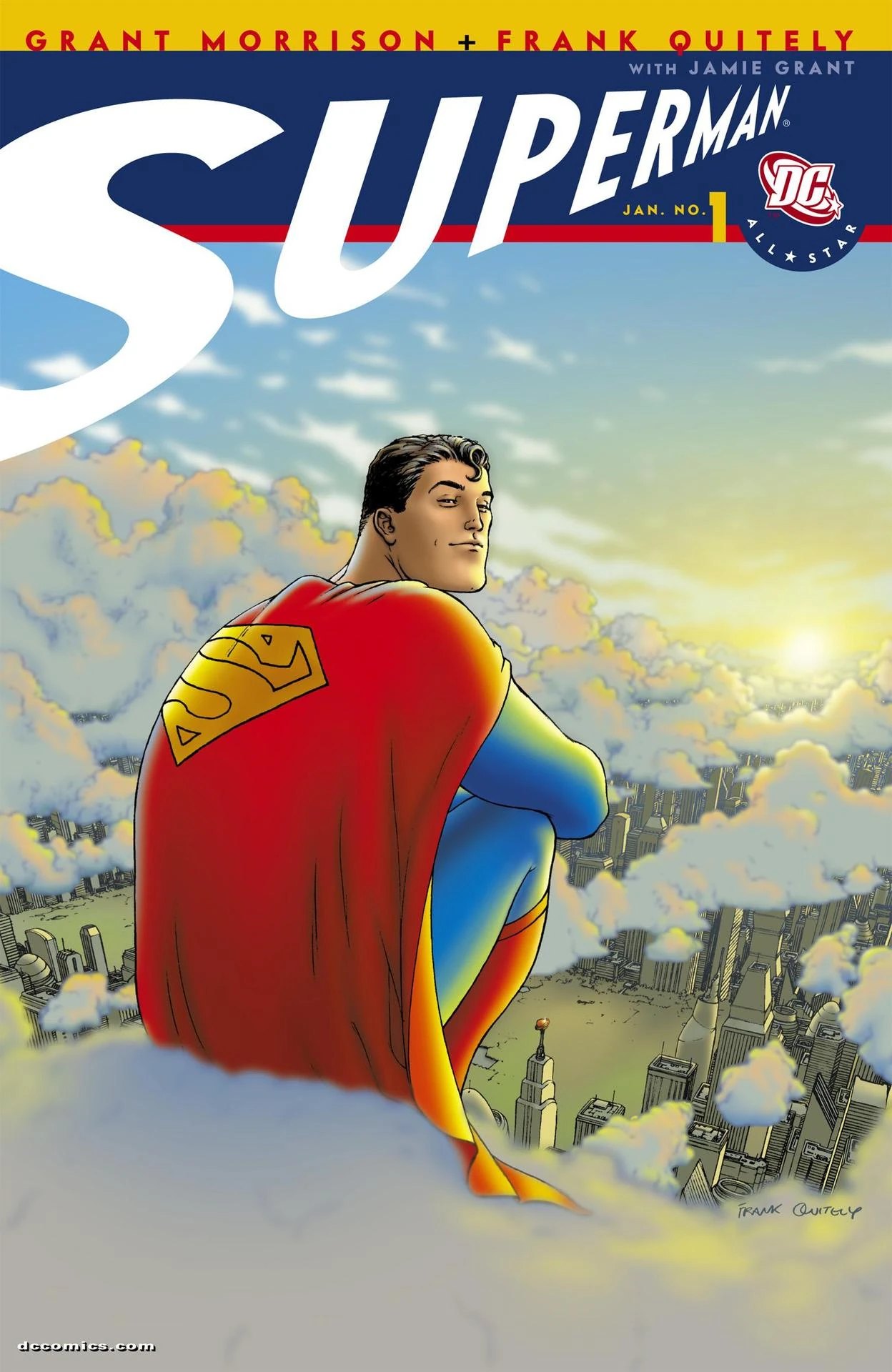
All-Star Superman, the twelve-issue Grant Morrison and Frank Quitely series that ran from November 2005 to October 2008, gives Luthor his most philosophically complete arc: a plot to poison Superman with solar radiation succeeds, and Luthor spends the rest of the story reveling in a victory that quietly destroys him too.
The series won the Eisner Award for Best New Series in 2006 and the Eisner Award for Best Continuing Series in both 2007 and 2009, and Luthor is a major reason why. Morrison, the series’ writer, told interviewer Kevin Mahadeo in a February 21, 2011 conversation for CBR that the trick to writing Luthor was keeping the conflict human-sized even at cosmic scale: “The bad guy hates him, but he likes the bad guy. That real, small human emotional stuff works great when you blow it up to cosmic proportions.” That’s exactly what All-Star Superman does — Luthor gets his win, briefly tastes Superman’s power, and immediately squanders it through his own arrogance. No other story makes his self-defeat feel so inevitable.
3. Superman: Red Son (2003)
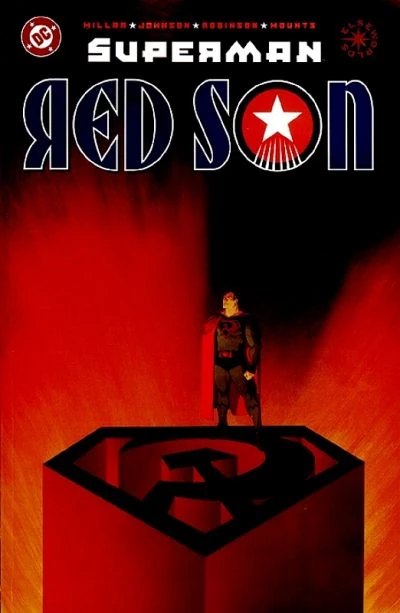
Superman: Red Son, Mark Millar and Dave Johnson’s three-issue 2003 Elseworlds miniseries, flips the entire dynamic: Superman lands in Soviet Ukraine instead of Kansas, and Lex Luthor becomes America’s greatest hero, the one man clever enough to fight a Soviet superman the U.S. government can’t touch.
What makes Red Son’s Luthor the real tragic figure of the book is that he never claims the moral high ground — he fights Superman because he hates losing, not because he’s right. His “victory,” engineering Superman’s apparent death and uniting the world under an American banner, plays like triumph for exactly one page before the story’s coda undercuts it completely: Luthor dies, Superman turns up alive at his funeral, and the whole cosmic joke resets across billions of years. It’s the starkest illustration on this list of a theme that recurs in nearly every great Luthor story — winning and being right are two entirely different things, and Luthor has never once managed both at the same time.
4. Forever Evil (2013-2014)
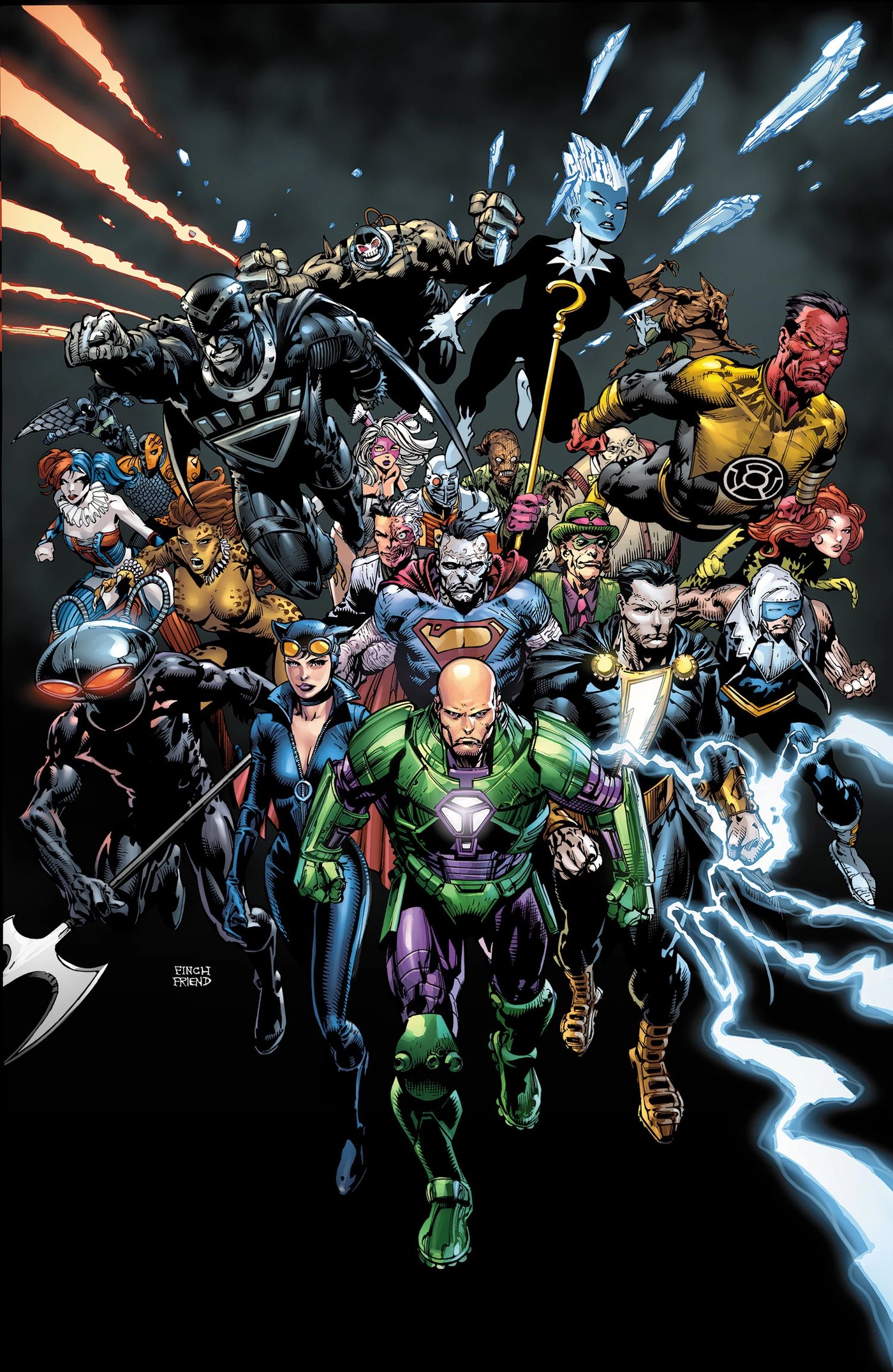
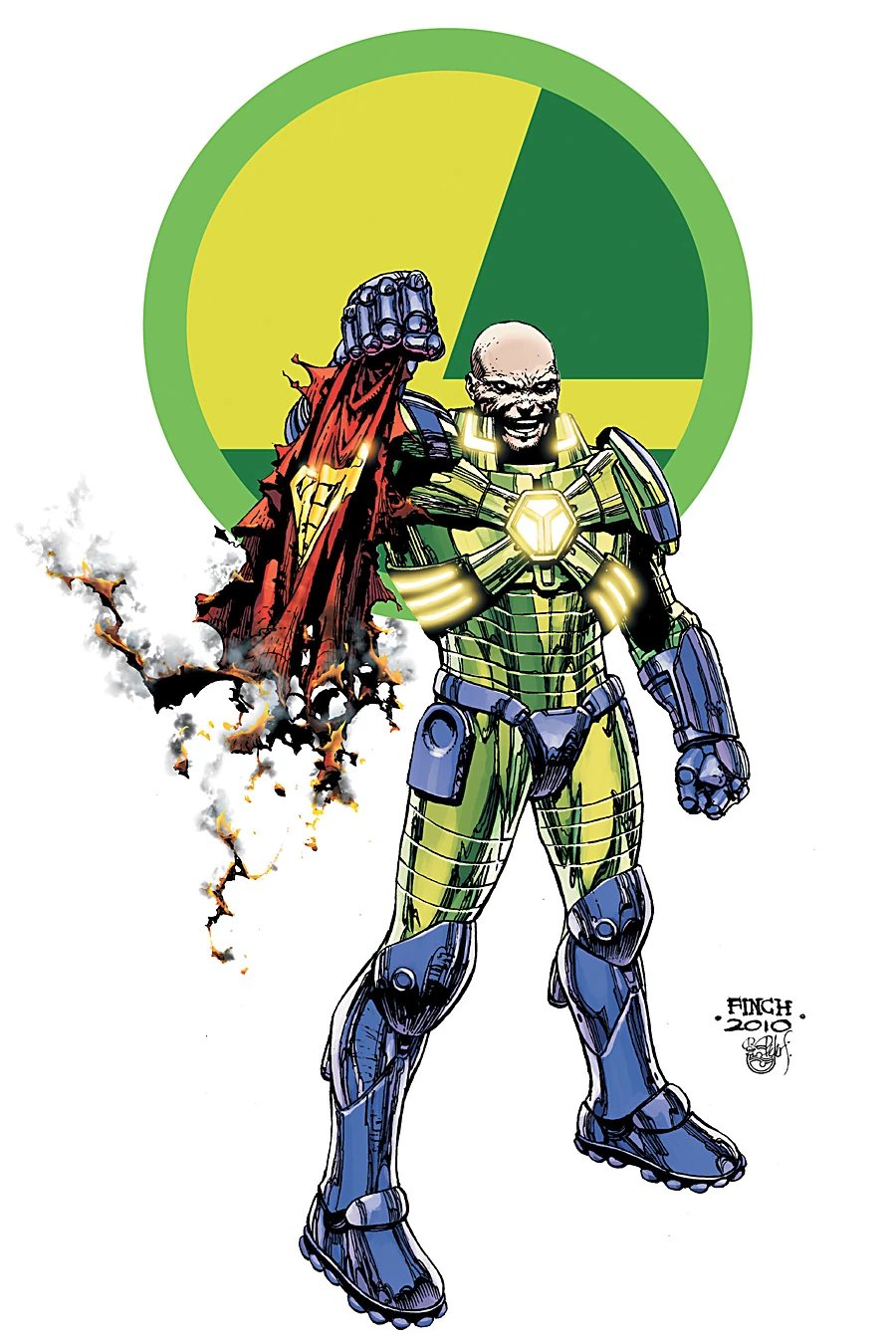
Forever Evil, Geoff Johns and David Finch’s seven-issue 2013-2014 New 52 crossover, strands Earth without its Justice League after the villainous Crime Syndicate arrives from a parallel world — leaving Lex Luthor as the only person left willing, and arguably able, to stop them.
Johns has described Forever Evil as fundamentally a Lex Luthor story, and the arc earns that framing by forcing Luthor into a role he’s spent 70-plus years of continuity avoiding: the guy other villains, and eventually the public, actually need. He doesn’t become good — he stays exactly as calculating and self-interested as ever — but the story uses that calculation to make an argument the character had never really gotten to make at this scale before: that his ruthlessness might occasionally be worth more than a hero’s good intentions. It’s the hinge point that made everything that follows on this list, including his eventual Justice League membership, plausible instead of a gimmick.
5. Justice League: Darkseid War (2015)
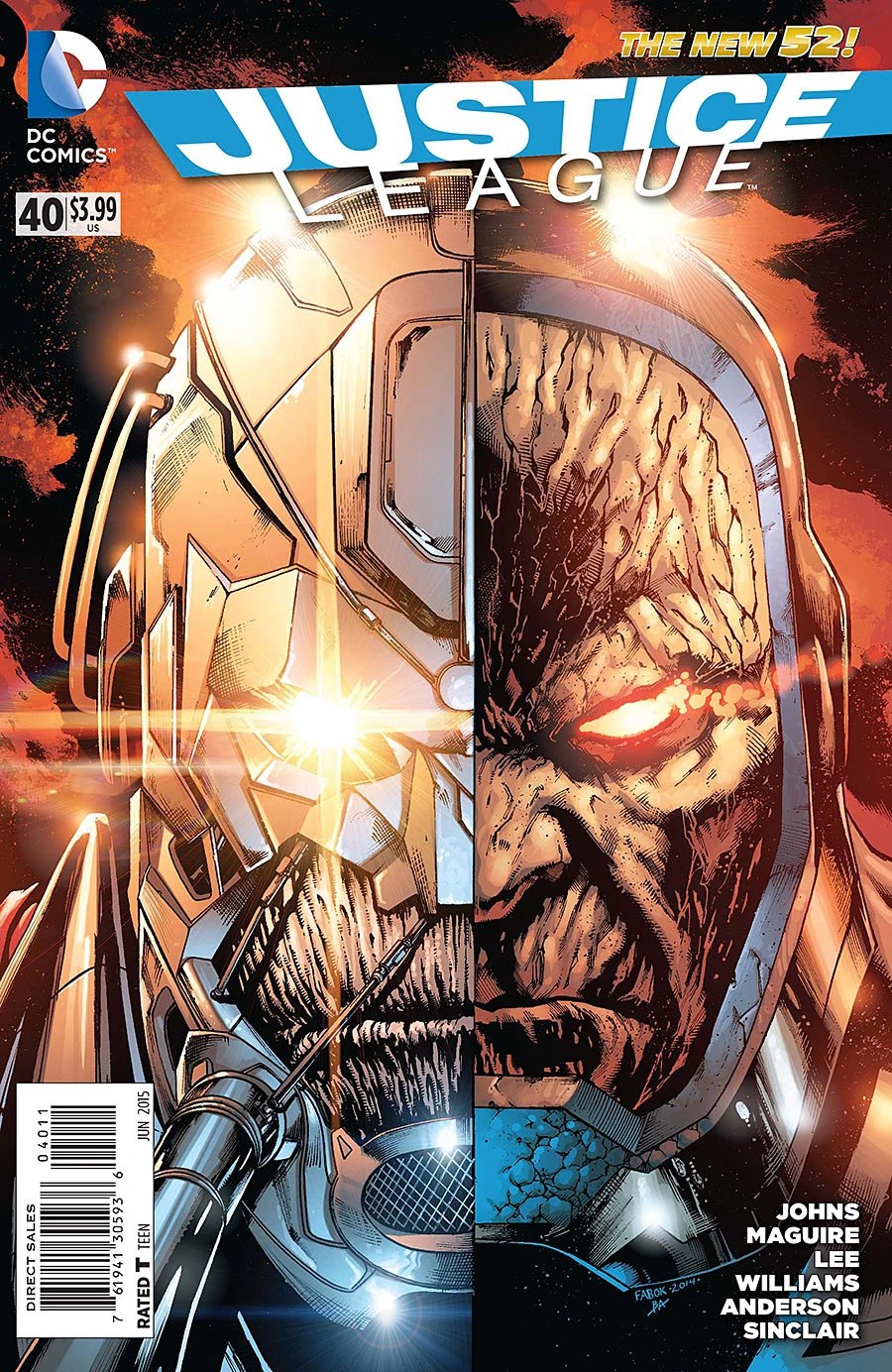
Justice League: Darkseid War, the 2015 Geoff Johns and Jason Fabok arc that closed out the New 52 Justice League run, gives Luthor his strangest and most audacious moment: caught in the crossfire between Darkseid and the Anti-Monitor, he seizes a fragment of god-tier cosmic power and crowns himself Lord of Apokolips.
Johns had already turned Luthor into something like an antihero during Forever Evil, and having him formally join the Justice League afterward turned out to be one of the New 52 era’s more effective narrative swings — a team-up book earning real tension from the fact that its newest member is also its most dangerous. Darkseid War is the payoff: Luthor briefly gets to be as powerful as the beings he’s spent his whole life resenting, and the story is smart enough to treat that power as corrosive rather than triumphant. He doesn’t get to keep it. He rarely does.
6. Superman: Birthright (2003-2004)
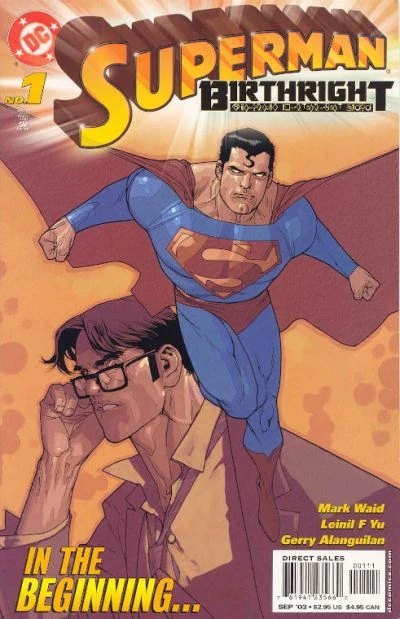
Superman: Birthright, Mark Waid and Leinil Francis Yu’s twelve-issue 2003-2004 origin retelling, is the story that gave Luthor and Clark Kent a shared adolescence: childhood acquaintances in Smallville whose friendship curdles the moment Lex realizes Clark is hiding something from him.
Waid’s version makes Luthor’s hatred personal in a way most Silver Age and Post-Crisis origins never bothered to. Clark rejects Lex’s overture of friendship as a teenager, and Lex spends the rest of the series treating that rejection as proof of everything he already suspected about the world — that the people worth trusting the most are the ones most likely to lie to you. By the time Luthor stages a fake alien invasion of Metropolis to expose Superman, the scheme reads less like supervillainy and more like a very smart, very wounded man finishing an argument he started as a teenager. It’s the best account of why, out of everyone Luthor could resent, it had to be Superman specifically.
7. President Luthor (2000-2004)
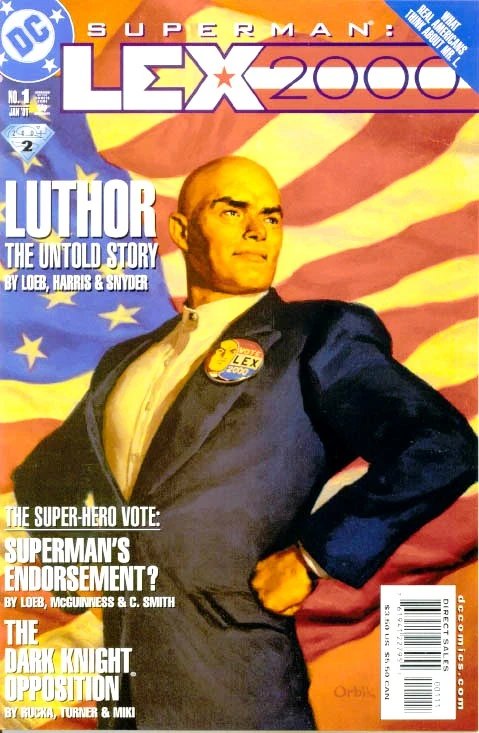
President Luthor began in Superman: Lex 2000 #1, a November 2000 one-shot by Jeph Loeb and Greg Rucka with art from a rotating team including Ed McGuinness and Doug Mahnke, and ran across the Superman titles for roughly the next four years as Luthor legitimately won the presidency of the United States.
Luthor’s campaign is the story’s cleverest move: he runs on real, publicly verifiable heroism, including his help during Metropolis’s Brainiac crisis and Gotham City’s “No Man’s Land” disaster, while using his own media empire to bury every “alleged” villainy story before it can spread. It’s the storyline that argues most directly that Luthor’s real superpower has never been science — it’s his ability to make ruthless self-interest look like public service, at a scale the courtroom-and-cape stories never touch. Watching Superman fume, powerless to intervene in a legitimate democratic election, is still one of the more uncomfortable Luthor stories DC has published.
8. Action Comics #23 (1940)
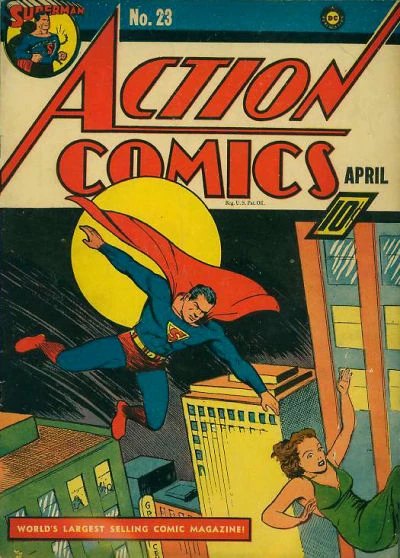
Action Comics #23, published in April 1940 by creators Jerry Siegel and Joe Shuster, is Luthor’s first appearance — a red-haired, sky-city-dwelling mad scientist trying to provoke a war between two European nations, defeated by Superman before he can finish the job.
It’s not a great comic by modern standards, but it’s the source code for everything above it on this list, and collectors still treat it that way. A CGC-graded 8.0 copy of Action Comics #23 sold for $84,000 at Heritage Auctions in October 2024, part of a broader climb for the issue: one CGC 6.5 copy brought $8,800 in 2012 and the same grade fetched $37,500 by 2018. (Luthor’s now-iconic bald look wasn’t even the original design — that came a year later, in 1941, after an artist’s mix-up that Shuster liked enough to keep.) Every other entry on this list is, in some sense, still answering the question this one issue asked first: what happens when the smartest man on Earth decides Superman is the problem?
What Actually Connects Luthor’s Best Stories
Here’s the pattern the individual rankings above don’t spell out on their own: every one of Luthor’s genuinely great stories ends with him holding the exact tool he needed to win — Superman’s own power in All-Star Superman, a legitimate presidency in President Luthor, a fragment of a god’s power in Darkseid War, a united world in Red Son — and then losing anyway, not to Superman’s fists, but to his own psychology. The gadgets and kryptonite rings are set dressing. The actual throughline of every Luthor story worth reading is a smart man sabotaging his own win the moment he has to decide what having it would actually mean. That’s a sharper, and more interesting, character flaw than “jealous of an alien,” and it’s the reason Luthor has outlasted almost every other Silver Age villain still in print.
For readers building out a full rogues’ gallery reading list, Luthor’s entry on comicbookco.com’s ranking of the most powerful DC villains is worth a look for how he stacks up against cosmic-tier threats despite having zero superpowers. His decades-long dynamic with Superman is also covered in our breakdown of comics’ greatest rivalries, and readers curious how Kryptonite fits into Luthor’s toolkit against the Man of Steel can check our superhero weaknesses guide.
Frequently Asked Questions
Is Lex Luthor’s best storyline “Lex Luthor: Man of Steel” or “All-Star Superman”?
It depends on what you want from the character. Man of Steel is the deeper character study because it’s told entirely through Luthor’s eyes across all five issues. All-Star Superman is the more celebrated and awarded work overall, winning Eisner Awards in 2006, 2007 and 2009, but it’s Superman’s story first and Luthor’s second.
Did Lex Luthor actually become President of the United States in the comics?
Yes. Starting with Superman: Lex 2000 #1 in November 2000, Luthor was elected the 43rd President of the United States in mainstream DC continuity and served roughly a full term before his presidency collapsed.
Has Lex Luthor ever been a member of the Justice League?
Yes. After his turn as Earth’s reluctant defender in 2013’s Forever Evil, Luthor joined the New 52 Justice League and briefly gained near-godlike power as the self-declared Lord of Apokolips during 2015’s Darkseid War.
What’s the best Lex Luthor comic for a new reader to start with?
Lex Luthor: Man of Steel is the most self-contained option — five issues, no prior continuity required, and it works as a complete character study on its own. All-Star Superman is nearly as accessible and doubles as one of the best Superman stories ever published.