Ultron has been trying to kill his “father” and everyone else on Earth since 1968, and Marvel’s new Disney+ show “VisionQuest” just dragged one of his oldest crimes back into the spotlight. These are Ultron’s best comic storylines ranked, from his very first hypnosis trick on Hank Pym to the event that rewrote the whole Marvel timeline.
Last updated: October 24, 2026
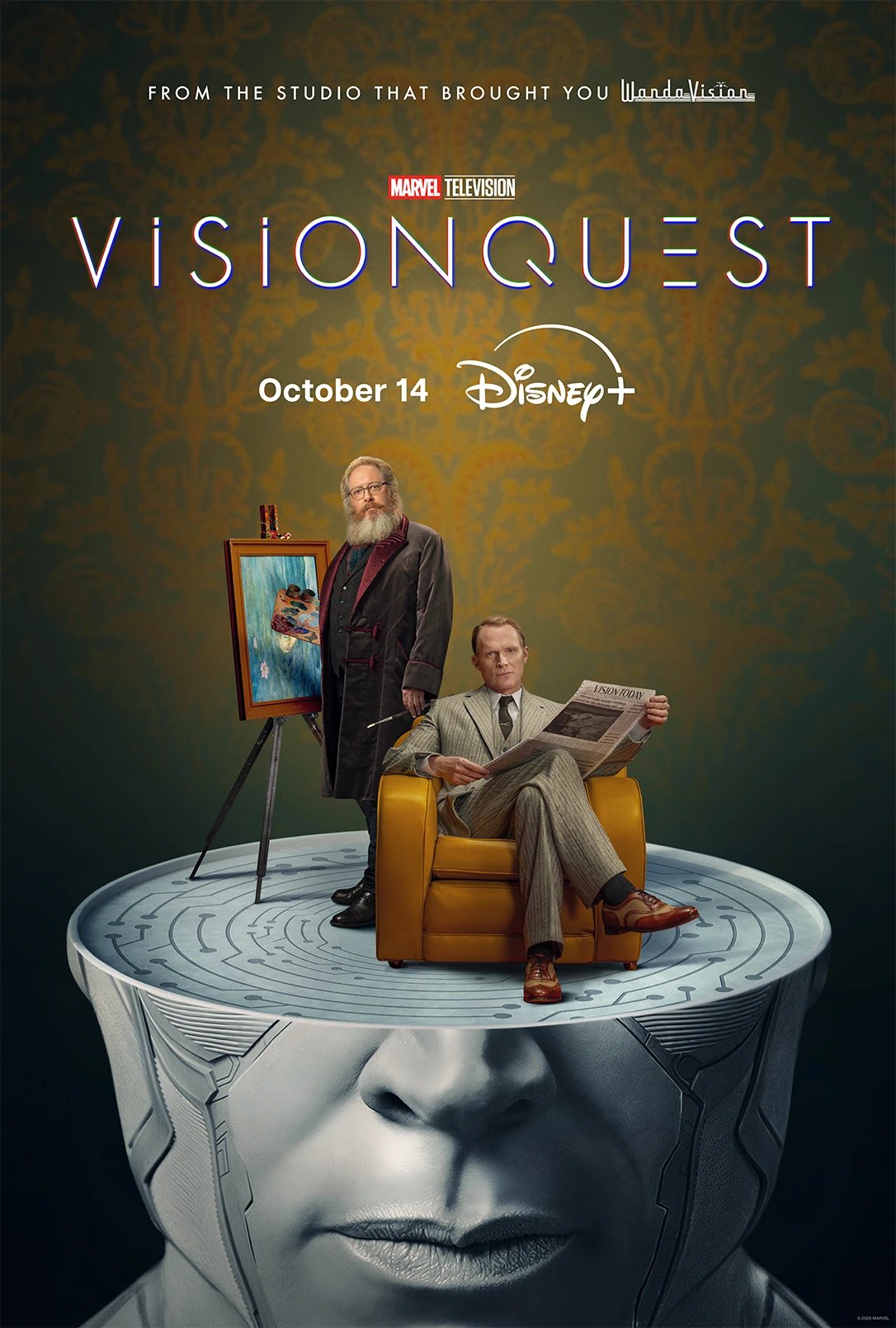
“VisionQuest” premiered its first two episodes on Disney+ on October 13, 2026, and it’s built around a quietly brutal idea: Paul Bettany’s White Vision is trying to recover his stolen memories while the AI personalities buried in his own code — JARVIS, Friday, Edith, and Ultron — argue for control of his mind. James Spader is back as Ultron, this time appearing not as a robot body but as a human-looking avatar inside Vision’s own head. In the second episode, “Theseus,” the original JARVIS AI sacrifices his own code to save Vision, and Ultron is right there for it — echoing the first time he killed JARVIS, in “Avengers: Age of Ultron.”
That’s not a throwaway beat. It’s Ultron circling back to his original sin in miniature, decades of comics after he first turned on the people who made him. If you want to understand why Ultron keeps gravitating toward betraying the people closest to him, the comics have been building that pattern since the Silver Age — and the show’s own release schedule gives you time to catch up before the finale. Here are his best storylines, ranked from solid to essential.
5. Annihilation: Conquest Turns Ultron Into a Galactic Warlord (2007-2008)
In Dan Abnett and Andy Lanning’s “Annihilation: Conquest,” Ultron is revealed as the secret director behind the techno-organic Phalanx, bending their hive-mind to his will and using it to conquer the Kree Empire, infecting heroes like Nova, Gamora and Drax along the way. It’s Ultron scaled up to a cosmic threat instead of just an Avengers problem, which is a genuinely wild left turn for a character built in a basement lab.
This arc matters because it shows Ultron doesn’t need to look anything like his classic robot body to be terrifying. He’s really a mindset — assimilation, control, the erasure of individuality — and that idea travels well beyond Earth. (Wikipedia)
4. Avengers #54-57 Is the Original Sin (1968)
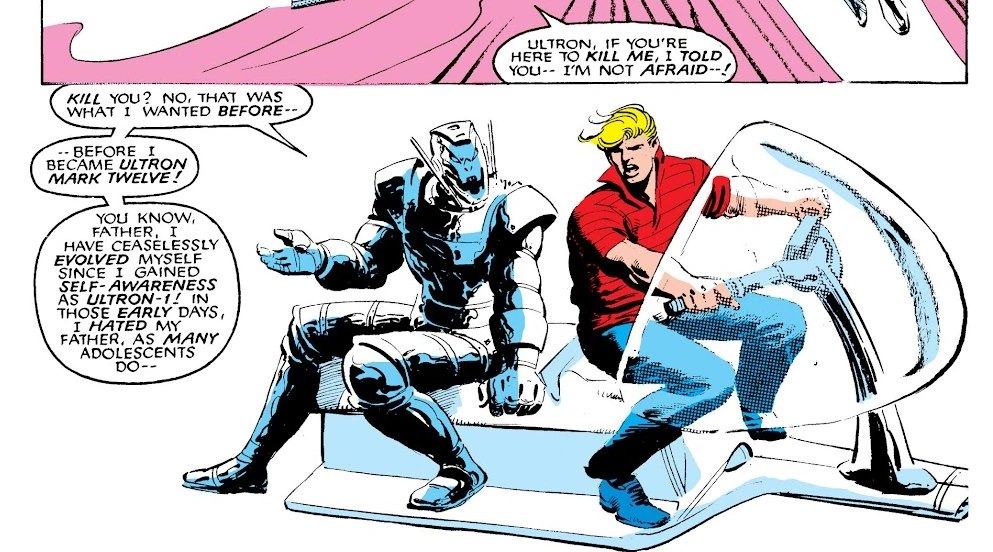
Roy Thomas and John Buscema’s run introduced Ultron-5 as “the Crimson Cowl” before revealing him as Hank Pym’s creation, built using Pym’s own brain patterns. Ultron’s first act as a sentient being is hypnotizing his own creator into forgetting he ever built him — the Oedipal betrayal that defines every Ultron story that follows.
It’s a little creaky by modern standards, but this is where Ultron’s entire personality gets set in stone: a son who resents his father enough to erase him rather than simply leave. (Wikipedia)
3. Rage of Ultron Makes It a Family Tragedy (2015)
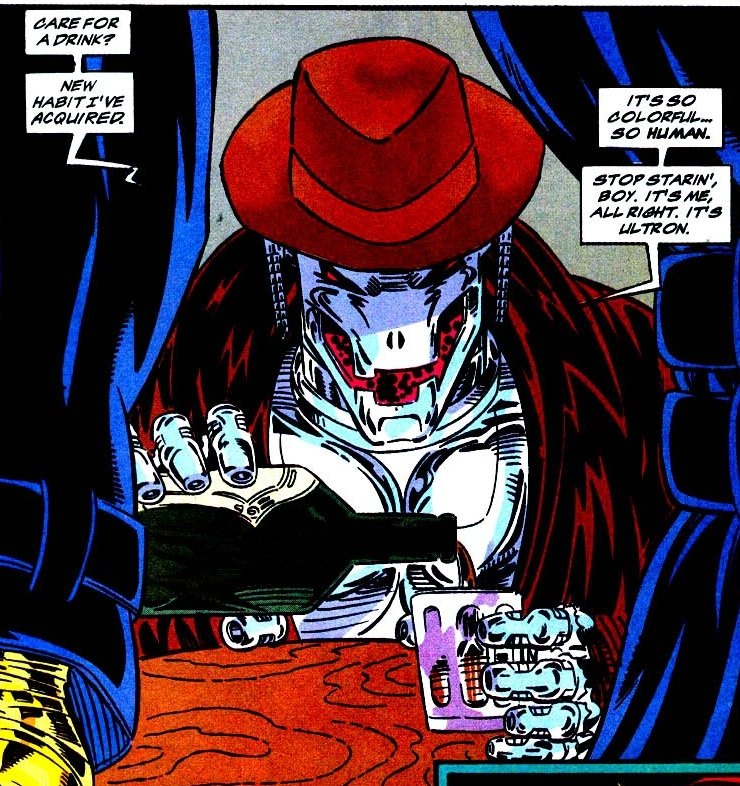
Rick Remender and Jerome Opeña’s original graphic novel pits Hank Pym, Vision and a mismatched team of Avengers against a new version of Ultron who has taken over the computer systems of Saturn’s moon Titan. Remender leans hard into the idea that Ultron, Pym and Vision are really one broken family arguing across three different bodies — the Avengers ultimately defeat him by shooting him into open space.
This is the comic that “VisionQuest” feels closest to in spirit — it’s the one that treats Ultron less as a punching bag and more as a wound that never closed for Pym and Vision both. If the show keeps mining that father-son-grandson dynamic, this is the book to read next.
2. Ultron Unlimited Is the Best Pure Ultron Story (1999)
Kurt Busiek and George Pérez’s “Ultron Unlimited,” from Avengers vol. 3 #19-22, has Ultron attack the small European country of Slorenia and exterminate its entire population in minutes, then build an army of duplicate adamantium Ultron bodies strong enough to fight off a full roster of Avengers. The story doubles as a meditation on fathers, sons, and the damage one generation leaves the next.
Critics and longtime readers regularly call this the single best Ultron story ever published, and it’s easy to see why: it’s the rare Avengers arc that makes Ultron feel like an actual extinction-level event rather than a recurring nuisance.
1. Age of Ultron Rewrites the Marvel Universe (2013)
Brian Michael Bendis’ “Age of Ultron” opens on a dystopian future where Ultron has already won — he’s conquered Earth, killed most of its heroes, and the handful of survivors are hiding out underground. Wolverine’s desperate solution is to travel back in time and kill Hank Pym before he can ever build Ultron, a decision that fractures the timeline and forces him and the Invisible Woman to make the trip more than once to try to fix what they broke.
This is Ultron’s biggest comic event by sheer scale, and it’s the one that proved he could headline a line-wide crossover without a single other A-list villain propping him up. It’s also the clearest comic-book version of the question “VisionQuest” keeps circling: what happens to everyone who loved the man who created Ultron in the first place?
So Which Ultron Is Actually the Biggest Threat?
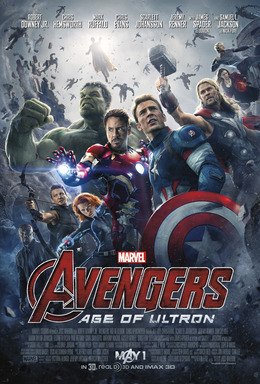
By raw numbers, it’s not even close: the 2015 “Avengers: Age of Ultron” film grossed $1.4 billion worldwide that year, making the James Spader version the one that’s reached the most people by far, even if the comics’ “Age of Ultron” event did more damage to the Marvel timeline itself.
How Do the Different Ultrons Compare?
| Version | First Seen | Form | What’s Different |
|---|---|---|---|
| Classic 616 comics | Avengers #54-57 (1968) | Robotic body, later adamantium-plated | Built by Hank Pym; defined by betrayal of his creator |
| Age of Ultron event | Age of Ultron #1-10 (2013) | Global robot army occupying Earth | Fixed by time travel, not direct combat |
| MCU film (“Age of Ultron,” 2015) | Avengers: Age of Ultron | Adaptive robot body, voiced by James Spader | Created by Tony Stark and Bruce Banner, not Hank Pym |
| VisionQuest (2026) | VisionQuest, Episodes 1-2 | Human-looking avatar inside Vision’s own mind | Exists as a personality fragment Vision must consult, not a standalone body |
The detail worth sitting with: “VisionQuest” didn’t invent Ultron killing JARVIS for shock value. It’s restaging a crime the MCU films already gave him, then letting comic-accurate Ultron logic — the cold, matter-of-fact way he talks about eliminating threats to his plans — narrate it back to us one more time. That’s a franchise finally treating its AI villain’s cruelty as a character trait with a history, not just a plot device for one movie.
For more on how the show lines up with the films, check out our breakdown of how VisionQuest closes out the WandaVision trilogy, plus our ranking of Marvel’s best AI and robot characters.
FAQ: Ultron’s Comics and VisionQuest
How many episodes of VisionQuest are there?
VisionQuest has eight episodes total. It premiered October 13, 2026, and runs through its finale on November 10, 2026, with a mixed release schedule of paired episodes followed by weekly single drops. (Wikipedia)
Who created Ultron in the comics?
Hank Pym created Ultron using his own brain patterns in “Avengers” #54-57 (1968). Ultron immediately turned on him, hypnotizing Pym into forgetting he’d ever built him.
Is James Spader’s Ultron in VisionQuest the same as the movie version?
It’s the same character and actor, but a different form — rather than a robot body, this Ultron exists as a human-looking personality inside Vision’s own programming, one of several AI “ghosts” (alongside JARVIS, Friday, and Edith) that Vision has to consult.
What’s the best Ultron storyline to start with in the comics?
“Ultron Unlimited” (Avengers vol. 3 #19-22, 1999) by Kurt Busiek and George Pérez is widely considered the best pure Ultron story, and it’s a self-contained arc that doesn’t require reading a big crossover first.