What Is the Speed Force in DC Comics? The Flash Power, Explained
What is the Speed Force? The Speed Force is an extra-dimensional energy field in DC Comics that grants The Flash and every other speedster their super-speed. Created by writer Mark Waid in 1994, it works as both a power source and a physical plane, protecting speedsters from friction while letting them run through time, walls, and reality itself.
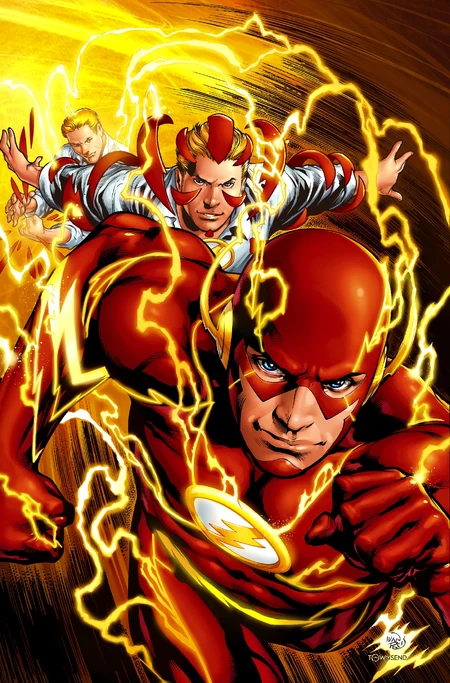
If you have ever wondered how Barry Allen can run faster than light without vaporizing, or how Wally West once outran death, the answer is the same three words: the Speed Force. It is arguably the single most important concept in Flash mythology, and it quietly powers some of the most cosmic corners of the DC Universe. Below, we break down exactly what it is, how it works, who is plugged into it, and why it may also be the most dangerous idea DC has ever put in a writer’s hands.
What Is the Speed Force in DC Comics?
At its simplest, the Speed Force is a boundless ocean of kinetic energy that exists outside of normal space and time. Writer Mark Waid introduced it in The Flash (Vol. 2) #91 in June 1994 as an elegant fix for a nagging problem: super-speed should be impossible. A person running at a fraction of light speed would burn up from air friction, be torn apart by g-forces, and destroy everything they touched. Waid’s solution was to say that speedsters do not generate their speed at all. They tap into an external energy field that handles the physics for them.
That field is the Speed Force. Later writers, especially Eobard Thawne, described it as “the kinetic engine of the multiverse,” the underlying current that pushes space and time forward. Some stories treat it as functionally equivalent to time itself. It is often counted as one of the Seven Forces of the Universe, an extra-dimensional wellspring that exists everywhere and everywhen at once.
Crucially, the Speed Force is not just a battery. It is also a place, a dimension a speedster can physically enter by running fast enough. Push past your limits and you can dissolve into the Speed Force, becoming one with the energy. That dual nature, power source and destination, is what makes it so flexible in the hands of DC’s writers, for better and worse.
How the Speed Force Works
The Speed Force does far more than make someone fast. Once a character is “connected,” a whole toolkit of abilities opens up. Here is what tapping the lightning actually grants.
- Protective aura: An invisible field surrounds the speedster, shielding them and their clothing from friction, heat, and impact. This is the unsung hero power. Without it, Barry Allen would ignite the instant he started running.
- Speed Force lightning: The signature crackling energy that trails a speedster. Barry and Wally leave yellow lightning; the Negative Speed Force burns red. It is a visible byproduct of the connection and can be thrown as a weapon.
- Phasing: By vibrating their molecules at the right frequency, a speedster can pass through solid matter, walking through walls or making an attack pass harmlessly through their body.
- Time travel: Because the Speed Force is bound up with time, running fast enough lets a speedster travel to the past or future. The Cosmic Treadmill was invented specifically to hit and hold the precise velocity needed.
- Dimensional travel: Matching the vibrational frequency of another Earth lets a speedster cross between parallel worlds, a trick established all the way back in The Flash (Vol. 1) #123, “Flash of Two Worlds.”
- Speed-stealing (and lending): Wally West famously learned to drain speed and momentum from moving objects and people, and to lend his own speed to allies. He could stop a bullet by stealing its velocity mid-flight.
- Enhanced perception and healing: Accelerated thinking, near-instant reflexes, and rapid recovery from injury all come bundled with a strong connection.
There is a catch built into the mythology: the Black Flash. First appearing in The Flash (Vol. 2) #138, this gaunt, corpse-like figure acts as a kind of grim reaper for speedsters, arriving to collect those who have run their last mile and drawing them back into the Speed Force. It functions as the Force’s natural defense mechanism, a reminder that the power always has a price.
Who Is Connected to the Speed Force?
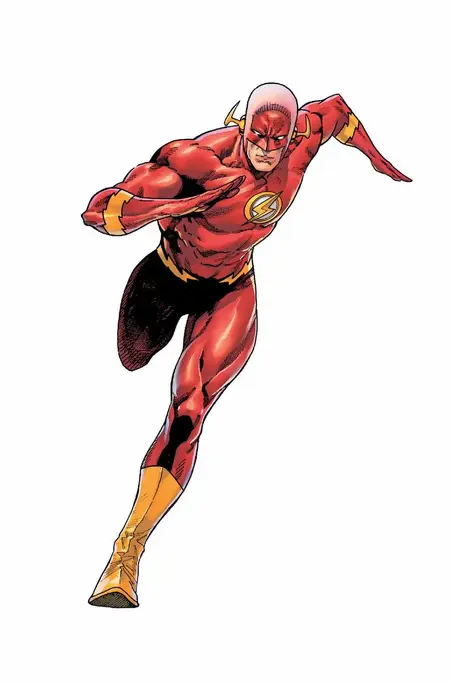
The Speed Force is what unites DC’s sprawling “Flash Family” and explains why so many speedsters share the same abilities across generations. The connection can be inherited, granted by accident, or, in a few cosmic cases, generated by the speedster themselves.
| Speedster | Alias | Notable For |
|---|---|---|
| Jay Garrick | The Flash (Golden Age) | The first Flash, retroactively linked to the Speed Force |
| Barry Allen | The Flash | The Silver Age icon; later retconned as the Force’s “engine” |
| Wally West | The Flash / Kid Flash | First to consciously understand the Speed Force; master of speed-stealing |
| Bart Allen | Impulse / Kid Flash | Born in the future; perfect recall and raw speed |
| Max Mercury | “Zen master of speed” | Explained the Speed Force to Wally; deeply attuned to it |
| Jesse Quick | Jesse Quick | Legacy speedster and JSA member |
| Eobard Thawne | Reverse-Flash | Wields the opposing Negative Speed Force |
Barry Allen holds a special place. Geoff Johns’s The Flash: Rebirth (2009) revealed that Barry is not merely a user of the Speed Force but its literal source, the “engine” whose lightning-strike accident retroactively created the Force across all of time. That idea was later softened in the New 52’s The Flash #13, which reaffirmed the Speed Force as something eternal that Barry connected to rather than authored. This flip-flopping is a preview of a bigger problem we will get to shortly.
The Negative Speed Force and the Other Forces
For most of its history the Speed Force stood alone. That changed when writer Joshua Williamson expanded the concept during his Flash run beginning in 2016, revealing a whole spectrum of cosmic energies. Understanding them clears up a lot of modern Flash confusion.
| Force | Governs | Chief Wielder | Lightning |
|---|---|---|---|
| Speed Force | Velocity, motion, time | Barry Allen, Wally West | Yellow |
| Negative Speed Force | Corrupted, “stolen” speed | Eobard Thawne (Reverse-Flash) | Red |
| Strength Force | Physical power, gravity | Fuerza | — |
| Sage Force | Mind, perception, telepathy | Psych | — |
| Still Force | Inertia, stopping motion | Steadfast, Turtle | — |
The Negative Speed Force is the most important of these. Eobard Thawne created it as a dark mirror of Barry’s power, an energy fueled by hatred that lets him kill other speedsters with a touch and time-travel with far fewer restrictions than a normal Flash. Its red lightning is the visual shorthand for every Reverse-Flash and for villains like Godspeed.
The Strength, Sage, and Still Forces round out the set, each tied to a fundamental aspect of reality, motion, power, mind, and stillness. The Still Force is a particularly neat counterweight: where the Speed Force is pure motion, the Still Force is the power to bring everything to a dead stop. Together they frame the Speed Force as one instrument in a larger cosmic orchestra rather than a lone anomaly.
Common Misconceptions About the Speed Force
Because the Speed Force has been rewritten so many times, a few myths cling to it. Let us clear them up.
- “It just makes you run fast.” As we have seen, raw speed is almost the least interesting thing it does. Time travel, phasing, dimensional hopping, and the protective aura are all equally core.
- “Only Barry Allen has it.” Barry is the most famous conduit, but the Speed Force predates and outlives any single Flash. An entire family of speedsters draws from it, and villains have their own dark variants.
- “Barry created it, full stop.” The Rebirth “engine” retcon is real but has been walked back and reinterpreted repeatedly. Canon is genuinely inconsistent here, so treat any single origin as story-dependent.
- “Faster is always better.” The Black Flash and the danger of dissolving into the Force forever mean that pushing your speed to the limit is a genuine risk, not a free power-up.
The Original Insight: Why the Speed Force Is DC’s Most Dangerous Plot Device
Here is the take you will not find on the wiki pages. The Speed Force is the most dangerous plot device in DC Comics, and its danger has nothing to do with the Black Flash. It is dangerous to storytelling, because it can justify almost anything.
Think about what the Speed Force has been asked to explain over three decades. It is the reason friction does not kill a runner. It is the reason a man can travel through time. It is the reason he can walk through a wall, cross to a parallel Earth, steal a bullet’s momentum, resurrect from apparent death, and, in Rebirth, retroactively author his own powers back through history. Whenever a Flash writer paints themselves into a corner, “the Speed Force did it” is a magic eraser that removes the wall. Barry Allen died in Crisis on Infinite Earths? He was living inside the Speed Force. A hero needs to undo a catastrophe? A Flashpoint-level Speed Force sprint rewrites reality itself.
That is exactly the problem. A power that can do anything creates no tension, because the audience learns that any obstacle can be dissolved by running slightly faster or vibrating at a new frequency. Deus ex machina stops being a mistake and becomes the engine of the franchise. When the Speed Force can rewrite the universe, the stakes of a single fight quietly evaporate.
The counterintuitive lesson is that the best Flash stories are the ones that impose limits on the Speed Force, not the ones that unleash it. Mark Waid’s own “The Return of Barry Allen” works because Wally’s self-doubt, not his raw power, is the obstacle. “Terminal Velocity” is gripping because reaching the Speed Force means potential death, a door that only opens one way. Geoff Johns’s best Rogues stories succeed by pitting Flash against opponents whose gimmicks blunt his speed, forcing him to think rather than accelerate. Even the Reverse-Flash works as a villain precisely because he represents a speed Barry cannot simply outrun. The drama lives in the ceiling, not in the open sky.
Compare it to a well-run magic system in fantasy fiction: the interesting rules are the ones about what magic cannot do. The Speed Force is at its most compelling when a writer treats it the same way, as a resource with a cost, a limit, and a dark reflection waiting on the other side. Handed a device that can justify anything, the disciplined creator justifies as little as possible. That restraint is the difference between a cosmic hand-wave and a genuinely great Flash story. For more on how creators build and balance overpowered abilities, see our roundups of the most powerful comic book characters, ranked and the strongest Marvel villains for the other side of the aisle.
If cosmic-scale power fascinates you, the same tension shows up across manga too, where writers constantly wrestle with characters who edge toward the unbeatable, as our list of the strongest anime characters lays out in detail.
Frequently Asked Questions
Who created the Speed Force?
Writer Mark Waid created the Speed Force, introducing it in The Flash (Vol. 2) #91 in June 1994. He designed it to explain away the physical impossibilities of super-speed, giving every speedster a shared, in-universe source for their powers.
Can anyone tap into the Speed Force?
In theory, yes, though a connection usually comes from a freak accident (like Barry Allen’s lightning-and-chemicals origin), inheritance within the Flash Family, or deliberate cosmic manipulation. Most people never touch it, and those who do risk being pulled into the Force permanently if they push too hard.
What is the difference between the Speed Force and the Negative Speed Force?
The Speed Force is the natural energy field powering heroes like Barry Allen and Wally West, marked by yellow lightning. The Negative Speed Force is an artificial, corrupted version created by Eobard Thawne (Reverse-Flash), fueled by hatred, marked by red lightning, and capable of killing other speedsters on contact.
Is the Speed Force a place you can visit?
Yes. Beyond being an energy source, the Speed Force is a dimension speedsters can physically enter by reaching extreme velocity. Some have been trapped there, most famously Barry Allen after Crisis on Infinite Earths, and the Black Flash exists to escort dying speedsters back into it.
Does the Speed Force appear in the movies and TV shows?
Absolutely. The Arrowverse’s The Flash television series made the Speed Force a central, even sentient, element, and DC’s live-action films reference it to explain Barry’s time-travel and reality-altering feats. Live-action versions simplify the comics but keep the core idea intact.
The Speed Force endures because it is the perfect comic-book concept: elegant enough to explain a hero in one sentence, deep enough to fuel thirty years of stories. Just remember that its real magic shows up when writers tell it “no.” For more on where these characters and their landmark issues rank, browse our guide to the most valuable comic books. And for the source material, DC’s own Speed Force explainer and the Wikipedia entry on the Speed Force are both solid next stops.