Darkseid vs Thanos is comics’ most loaded rivalry because the two characters are not independent inventions. Thanos debuted in 1973 after Marvel editor Roy Thomas told creator Jim Starlin to redesign him to look more like Jack Kirby’s Darkseid. In most straight comparisons Darkseid wins on raw power; Thanos wins whenever he is holding the Infinity Gauntlet.
That is the short answer. The longer one is more interesting, because the reason this matchup never resolves cleanly is baked into how the two characters were built — and there is one canonical crossover that quietly explains why.
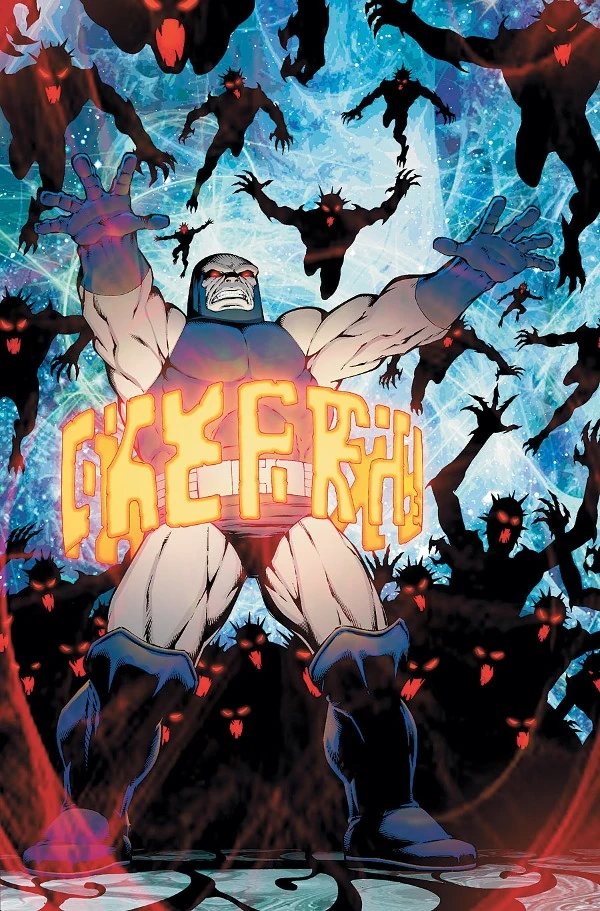
Origins: one of these was designed to look like the other
Jack Kirby created Darkseid for his Fourth World saga at DC. The character made a cameo on the final page of Superman’s Pal Jimmy Olsen #134 (December 1970), appearing only as a face on a television monitor, and received his first full appearance in Forever People #1 (February 1971), where he is properly coloured, appears across several pages and speaks with Superman directly.
Thanos arrived at Marvel two years later, in Iron Man #55 (February 1973), created by Jim Starlin. And Starlin has been unusually candid that the resemblance is not accidental — just not in the direction people assume.
Speaking to Jon B. Cooke in Comic Book Artist #2, Starlin said: “You’d think that Thanos was inspired by Darkseid, but that was not the case when I showed up. In my first Thanos drawings, if he looked like anybody, it was Metron.”
Metron is the seated, contemplative New God who rides the Mobius Chair — a thinker, not a bruiser. Roy Thomas saw the design and pushed back with a line that has become famous: “Beef him up! If you’re going to steal one of the New Gods, at least rip off Darkseid, the really good one!”
Starlin redesigned Thanos accordingly before the character ever saw print. So Thanos is not a copy of Darkseid in concept — the philosophy, the nihilism, the relationship with Death are all Starlin’s. But the granite build, the heavy jaw and the imposing silhouette exist because an editor explicitly instructed a young artist to make him look more like Kirby’s villain.
Why Darkseid vs Thanos is unresolvable: incompatible power sources
Darkseid vs Thanos arguments usually devolve into feat-trading. There is a much better piece of evidence, and it comes from the one time both characters appeared in the same story.
In JLA/Avengers, the 2003–2004 crossover by Kurt Busiek and George Pérez, Darkseid gets hold of the Infinity Gauntlet — and discards it. Not out of arrogance. He drops it because he discovers the powers the Gauntlet is built to command do not exist in the DC Universe.
That detail is the whole argument in miniature. The Infinity Gems govern specific aspects of Marvel’s cosmology — Time, Space, Mind, Soul, Reality, Power — as literal, personified domains of that universe. Take the Gauntlet somewhere those domains do not exist and it is jewellery.
Darkseid’s power runs on a different substrate entirely. The Omega Effect is not a manipulation of an external cosmic force; it is his own, and the Anti-Life Equation is a mathematical proposition about the futility of free will rather than a gem-shaped battery.
So “who would win” has no stable answer because the two characters are load-bearing pillars of incompatible physics. In Marvel’s cosmology, Thanos with the Gauntlet is functionally omnipotent and beats anyone. In DC’s, the Gauntlet is inert and Darkseid’s Omega Beams are not. The matchup is not close — it is undefined, and it changes entirely depending on whose rules you are playing by.
Power comparison
| Darkseid | Thanos | |
|---|---|---|
| Created by | Jack Kirby | Jim Starlin |
| First cameo / full appearance | Jimmy Olsen #134 (1970) / Forever People #1 (1971) | Iron Man #55 (1973) |
| Species | New God of Apokolips | Titanian Eternal with Deviant Syndrome |
| Signature power | Omega Beams — disintegrate, teleport, and resurrect targets | Cosmic energy manipulation, superhuman durability, genius intellect |
| Ultimate goal | The Anti-Life Equation, to erase free will across creation | Varies by era; classically to win the favour of Death |
| Force multiplier | Rules Apokolips and its armies | The Infinity Gauntlet |
| Baseline without artifacts | Extremely high — his power is intrinsic | High, but a step below his artifact-enhanced states |
| Core weakness | Pride, and a compulsion to be worshipped rather than merely obeyed | Self-sabotage — he repeatedly engineers his own defeats |
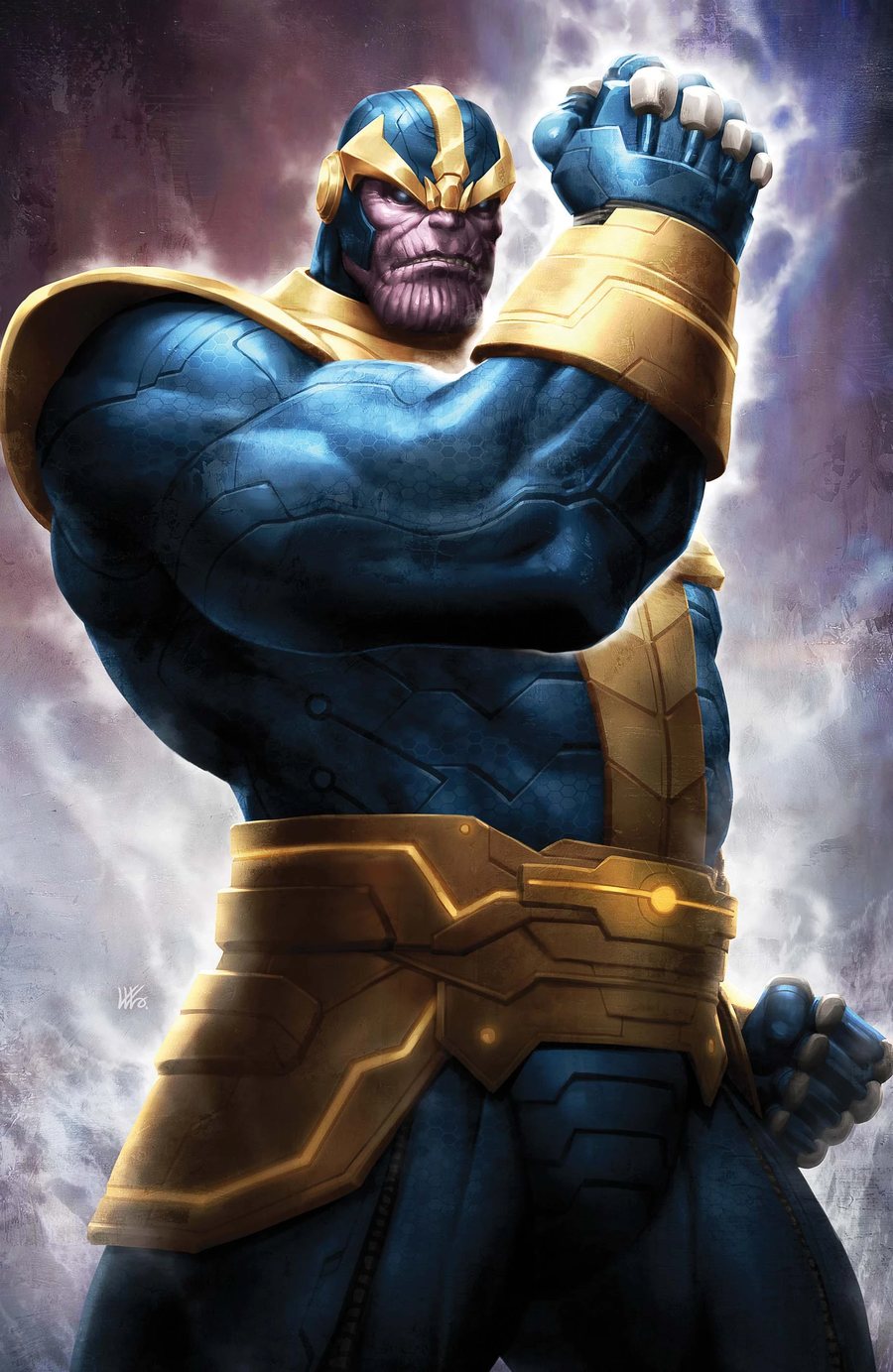
Darkseid’s real advantage: the Omega Beams
The Omega Effect is the most underrated part of this discussion, because people describe it as a disintegration blast and stop there. It is considerably stranger than that.
The beams curve. They pursue a target rather than travelling in a straight line, which makes dodging largely irrelevant as a defence. And they do not only destroy — Darkseid can use the same force to teleport a target somewhere else, or to resurrect someone he previously erased. A weapon that can undo its own kill is a fundamentally different category of threat than a very powerful laser.
Then there is the Anti-Life Equation. Darkseid’s actual objective has never been conquest by force; it is to obtain a formula that, once spoken, strips every sentient being of free will. He is not trying to rule a universe of subjects. He is trying to remove the possibility of anyone choosing otherwise.
Thanos’s real advantage: he is smarter, and he escalates
Thanos without the Gauntlet is not Darkseid’s equal in raw output, and Marvel has been fairly consistent about that. What Thanos has instead is a track record of acquiring things.
The Infinity Gauntlet is the famous one, but the pattern repeats: the Cosmic Cube, the Heart of the Universe, the Infinity Gems in various configurations. Thanos’s defining trait as an antagonist is that he identifies the single object that would make him unbeatable and goes and gets it. He is also, straightforwardly, one of the smartest characters Marvel has — a genuine scientific intellect, not just a schemer.
His weakness is equally consistent and genuinely unusual: Thanos loses because part of him wants to. Starlin wrote him as a character who cannot accept victory, and multiple defeats across decades hinge on Thanos leaving an opening he did not need to leave.
Darkseid vs Thanos: so who actually wins?
Setting aside the cosmology problem and judging on how each publisher writes them:
- Base versus base, no artifacts: Darkseid. His power is intrinsic and his Omega Beams have no clean counter.
- Thanos with the full Infinity Gauntlet, in Marvel’s universe: Thanos, decisively. Gauntlet-era Thanos has defeated the assembled cosmic hierarchy of his own universe.
- Darkseid with the Anti-Life Equation: Darkseid, and it is not a fight — the Equation removes the opponent’s capacity to resist rather than defeating them physically.
- In a neutral setting: undefined, for the reason JLA/Avengers demonstrated. Whichever cosmology the fight takes place in effectively decides it beforehand.
Anyone settling Darkseid vs Thanos with a confident one-word answer is picking a ruleset without telling you. For more on where both sit among their peers, see our rankings of the most powerful DC villains and the strongest Marvel villains, or the combined best comic book villains of all time.
Key issues for collectors
Both characters have genuinely significant first appearances, and the Darkseid situation is a useful lesson in how cameo and first-full-appearance status affects value.
Superman’s Pal Jimmy Olsen #134 holds the cameo — a single face on a monitor on the last page — and remains a highly valued key, with graded high-grade copies commanding four and five figures. Forever People #1 carries the first full appearance and also debuts the Forever People themselves, Infinity-Man, and the first mention of Mother Boxes, which is an unusual amount of first-appearance content in one book.
Iron Man #55 is the single Thanos key, and also the first appearance of Drax the Destroyer and Mentor. If you are working out which of these is worth chasing, our comic collecting guide covers how cameo status, grading and print runs interact, and the most valuable comic books puts these prices in context.
Frequently asked questions
Who is stronger, Darkseid or Thanos?
Without artifacts, most comparisons favour Darkseid because his Omega Effect is an intrinsic power with no reliable counter. With the complete Infinity Gauntlet inside Marvel’s cosmology, Thanos wins decisively.
Was Thanos copied from Darkseid?
Partially, and by editorial instruction. Jim Starlin originally modelled Thanos on Metron, another Kirby New God. Roy Thomas told him to beef the design up and “rip off Darkseid, the really good one,” and Starlin redesigned the character before his debut.
Have Darkseid and Thanos ever met in a comic?
Both appear in the 2003 crossover JLA/Avengers by Kurt Busiek and George Perez. In it, Darkseid obtains the Infinity Gauntlet and discards it after realising the powers it commands do not exist in the DC Universe.
What is Darkseid’s Omega Effect?
Omega Beams are energy blasts Darkseid fires from his eyes that curve to track their target. They can disintegrate, teleport, or resurrect a target, making them far more versatile than a conventional energy attack.
Sources: CBR’s Comic Book Legends Revealed on Starlin’s Comic Book Artist interview, Darkseid’s publication history, and GoCollect on the cameo versus first-full-appearance question.