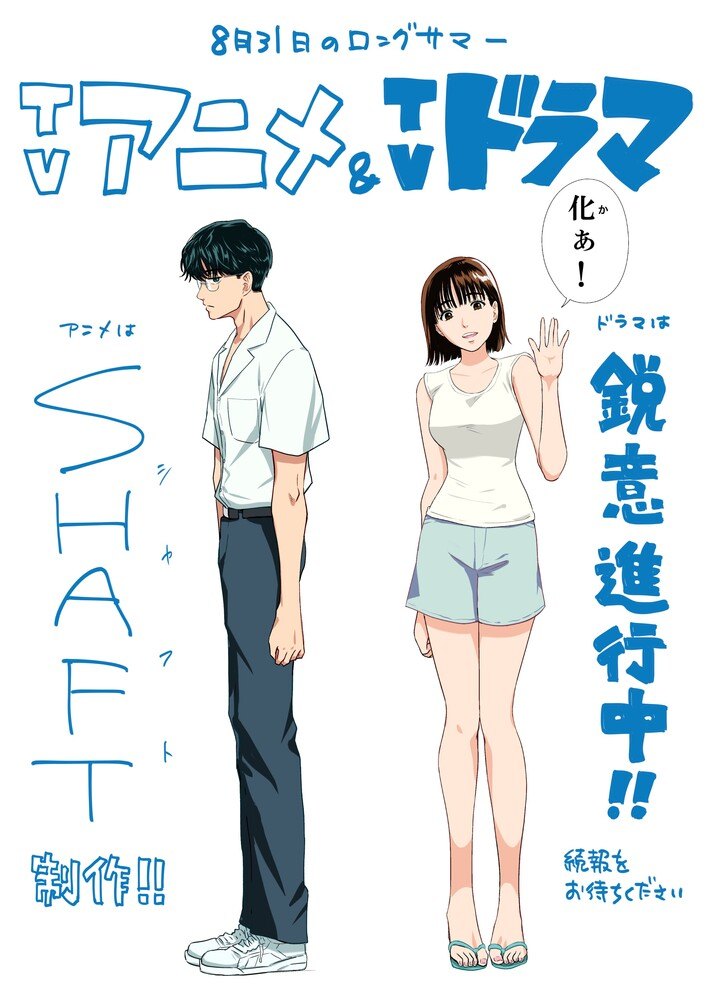
The Long Summer of August 31, Ikkado Ito’s time-loop manga for Kodansha’s Morning, is getting two adaptations at once: a television anime produced by SHAFT and a live-action drama series. Both were announced on August 31, 2026 — the single date the manga’s characters are trapped inside — through an illustration drawn by Ito himself.
What Was Actually Announced
The official The Long Summer of August 31 X account confirmed two separate adaptations in one post: a TV anime animated by SHAFT, and a live-action television drama. No broadcast window, staff list, cast or network was given for either. The announcement image carries the phrase eii shinkou-chuu — “in active production” — which in Japanese industry usage means work has started but a date is not close enough to name.
The date is worth nailing down, because English-language aggregators have already reported it inconsistently. Japanese trade outlets on JST — Comic Natalie and Anime!Anime! among them — all carried it on August 31, and Anime News Network matched them. Every one of those reports carries the same two facts and no more: SHAFT for the anime, an unnamed production for the live action. Treat a season, a streaming home or a cast as speculation until Kodansha says otherwise.
| Detail | Confirmed | Source |
|---|---|---|
| Anime studio | SHAFT | Official X account, August 31, 2026 |
| Anime broadcast window | Not announced | — |
| Live-action format | Television drama series | Official X account, August 31, 2026 |
| Live-action network / cast | Not announced | — |
| Staff, cast, theme songs | Not announced | — |
Why SHAFT Is the Sharpest Possible Choice Here
Japanese coverage led on the obvious hook: SHAFT is “the Madoka Magica studio.” That is true and it undersells the fit. SHAFT is behind Puella Magi Madoka Magica (2011, 12 episodes) and the Monogatari series, and its house style is built almost entirely out of repetition. Text cards, held frames, sudden cuts to abstract space, the same corridor shot returning with one element changed — director Akiyuki Shinbo’s grammar treats a repeated image as a unit of meaning rather than a budget saving.
That is the part the shorthand misses. The relevant credential is not that SHAFT made one famous time-loop show; it is that the studio’s default visual language already treats a repeated image as information rather than as filler, which is the exact problem a loop adaptation has to solve every week. Madoka Magica is, structurally, the most famous time-loop anime of the last fifteen years: its entire emotional payload lands in episode 10, when the audience learns Homura Akemi has already lived the series many times over. SHAFT has solved this exact problem before — how do you show a viewer the ninetieth repetition of a scene without boring them? — and it solved it by making each repetition look different rather than identical.

The counter-case is real, though. SHAFT’s output has slowed sharply in the last decade, and the studio’s recent work has leaned on films and sequels rather than new adaptations — our own coverage of the long road to Walpurgisnacht: Rising is a fair illustration of how slowly the studio moves when a project matters to it. A no-date announcement from SHAFT is not a promise of a 2027 broadcast.
What The Long Summer of August 31 Is About
Takaya Suzuki and Kana Takagi are high schoolers stuck repeating August 31 — the last day of Japan’s summer holiday — and they are the only two people who remember each pass. Suzuki’s theory is that the loop is tied to his unfinished summer, which in his framing means getting a girlfriend and losing his virginity. Seven Seas Entertainment’s official English description calls it “a hilarious yet heartfelt time-loop comedy.”
That premise is doing something slightly unusual. Most time-loop stories in manga and anime are thrillers or tragedies — the loop is a prison, and escaping it is the plot. Here the loop is a raunchy teenage comedy engine first, and the emotional weight accumulates underneath it. The date is the joke and the wound at the same time: August 31 is the day Japanese students traditionally face the summer homework they never did, and the day the holiday ends.
The Publication Numbers, and Why a Morning Title Getting Two Adaptations Is Notable
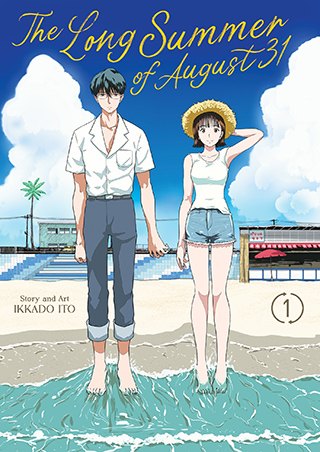
The Long Summer of August 31 began serialization in Morning on March 30, 2023, and reached 13 collected Japanese volumes as of August 21, 2026. Seven Seas Entertainment publishes the English edition in print, with digital chapters on Kodansha’s K MANGA app. Six English volumes were out as of August 31, 2026, beginning with volume 1 on April 1, 2025 and running to volume 6 on August 25, 2026 — six days before the adaptations were announced. Volumes 7 and 8 are scheduled for November 10, 2026 and February 2, 2027.
Morning is a weekly seinen magazine, not a shonen juggernaut. Its audited print circulation was 67,555 copies for the October–December 2025 period, according to the Japan Magazine Publishers Association — a figure worth holding next to the news that Weekly Shonen Jump fell below one million print copies for the first time in August 2026. Print manga circulation is contracting across the board, and mid-size seinen magazines have far less room than Jump does. Adaptations are how a Morning title escapes that ceiling, which is why greenlighting two of them simultaneously reads as a deliberate bet rather than routine housekeeping. (If the seinen/shonen distinction is new to you, we break it down in our shonen vs. seinen guide.)
The Genuinely Odd Part: Both Adaptations at Once
Simultaneous anime and live-action announcements are uncommon, and the reason is commercial. The standard Japanese sequence is anime first, live-action later — usually years later, often never — because the two formats chase the same viewers in the same window and cannibalize each other’s launch. Announcing both on the same day means Kodansha has decided the property is large enough to support two audiences rather than split one.
There is a second reading, and it is less flattering: a dual announcement is also what you do when neither project is close to finished and you want a single loud news day instead of two quiet ones. The complete absence of staff, cast, network and window on both sides supports that reading at least as well as the first one. Which of the two it turns out to be will be obvious from how quickly a broadcast window follows.
Where to Read It in English
Seven Seas Entertainment holds the North American print licence, with English volumes released since April 2025 and volume 6 out as of August 25, 2026. Kodansha’s K MANGA app carries the series digitally. If you want to be caught up before the anime, the manga is the only option — there is no anime footage yet beyond the announcement illustration above. Last verified: August 31, 2026.
For what else is landing this season, our fall 2026 anime lineup tracks confirmed premiere dates, and the HarperCollins/Kaze manga imprint launch covers how the English manga market is shifting underneath all of this.
Frequently Asked Questions
Who is animating The Long Summer of August 31?
SHAFT, the studio behind Puella Magi Madoka Magica and the Monogatari series, is producing the TV anime. This was confirmed by the manga’s official X account on August 31, 2026. No director, series composer or character designer has been named yet.
When does The Long Summer of August 31 anime come out?
No broadcast window has been announced. The August 31, 2026 announcement stated only that the project is in active production. Given that no staff have been revealed, a 2027 premiere at the earliest is the realistic expectation, but nothing has been confirmed.
Is there a live-action version too?
Yes. A live-action television drama series was announced on the same day as the anime. No network, cast, staff or air date has been given for it, and it is not known whether the two adaptations will be released close together.
Where can I read The Long Summer of August 31 in English?
Seven Seas Entertainment publishes the English print edition. Six volumes were available as of August 31, 2026, from volume 1 on April 1, 2025 to volume 6 on August 25, 2026, with volumes 7 and 8 scheduled for November 10, 2026 and February 2, 2027. Kodansha’s K MANGA app carries the series digitally, and the Japanese edition reached 13 volumes on August 21, 2026.
What is the manga about?
Two high schoolers, Takaya Suzuki and Kana Takagi, are trapped repeating August 31 and are the only people who remember each loop. Seven Seas describes it as a time-loop comedy; the loop appears tied to Suzuki’s unfinished summer plans.