
Avatar: Seven Havens episodes 7-9 are the show’s best stretch yet, finally splitting Pavi and Nisha into two separate crises instead of keeping them joined at the hip — but the season leans on “Korra caused the Cataclysm” as unquestioned backstory, and that shortcut is weaker than the mystery it’s replacing.
Spoiler warning: this review covers “What Lies Beneath,” “The Envoys: Part One” and “The Envoys: Part Two” in full, including the episode 9 ending. Turn back now if you haven’t watched through episode 9.
We haven’t watched these episodes firsthand — this review is built from Paramount+’s own episode synopsis and multiple critics’ published accounts, cross-checked across outlets before writing a word of analysis below.
What Happens in Episodes 7-9
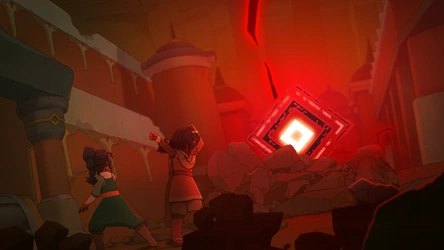
“What Lies Beneath” (official Paramount+ synopsis) sends Pavi digging into the tunnels under Ellora, where she finds an Old World facility tied to Asami Sato and a recording of an older Korra standing beside her. A pool of red energy knocks Pavi into a vision of the Cataclysm itself — Republic City tearing itself apart — and the episode’s real trick is that the vision doesn’t confirm Korra did it so much as imply the story everyone already believes might be missing pieces. Meanwhile Jae learns the masked Faceless aren’t being coerced: they’re volunteers, organized around one specific grievance, forced bending service in the Bending Brigade.
“The Envoys” splits into two halves, recapped in detail by TheTVCave. Part One brings delegations from the other Havens to Ellora for a summit, while the White Lotus puts Nisha through a formal trial to judge whether she’s ready to be the Avatar. She fails it, and the show finally lets that sting instead of shrugging it off. Part Two reveals the Faceless’s leader as Agam, Ellora’s own baker, whose father was conscripted into the Bending Brigade — not an outside threat but a product of the city’s own policy. The Faceless attack the summit; Nisha publicly declares herself the Avatar to protect people in the chaos; the Anomaly erupts and pulls Pavi into a fight underground. By the end, Jae — raised to see the Avatar as a danger, not a protector — turns on Karthik and the White Lotus and steps up as the Bending Brigade’s new commander.
The Twin-Avatar Split Finally Earns Its Premise
Seven Havens’ one real innovation is putting two Avatars in the same body of lore at once, and for six episodes that mostly meant Pavi and Nisha reacting to the same plot in the same room. Episodes 7-9 are the first time the show trusts the idea enough to split them: Pavi goes down into the Anomaly’s tunnels alone while Nisha stands in front of the White Lotus alone, and each of them fails in a different, specific way. Pavi’s failure is epistemic — she finds a piece of the truth and still doesn’t know what to do with it. Nisha’s is institutional — she’s judged by a body that was built around a single Avatar and has no good answer for two. That’s a real structural idea, and it’s the first time Seven Havens has felt like more than a Korra sequel wearing a new cast — which matters, because this is the first new Avatar story to pick up the cycle since The Legend of Korra ended its run in 2014.
Jae’s Turn Is the Best Twist the Show Has Written
Jae becoming the Bending Brigade’s new commander works because the show actually built it. He’s spent the season as the group’s most tactically sharp member, the one who thinks two moves ahead under pressure — and “The Envoys” cashes that trait in by having him use it against the White Lotus instead of for them. He wasn’t raised as a villain; he was raised inside an institution that taught him the Avatar is a danger to manage, and the finale of this three-episode run is the first time that belief gets to win an argument instead of losing one off-screen. It’s also the first character turn in Seven Havens that doesn’t depend on the audience already knowing Korra’s story — it’s built entirely out of what this show has actually shown us about Jae.

Blaming Korra Is the Episode’s Weakest Idea, Not Its Boldest One
Here’s where the run loses me. The red-energy vision in “What Lies Beneath” frames Korra as, at minimum, present for the Cataclysm and possibly responsible for it, and the show treats that as settled history the characters argue around rather than a claim anyone interrogates. TellTaleTV’s review of these episodes called that framing “tiring,” arguing it recycles an old, lopsided pattern where Korra gets blamed for destruction in a way Aang never would. That complaint lands, because it’s not describing a new problem — Korra’s fandom reception was genuinely more hostile than Aang’s for years after The Legend of Korra aired, much of it over things (her attitude, her body language, her being a woman in the role) that had nothing to do with her choices as the Avatar. Seven Havens making “Korra broke the world” its load-bearing mystery isn’t a twist built from new material; it’s borrowing a grudge the fandom already had and calling it lore. The show has forty more episodes ordered to walk this back and complicate it. Right now, episode 9 ends with that backstory unchallenged, and it’s the one thing in these three episodes that feels like a shortcut instead of a choice.
Where This Leaves Book One’s Final Stretch
Episodes 10-13 land October 30, 2026, closing out Book One: Survival, and they’re inheriting a genuinely good setup — Jae now runs the institution hunting the Avatars, Nisha has publicly outed herself with nothing to back it up, and Pavi is still underground with a vision she can’t prove. That’s a sharper place to end a season than where episodes 4-6 left things. If the finale uses that to actually complicate the Korra backstory instead of just paying it off, episodes 7-9 will look like the turn where the season started working. If it doesn’t, this run will be remembered as the moment the show picked the easy answer and stuck with it. The full cast, crew and streaming details are in our Avatar: Seven Havens guide.
Frequently Asked Questions
What happens in Avatar: Seven Havens episode 7?
In “What Lies Beneath,” Pavi investigates an Old World facility under Ellora connected to Asami Sato and experiences a vision of the Cataclysm that destroyed Republic City, while Jae learns the masked Faceless are volunteers protesting forced Bending Brigade service.
Who is the leader of the Faceless in Avatar: Seven Havens?
Agam, revealed in “The Envoys: Part Two” to be Ellora’s own baker. Her father was conscripted into the Bending Brigade, and she leads the Faceless to free others from the same service.
Does Nisha pass her Avatar trial?
No. The Order of the White Lotus tests Nisha in “The Envoys: Part One,” and she fails, leaving her to publicly declare herself the Avatar on her own terms during the episode 9 attack rather than with the order’s backing.
What does Jae do at the end of episode 9?
Jae turns against Karthik and the White Lotus, exposes them, and takes over as the Bending Brigade’s new commander — a reversal built on his established skill at thinking several moves ahead under pressure.
When do new episodes of Avatar: Seven Havens come out?
The next batch, episodes 10-13, closes out Book One: Survival on Paramount+ on October 30, 2026.